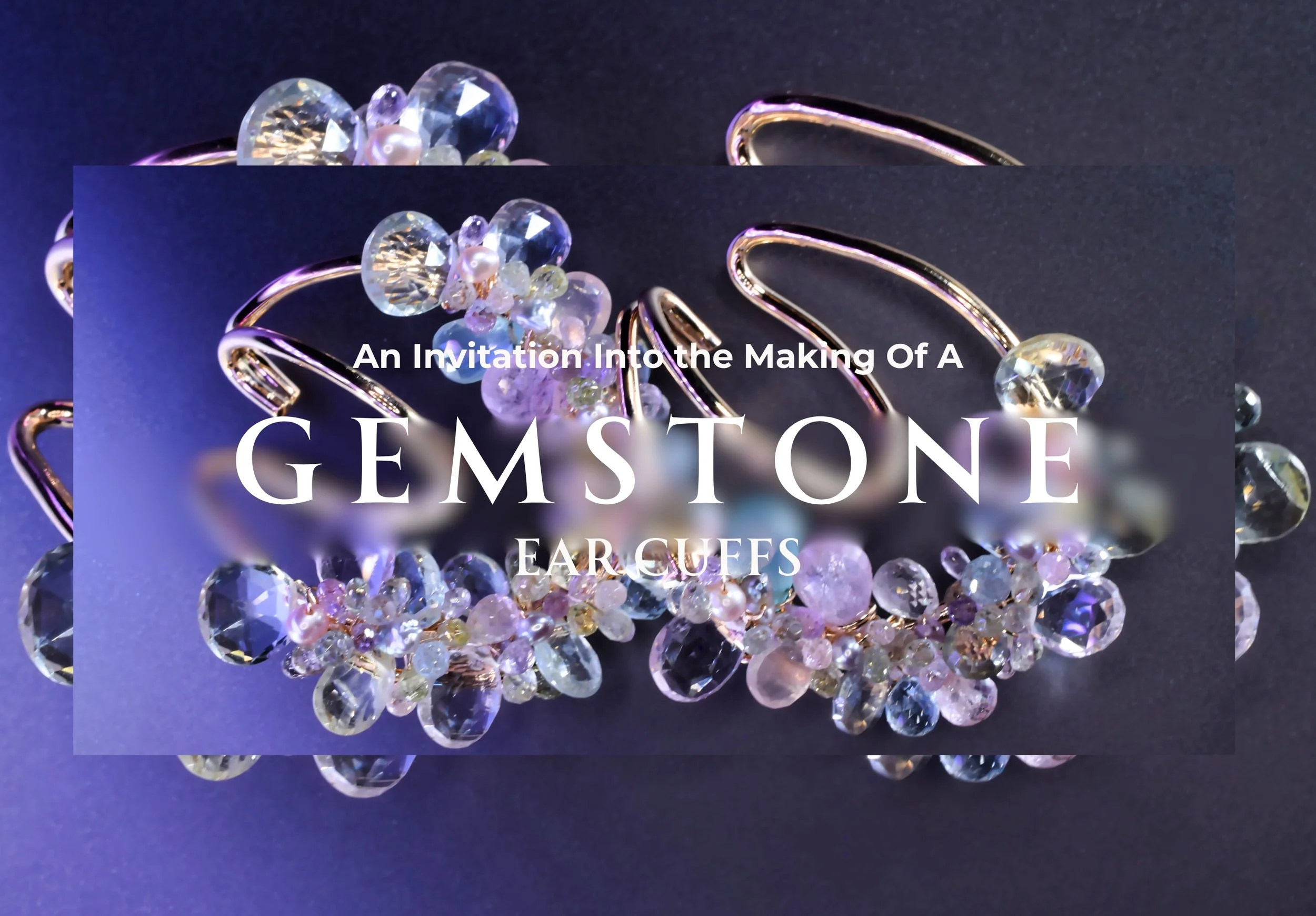
Studio Stories: The Pastel Gemstone Ear Cuffs
What Are the Pastel Gemstone Ear Cuffs?
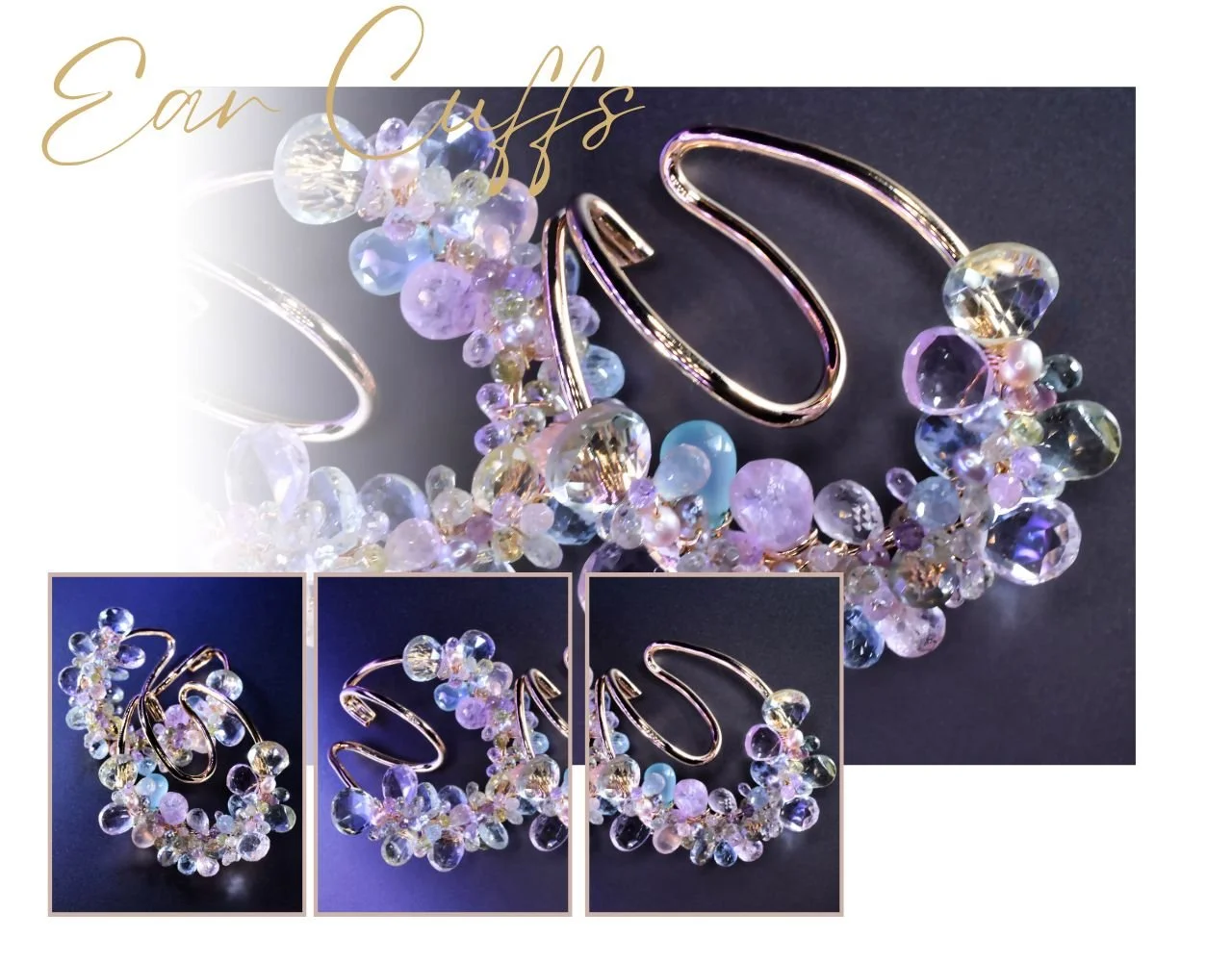
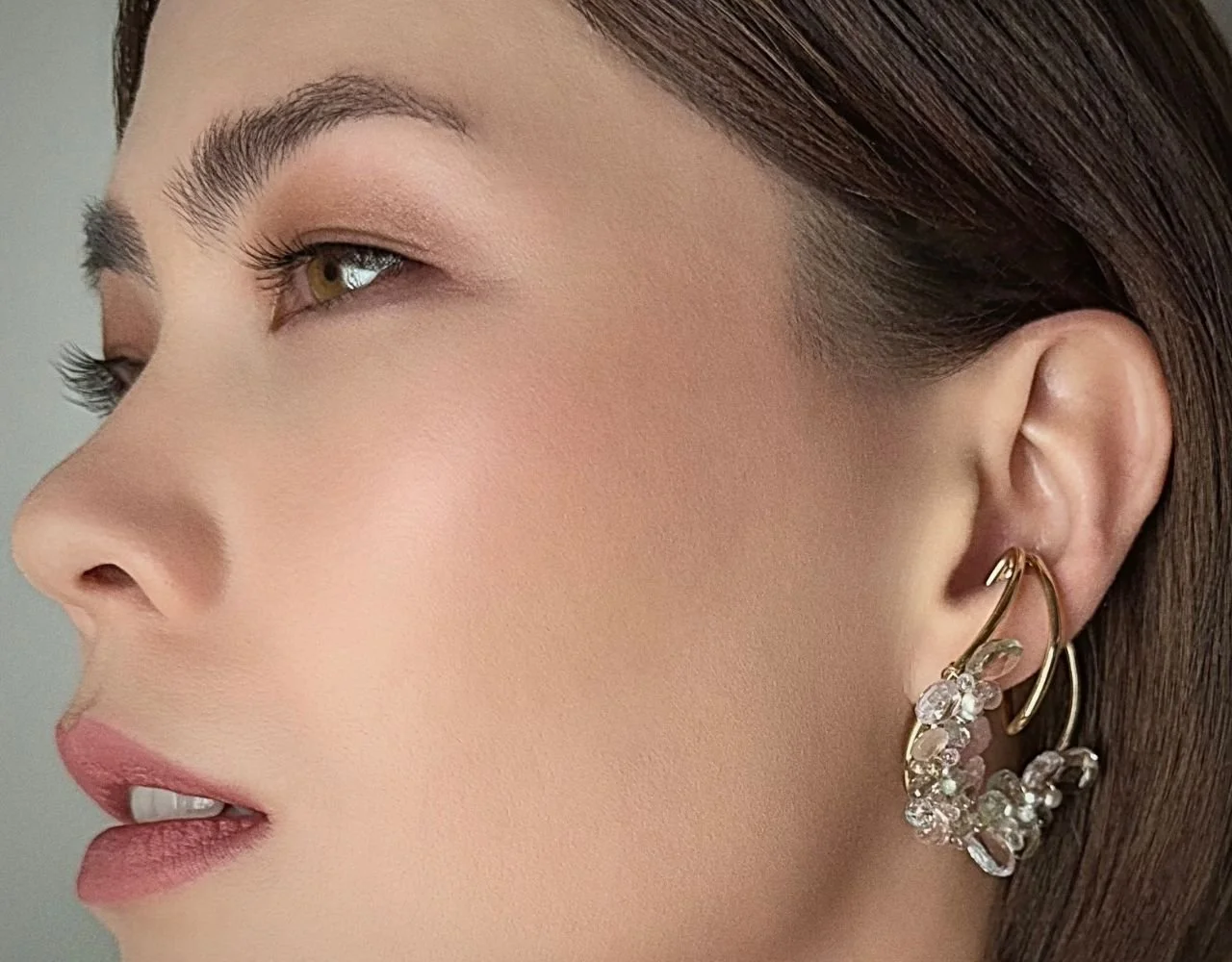
The Pastel Gemstone Ear Cuffs are hand-fabricated non-pierced ear cuffs featuring yellow aquamarine, blue aquamarine, rose quartz, kunzite, morganite, green amethyst (prasiolite), green topaz, Japanese Keshi Akoya pearls, Peruvian opal, green sapphire, purple sapphire, and grey sapphire set in recycled 14/20k gold-filled wire — part of the Tamar Collection by Andrea Li Jewelry. These ear cuffs require no piercing. They were designed as an adornment that does not require permission — no hole, no convention, just form meeting body in a new way.
The design fuses Andrea Li's signature gemstone clustering technique with a sculptural, modern form factor that wraps the ear's natural contours. But the final version of these cuffs is not the one originally planned. A measurement error during fabrication forced an improvisation that made the design stronger than the original concept.
Why Design a Non-Pierced Ear Cuff?
Non-pierced ear cuffs occupy a specific space in jewelry design: they must hold their position through form alone, without the mechanical advantage of a post through the earlobe. The cuff must hug the ear cartilage firmly enough to stay in place, but gently enough that it does not pinch or cause discomfort during hours of wear. It cannot slide, fight the anatomy, or rely on excessive tension.
That balance between grip and comfort is entirely determined by the wire's shape. Andrea Li twisted and retwisted heavy-gauge gold-filled wire, shaping it to follow the natural curve of the ear. The process was iterative and physical — there is no template for an ear's contour, and every adjustment to the curve changes how the cuff distributes pressure against the cartilage.
After extensive shaping, she soldered the ends of each cuff and felt the accomplishment of a resolved form. Until she held them side by side.
How Did a Measurement Mistake Improve the Design?
One cuff was noticeably shorter than the other. That moment presented a choice every maker faces: start over from scratch, or solve the problem differently.
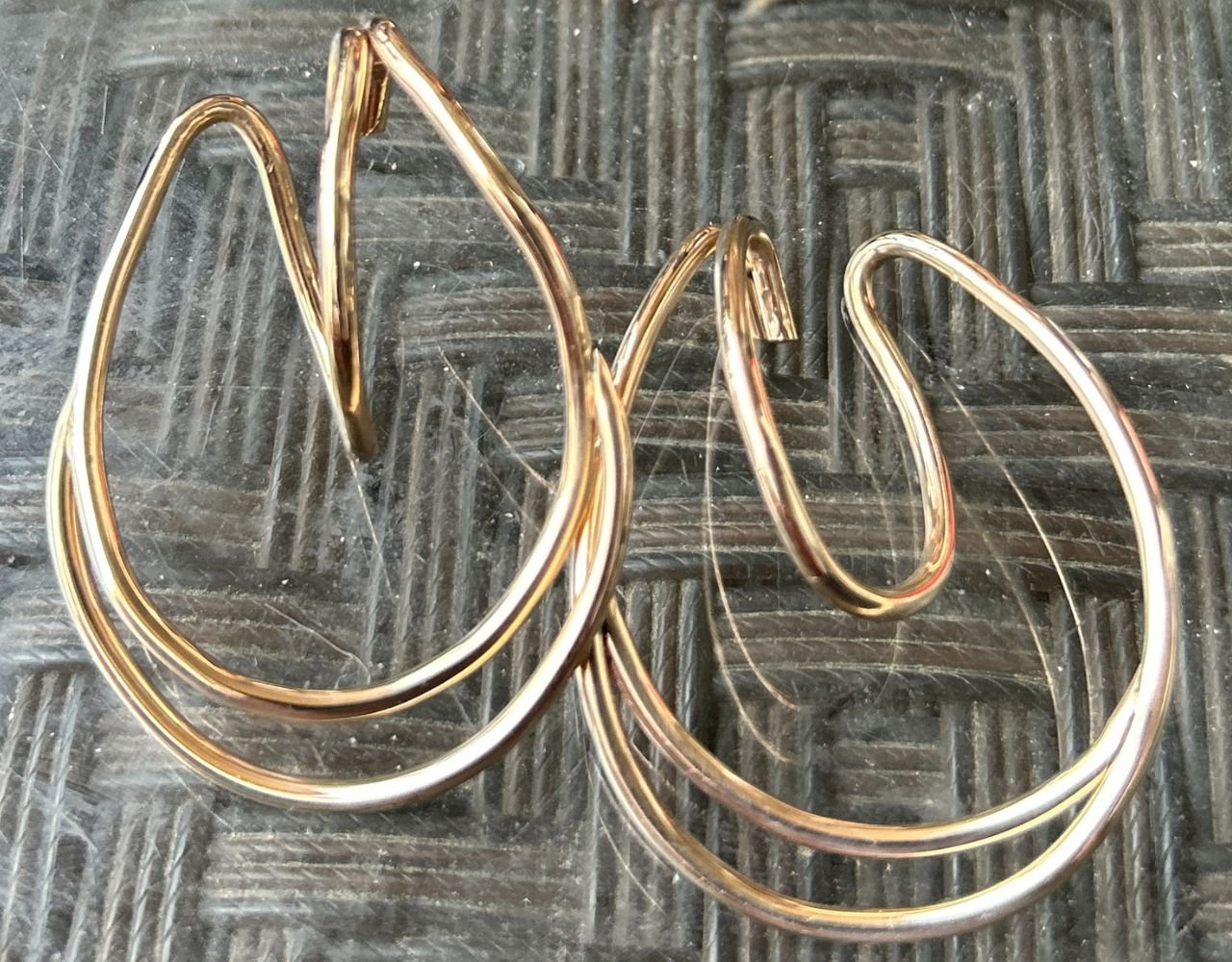
Instead of scrapping the pair, Andrea Li added another layer of wire, one beneath the shorter cuff and one above the longer, to bring them into balance. What began as a dimensional correction became an evolution of the design itself. The added wire layers created a structural frame around the perimeter of each cuff, which became the perfect foundation for edging with a gemstone cluster.
The mistake did not weaken the design. It introduced a structural element the original single-wire concept lacked—a multi-layered gilded frame that interplays with the ear's natural contours and provides a broader surface for the pastel gemstone arrangement. The finished cuffs are more dimensional, more sculptural, and more visually complex than the original plan would have allowed.
How Is the Gemstone Cluster Arranged on a Curved Surface?
Clustering gemstones along a curved perimeter presents different challenges than clustering on a flat, planar surface, such as a cuff bracelet or pendant. Every stone must be set at an angle that follows the curve of the wire frame while maintaining visual continuity with its neighbors. Additionally, the clusters need to mirror each other to create symmetrical cohesion.
The palette spans more than a dozen individually selected stones, from the pink-violet shift of kunzite and the warm blush of morganite and rose quartz to the cool tones of blue aquamarine, green amethyst, and Peruvian opal, with green, purple, and grey sapphires adding depth. Japanese Keshi Akoya pearls are woven throughout, continuing the Tamar Collection's use of pearls as a structural anchor, bringing lustrous cohesion to multi-stone compositions.
The overall effect is a spring sunset wrapping the ear—soft, ethereal, and quietly radiant.
What Makes Kunzite Change Color When You Move?
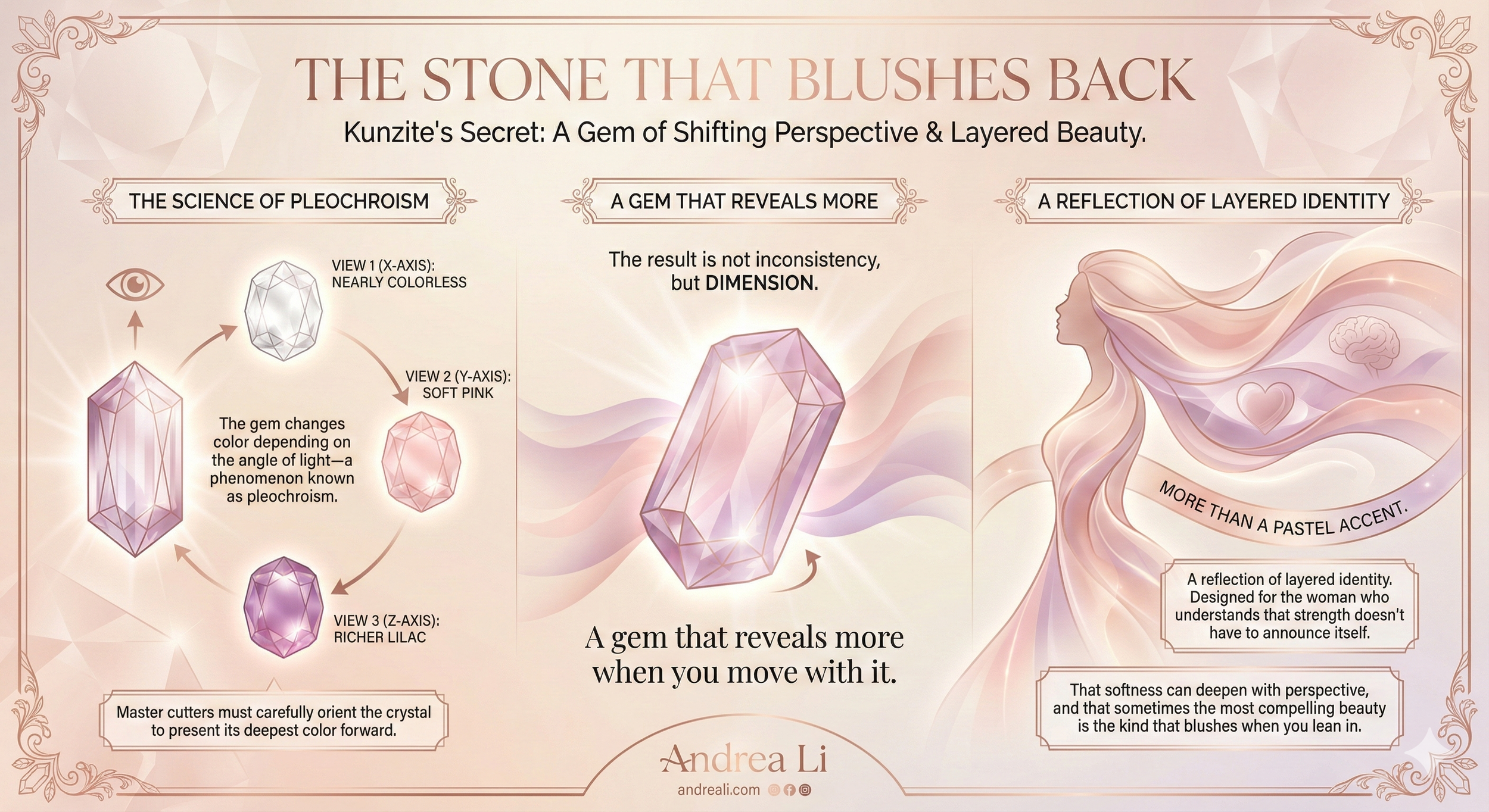
Kunzite is strongly pleochroic, meaning it displays different colors depending on the angle at which light enters the crystal. A single kunzite stone can shift from nearly colorless to soft pink to richer lilac simply by rotating it along a different axis. This is not a surface effect or a trick of lighting — it is a fundamental property of the crystal's internal structure, which absorbs and transmits light differently along each of its three optical axes.
This property creates a specific challenge for gem cutters. A kunzite crystal must be carefully oriented so its deepest, most saturated color faces forward in the finished stone. If the crystal is angled incorrectly during cutting, its color intensity fades, and the stone appears washed out. Master cutters study the raw crystal before making a single cut, mapping the pleochroic axes to determine the optimal orientation.
In the Pastel Gemstone Ear Cuffs, the kunzite adds a dimension that static stones cannot — it responds to the wearer's movement, shifting in color as the head turns and light enters from different angles. That responsiveness makes kunzite a natural fit for an ear cuff, where the stone is constantly in motion.
What Does It Mean to Design Jewelry That Requires No Piercing?
Non-pierced jewelry removes a barrier to adornment that is often taken for granted. A piercing is a permanent modification, a commitment that not everyone wants to make, and one that some people cannot make for medical, cultural, or personal reasons. Designing jewelry that achieves the same visual impact without requiring that commitment expands who can participate in the experience of wearing sculptural, gemstone-set pieces.
The Pastel Gemstone Ear Cuffs are designed for anyone who understands that refinement does not require conformity, that thoughtful design can meet the body on its own terms. The cuffs hold their position through form and engineering rather than hardware, which means the decision to wear them is entirely reversible. No piercing required. No convention required.
The Pastel Gemstone Ear Cuffs are part of the Studio Stories series, where Andrea Li documents the design decisions, material choices, and making process behind each piece in the Tamar Collection.
Love What You See? Keep Finding Us.
Google now lets you choose your favorite sources so they show up labeled in AI search answers. If you enjoy discovering handcrafted gemstone jewelry here, add Andrea Li Designs and we'll be easier to find next time you search.
Add Andrea Li Designs as a Preferred SourceOne click. Works across Google Search, AI Overviews, and AI Mode.