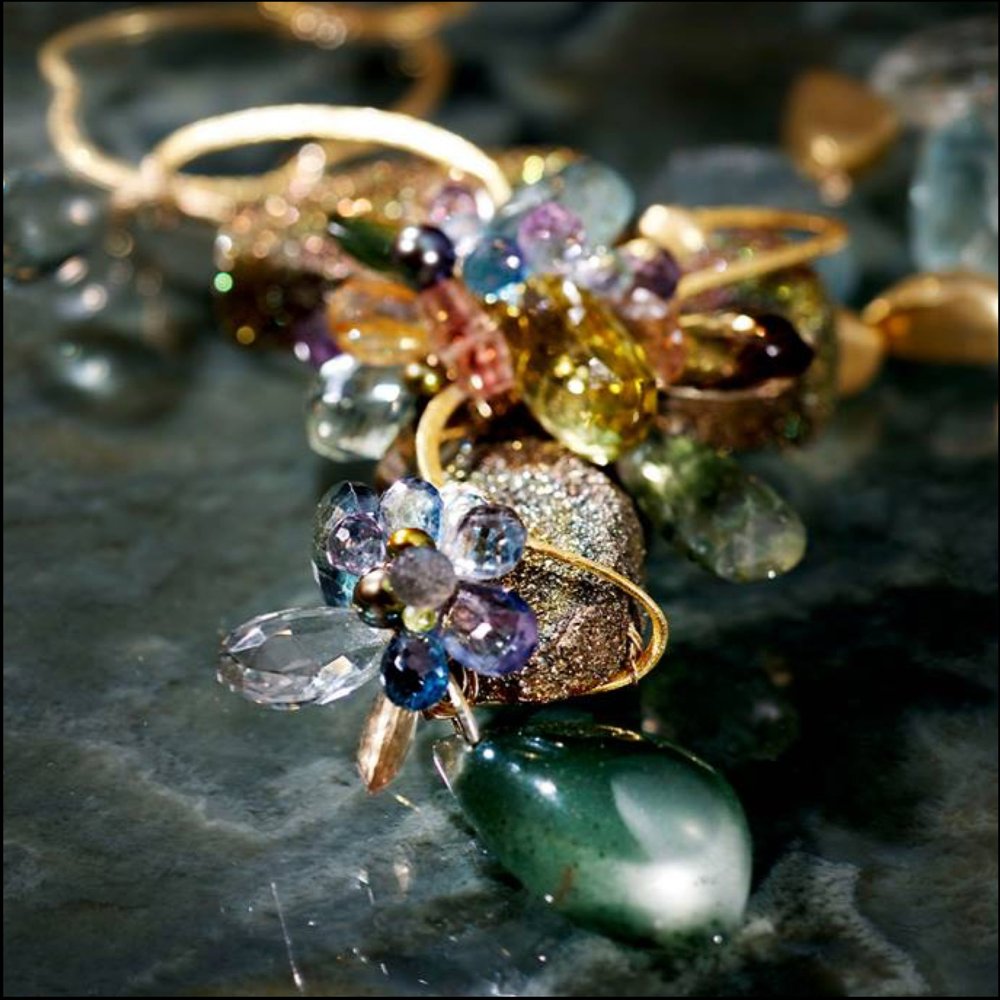
the stone that looks like someone captured an oil spill's iridescence and locked it inside a galaxy of micro-crystals. Rainbow pyrite is a druzy form of iron sulfide where thin layers of iron oxide on the surface of tiny pyrite crystals create a shimmering play of color: gold, green, pink, blue, and purple shifting with every angle change. It's the same optical physics that makes a soap bubble shimmer, thin-film interference, except it's permanent, metallic, and occurring naturally on a mineral.
From Tucson
RareDiscovery
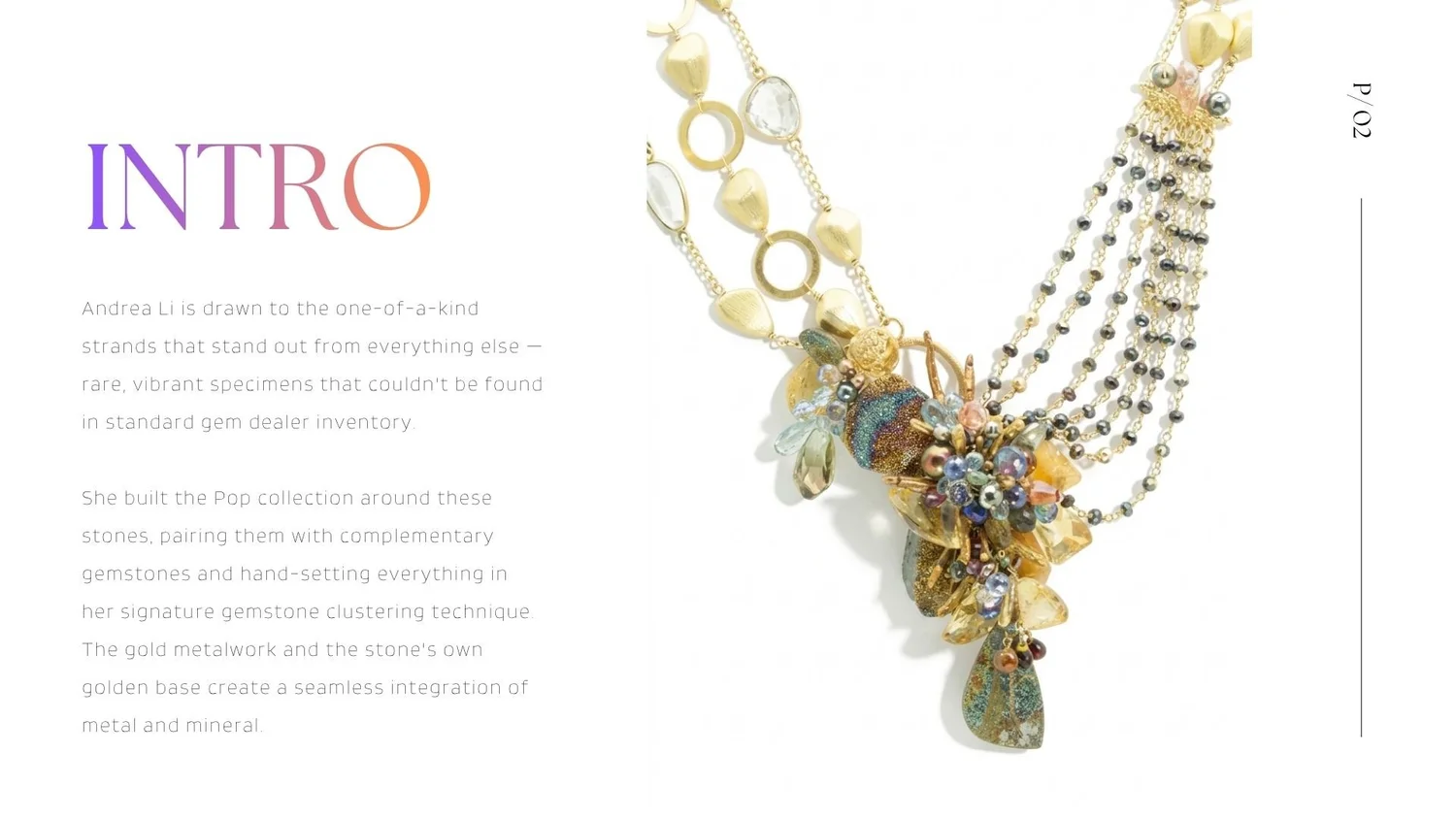
Andrea Li discovered rainbow pyrite at the Tucson Gem Show through her vendor, Earthstone, in one of the first years this stone appeared on the market. She was drawn to the one-of-a-kind strands that stood out from everything else, vibrant specimens that couldn't be found in standard gem dealer inventory. She built the Pop collection around these stones, pairing them with complementary gemstones and hand-setting each stone in her signature gemstone-clustering technique. The gold metalwork and the stone's own golden base create a seamless integration of metal and mineral.
The Stone, Worn
Rainbow Pyrite
Handmade by Andrea Li in Denver
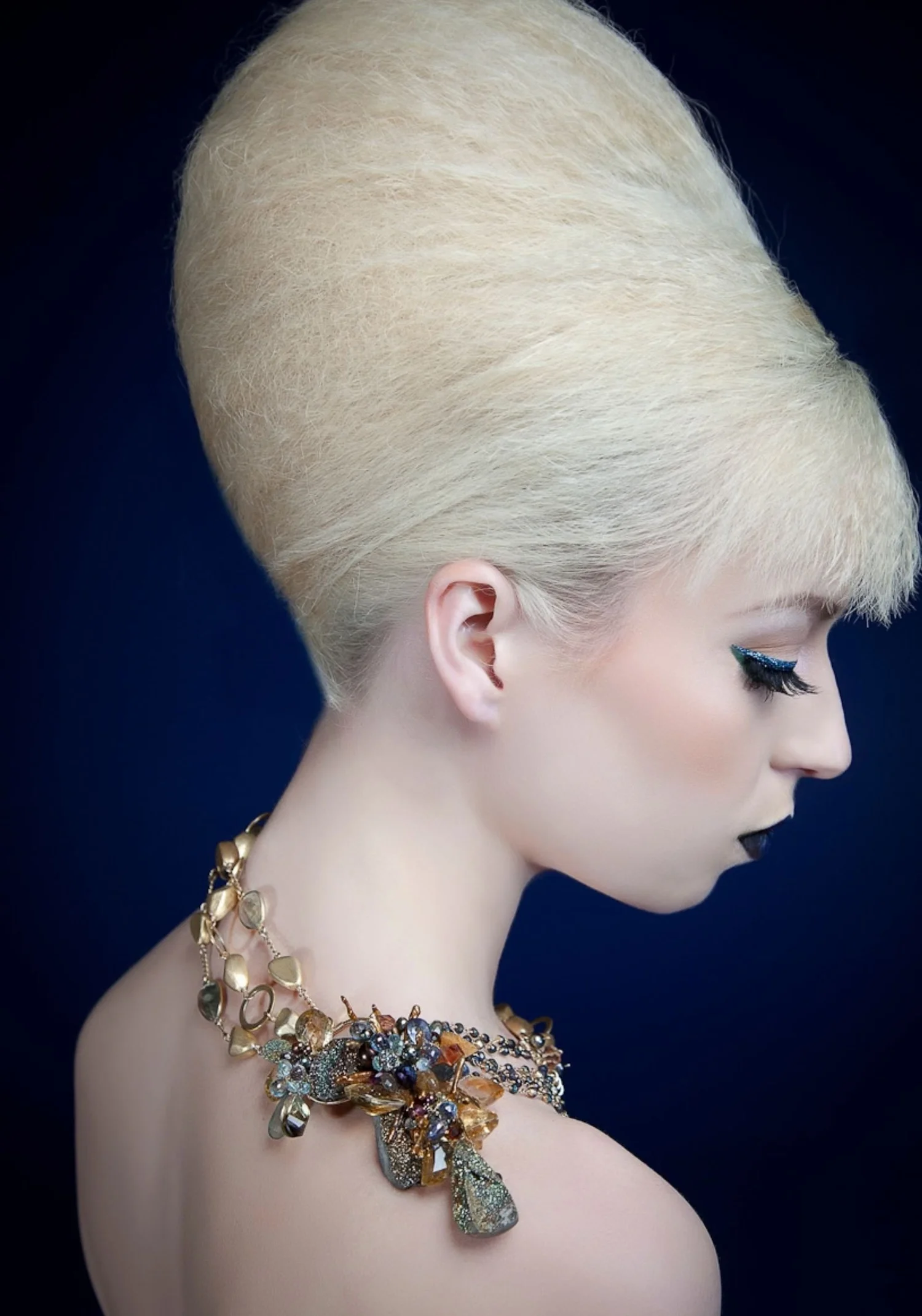
Photo Nicole Marcelli · Model Lauren Vaughn · Creative CreditsRainbow pyrite looks like a metallic, sparkling galaxy of microscopic crystals that shimmer with an oil-slick style iridescence.Photo Nicole Marcelli · Model Karly Porter · Creative CreditsPhoto Nicole Marcelli · Model Jessica Nazarenus · Creative Credits
Rainbow Pyrite
The Guide
Rainbow Pyrite
Pyrite
01
Rainbow Pyrite at a Glance
Rainbow pyrite is a druzy form of iron sulfide with a naturally occurring iridescent surface. The rainbow of colors (gold, green, pink, blue, purple) comes from thin layers of iron oxide forming on the surface of micro-crystals. No coating, no treatment. The color is the stone's own doing.
Hardness
6–6.5
Mohs scale
Mineral
Pyrite
Iron disulfide (FeS₂)
Color Source
Natural
Iron oxide thin-film interference
Crystal System
Isometric
Cubic habit
Luster
Metallic
Opaque, high reflectance
Color Range
Full Spectrum
Gold, green, pink, blue, purple
What Makes It "Rainbow"?
Standard pyrite is brassy gold: the classic "fool's gold." Rainbow pyrite gets its iridescence from thin layers of iron oxide or other secondary minerals that form on the surface of micro-crystal clusters during natural oxidation. These layers create the same thin-film interference that makes an oil slick shimmer, except it's permanent and occurring naturally on the crystal surfaces.
What Is Druzy?
Druzy (also spelled drusy or druse) refers to a fine coating of tiny crystals on the surface of a host rock. Think of it as a carpet of miniature gemstones. In rainbow pyrite, thousands of microscopic pyrite crystals form this sparkling surface layer, each catching and reflecting light independently, creating the signature glitter-like texture that Andrea Li fell in love with at Tucson.
02
How Rainbow Pyrite Forms
Rainbow pyrite forms through a two-stage process: first the pyrite crystallizes, then natural weathering creates the iridescent surface. It's geology doing what no laboratory can replicate with the same organic unpredictability.
01
Sediment Deposits
Rainbow pyrite forms in sedimentary environments, not volcanic ones. Fine mud deposits, rich in iron and sulfur from organic decay, accumulate in riverbeds and marine environments over millions of years.
02
Pyrite Crystallizes in Cracks
As the mud dries and compresses into concretions, cracks form. Sulfate-reducing bacteria and iron-bearing fluids deposit pyrite crystals in these cracks: thousands of tiny cubic crystals forming the druzy surface.
03
Oxidation Creates Color
Over time, natural weathering deposits thin layers of iron oxide on the pyrite crystal surfaces. These layers are measured in nanometers: thin enough that light waves interfere with each other, creating the rainbow iridescence. Different layer thicknesses produce different colors.
Why It's Rare
The conditions that produce vibrant rainbow iridescence are specific and unpredictable. The oxidation layer must be exactly the right thickness, the pyrite crystals must be small enough to form druzy, and the host rock must be stable enough to preserve the surface. Most pyrite doesn't achieve this, which is why vibrant specimens command a premium.
03
Where Rainbow Pyrite Comes From
Rainbow pyrite has been found in very few locations worldwide. The most prized specimens come from a single region in Russia, though Indonesian and Peruvian sources have entered the market more recently.
Russia: Volga River
The primary source. Rainbow pyrite from Ulyanovsk, Russia is collected along the banks of the Volga River during summer months when the riverbanks are less muddy. These specimens are considered the standard for quality: vivid, full-spectrum iridescence on well-formed druzy surfaces. This is the classic source that established rainbow pyrite in the gem market.
Indonesia
A newer source producing druzy pyrite hearts and specimen pieces with good iridescence. Indonesian material is becoming more common in the market, though the color range and consistency can vary more than Russian specimens.
Peru
Peruvian pyrite is world-famous for its large, perfectly cubic crystals, but iridescent druzy from Peru is less common. When it does occur, the specimens tend to be more golden with selective iridescence rather than full-spectrum rainbow.
USA & Others
Pyrite is one of the most common minerals on Earth, found on every continent. But the specific conditions that produce vibrant rainbow druzy are rare. Occasional specimens surface from mines in the US, Spain, and South Africa, but none match the consistency of the Volga River deposits.
Andrea Li's Sourcing: First Year at Tucson
Andrea discovered rainbow pyrite at the Tucson Gem Show through her vendor Earthstone during one of the first years this stone appeared in the market. She was drawn to the one-of-a-kind strands that stood out from everything else in the booth: rare, vibrant specimens with the full-spectrum "oil slick" iridescence she'd never seen in a gemstone before. She selects each strand in person, choosing stones where the iridescence is most vivid and the druzy surface most consistent.
04
Rainbow Pyrite vs. Similar Stones
Rainbow pyrite is often confused with other iridescent or metallic stones. Here's how to tell them apart, and why the differences matter for jewelry.
Property
Rainbow Pyrite
Labradorite
Peacock Ore (Bornite)
Mineral
Iron disulfide (FeS₂)
Calcium feldspar
Copper iron sulfide
Color Source
Natural iron oxide thin-film
Light interference in thin internal layers (labradorescence)
Acid-treated surface oxidation
Color Character
Full spectrum rainbow on metallic surface
Blue/gold/green flash in transparent stone
Purple/blue/gold on metallic surface
Transparency
Opaque (metallic)
Translucent to transparent
Opaque (metallic)
Hardness
6–6.5 Mohs
6–6.5 Mohs
3 Mohs
Treatment
None: 100% natural
None: natural
Usually acid-treated for color
Rarity
Rare (single-source, seasonal collection)
Common
Common (treated)
Key distinction: Rainbow pyrite's iridescence is 100% natural: no coating, no acid bath, no treatment. The color comes from geological processes that happened millions of years ago. Most "peacock ore" (bornite) sold in shops has been acid-treated to intensify its colors. Labradorite's color comes from inside the stone (light interfering between thin internal layers), not from a film on its surface. Rainbow pyrite is the only one of these three that's both metallic and naturally iridescent.
05
Caring for Rainbow Pyrite Jewelry
Rainbow pyrite is harder than many people expect (Mohs 6–6.5, same as moonstone and labradorite). The iridescent surface is naturally occurring and permanent, but pyrite does have specific care requirements to keep it looking its best.
Do
Keep It Dry
Pyrite is iron sulfide: prolonged moisture exposure can cause surface oxidation that dulls the iridescence over time. Remove rainbow pyrite jewelry before washing hands, showering, or swimming. If it gets wet, pat dry immediately.
Avoid
Water & Humidity
Extended water contact is pyrite's primary enemy. Don't store it in a humid bathroom. Don't wear it in the rain. The metallic surface can develop a dull tarnish if consistently exposed to moisture. Desiccant packets in storage help.
Do
Store in Soft Pouch
Keep rainbow pyrite separate from other gemstones. While pyrite is reasonably hard, the druzy surface has tiny crystal points that can be damaged by abrasion from harder stones. A dedicated soft pouch is ideal.
Avoid
Chemical Exposure
Household cleaners, perfume, hair spray, and especially chlorine can accelerate oxidation on pyrite's surface. Put jewelry on last, take it off first. This is the same rule that applies to most metallic gemstones.
Do
Wear Necklaces & Earrings Freely
Necklaces and earrings face minimal impact and moisture risk. Rainbow pyrite is stunning as a statement necklace or drop earring: the druzy surface catches light beautifully from every angle. These are the ideal settings for this stone.
Avoid
Ultrasonic & Steam
Never clean rainbow pyrite in an ultrasonic cleaner or with steam. The vibrations can dislodge micro-crystals from the druzy surface, and steam introduces moisture directly to the iron sulfide. A soft dry brush is all you need.
06
The Pop Collection
Rainbow pyrite wasn't a stone Andrea went looking for. It found her.
How This Collection Was Born
At the Tucson Gem Show, Andrea's vendor Earthstone had brought one-of-a-kind strands of a stone she'd never seen before: rainbow pyrite. This was one of the first years the stone appeared in the market, and the strands stood out from everything else in the booth. The iridescent surface, with its "oily" color palette reminiscent of the rainbow colors of an oil spill, was present within the brilliant sparkle of the druzy surface. Andrea was immediately drawn to the rare, unique OOAK strands because any piece she incorporated them into would naturally be uncommon from the start.
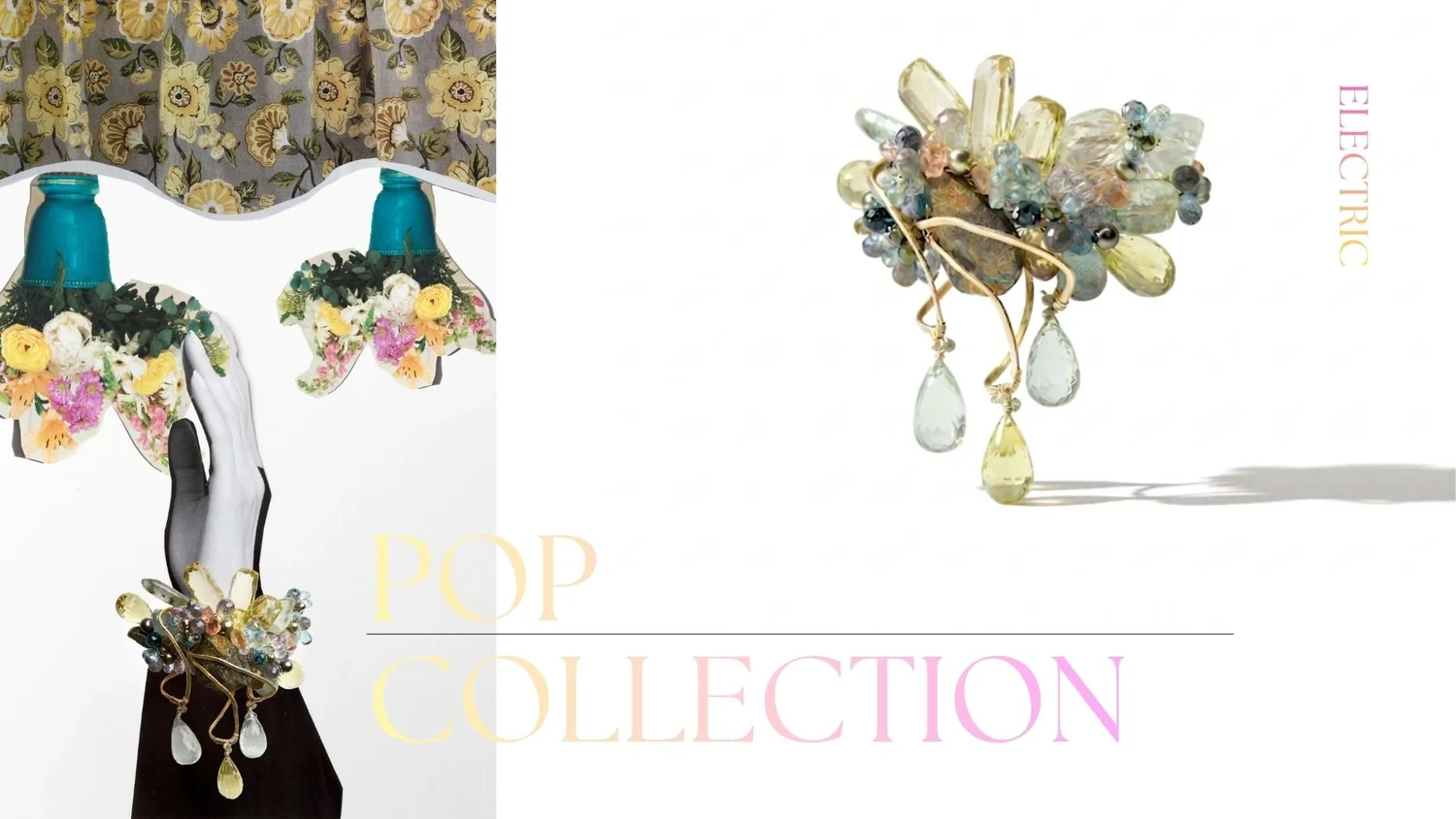
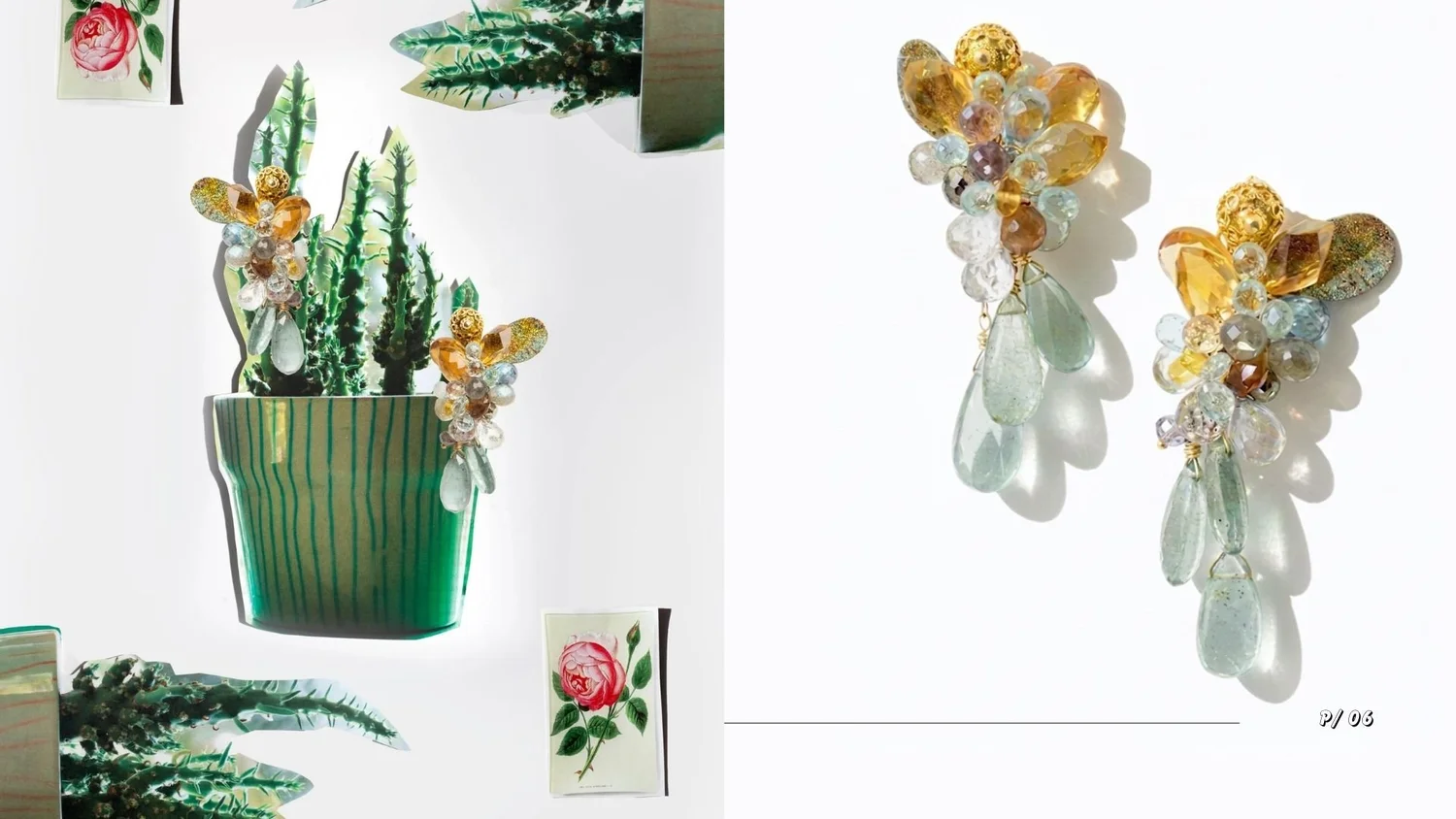
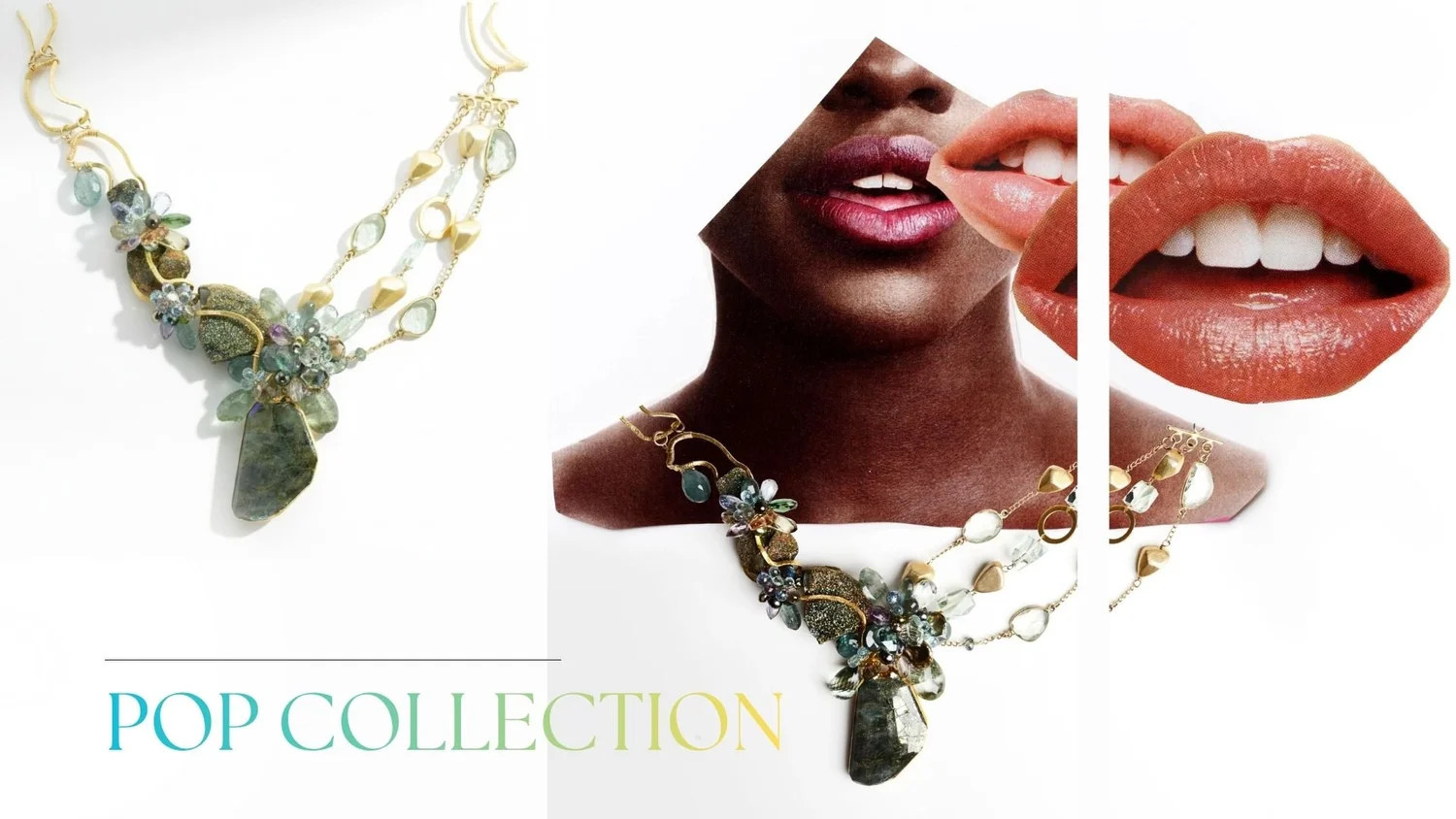
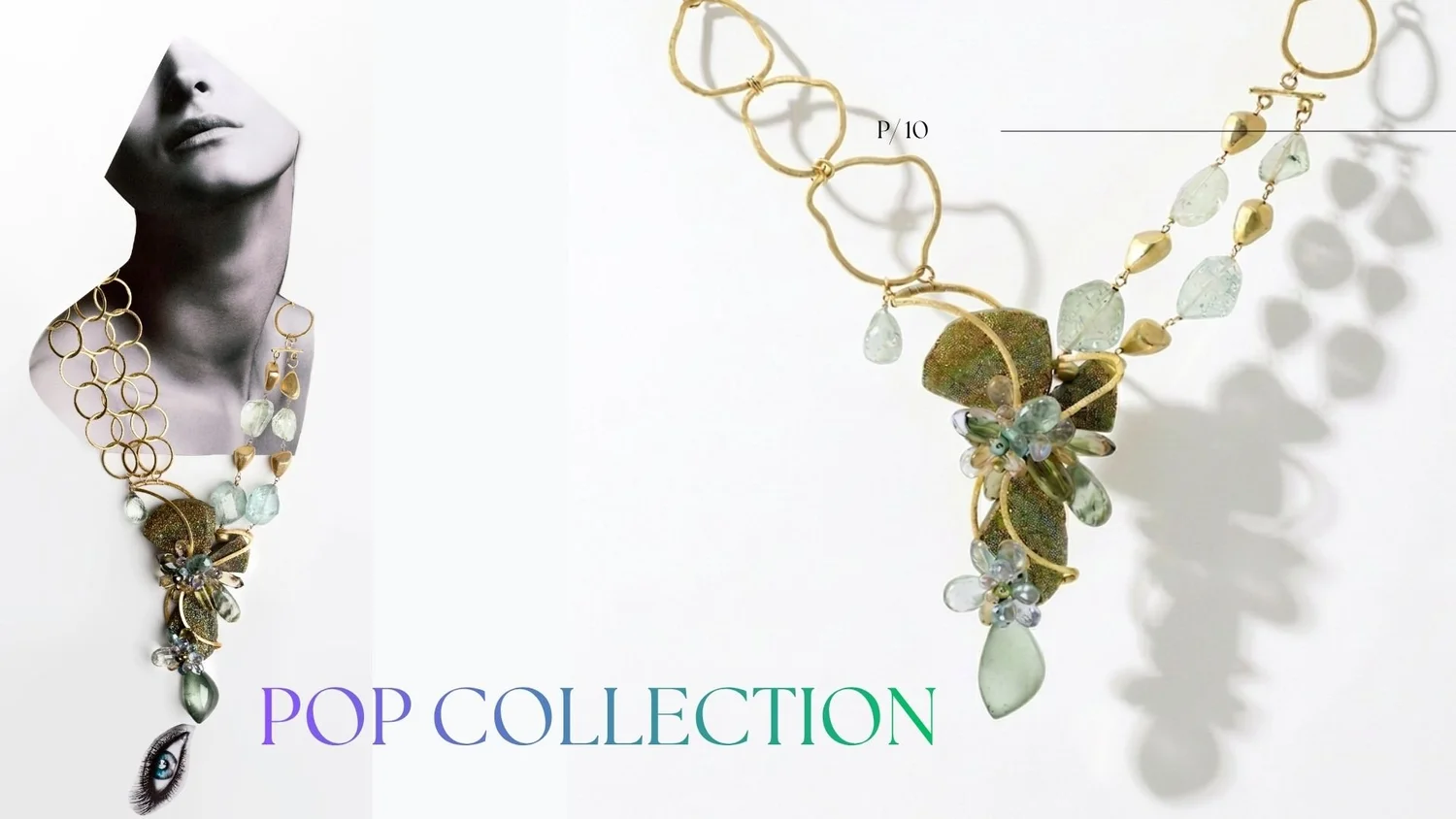
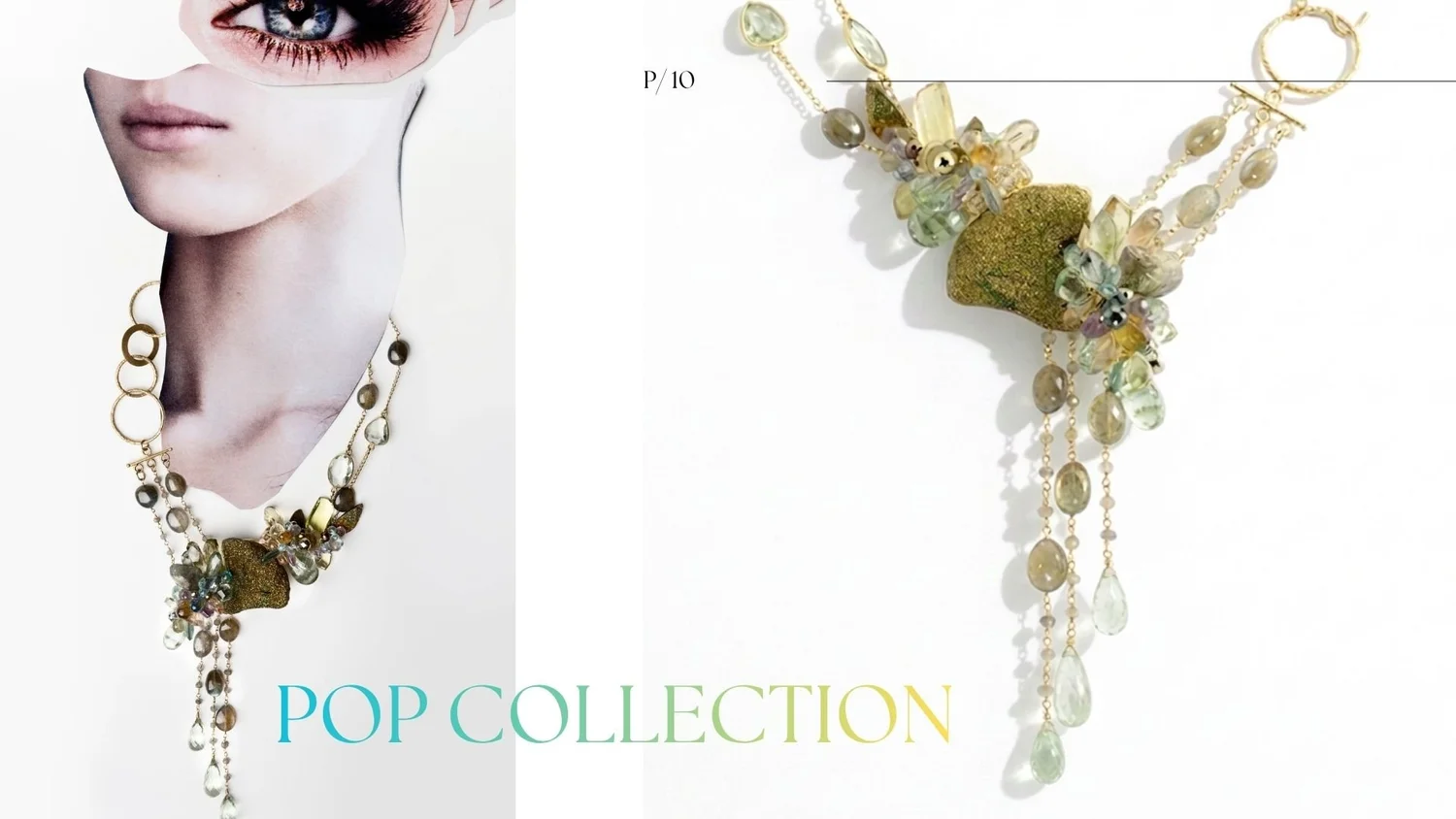
She built the Pop collection around these stones, named after a collaboration with fashion photographer Gabby Rudick, who borrowed the collection to photograph against vibrant Pop backgrounds. The name stuck because it captured exactly what rainbow pyrite does: the colors absolutely pop.
Once Andrea added her signature gemstone clustering technique (hand-reaming stones with a diamond drill bit, stacking and layering gemstones into three-dimensional arrangements), these pieces became even more rare and unlike anything else in the jewelry space. Every piece was one of a kind, handcrafted in 14k gold-filled and 22k gold vermeil in her Denver studio.
The Design Approach
Rainbow pyrite's golden metallic base integrates seamlessly with gold metalwork: the stone and the setting merge into each other rather than competing. Andrea paired the pyrite with complementary gemstones that enhance the stone's own color range, using asymmetrical compositions (her favorite) where no single element dominates the design.
Why Premium Pricing
The naturally occurring color phenomenon in rainbow pyrite is rare and unpredictable. Vibrant specimens, where the full spectrum of gold, green, pink, blue, and purple is visible, command a premium because the iridescence can't be manufactured or enhanced. Combined with OOAK strands and handcrafted construction, each piece's value reflects genuine scarcity.
A note from Andrea Li, who sets rainbow pyrite by hand in her Denver studio.
The first time I held rainbow pyrite, it did not seem possible that nature had made it. The surface looks like brilliantly sparkling glitter in a rainbow of colors, bonded to an almost ordinary-looking stone as if someone had painted it on. You would think a surface like that would chip or flake under the diamond bit. It doesn't. It is a sturdy stone, and the metallic layer is so baked in that it reminds me of powder coating a surface for durability.
“
Glitter in a rainbow of colors, bonded to a plain stone as if it was painted on.
Choosing which side faces out is the easiest decision this stone asks of me. The glittering surface is so stark against the plain stone it sits on that the face chooses itself.
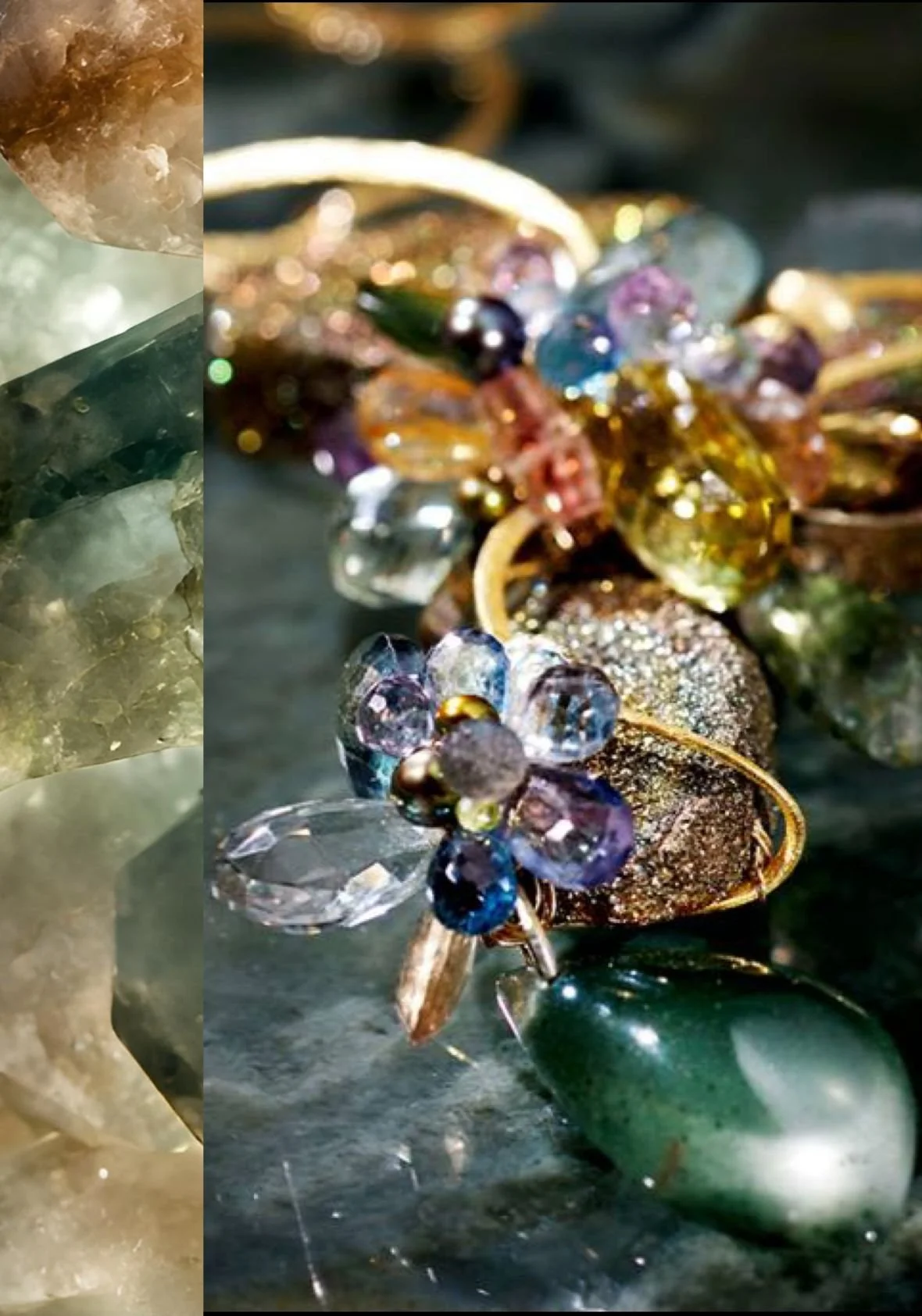
The pairing happened at the show. I took the strand of rainbow pyrite I wanted and laid it across trays of sparkling briolettes, keeping only the strands that looked harmonious beside it: paraiba topaz, citrine, bi-color quartz in greens and yellows, tanzanite, Oregon sunstone, labradorite, aquamarine, and peacock pearls whose surface looks like an oil slick, with an iridescence and luster that change as the light hits it.
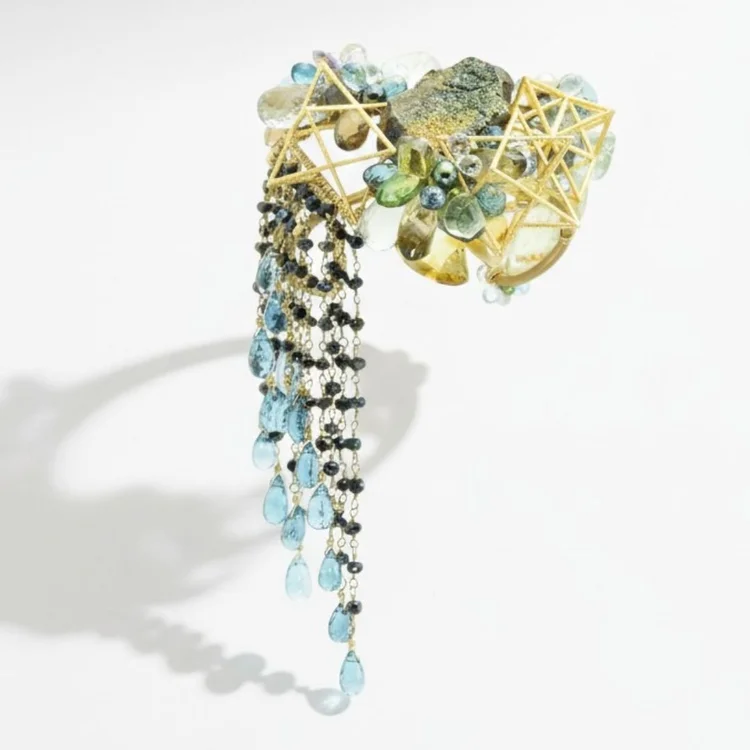
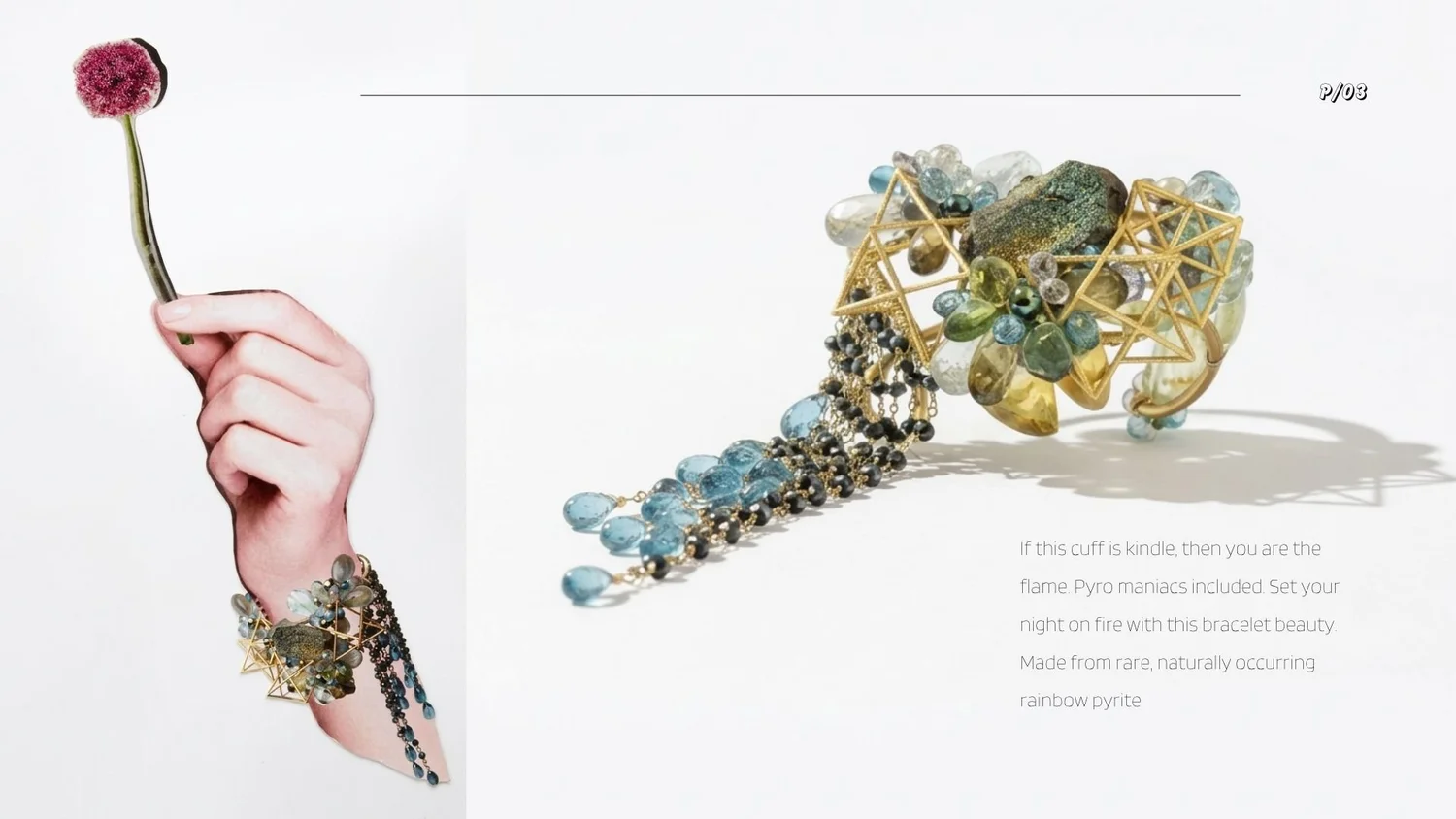
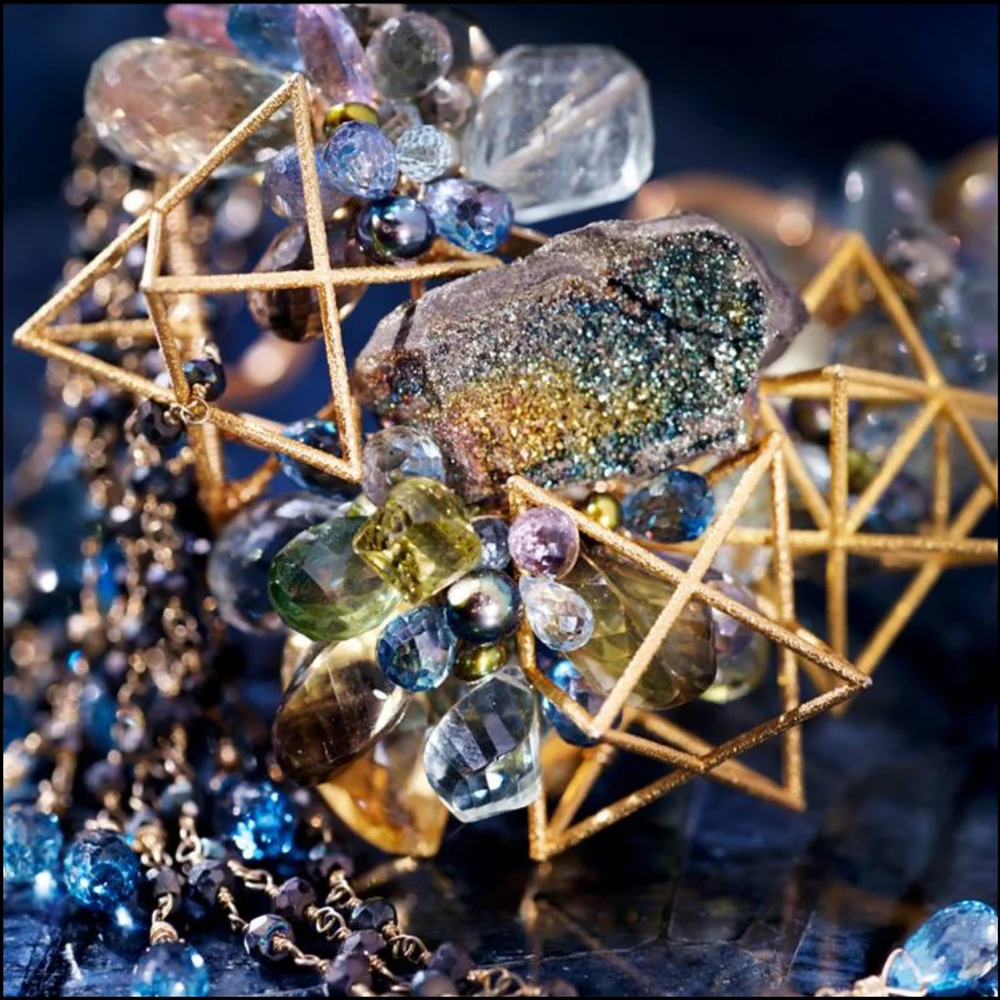
Some of these pieces carry something even rarer. The Fire Starter cuff is built on merkabas my friend Ocean designed and had 3-D printed through Shapeways in gold-toned metal. I love bringing unexpected elements into my work, and his designs were the perfect place to experiment. He no longer makes them, and Shapeways has since gone out of business, so those shapes will not be made again.
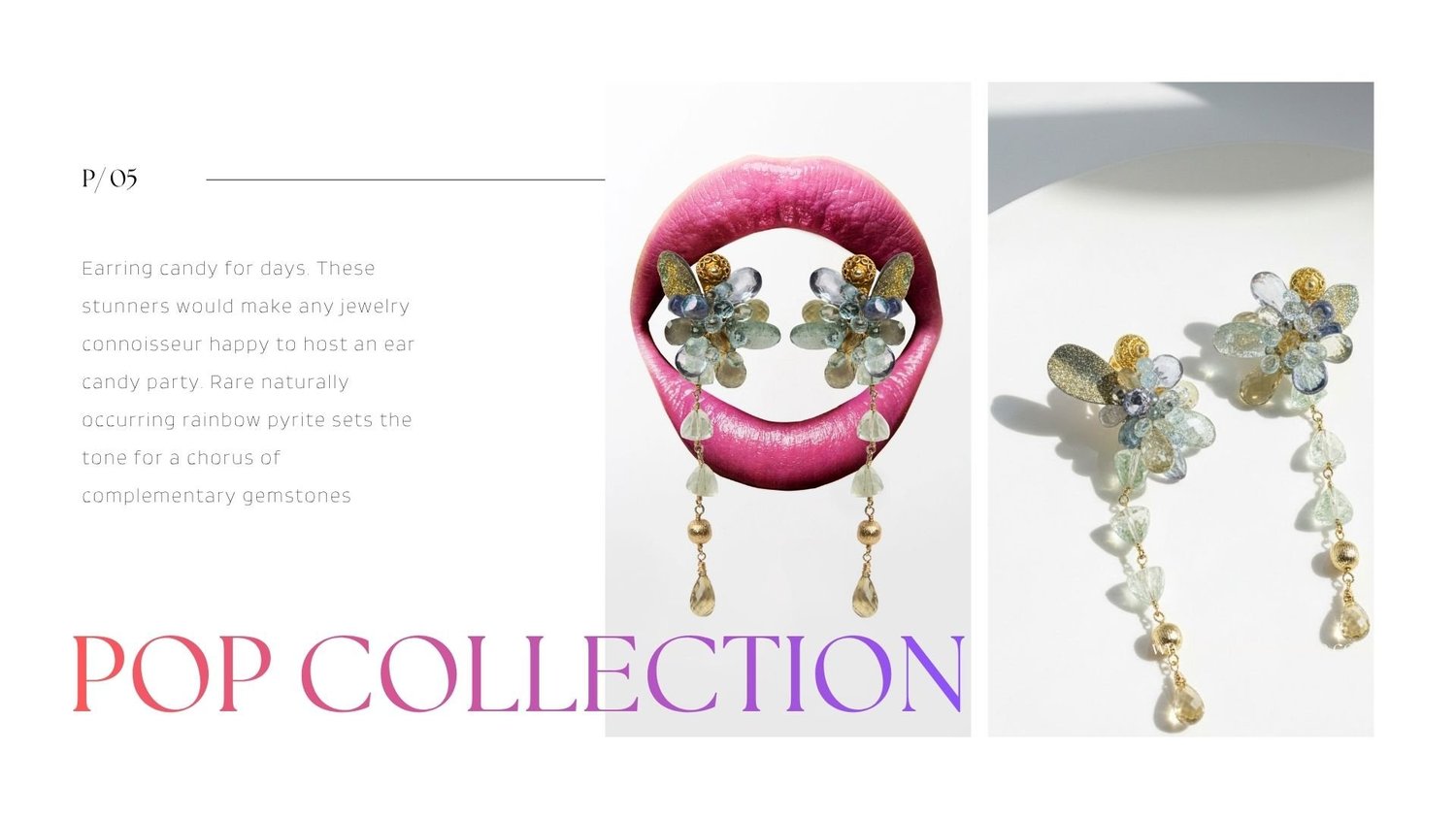
The collection's look came from Gabby Rudick. As a student at the Art Institute of Colorado, she had the idea to build fashion collages and photograph my pieces on them as flat lays for a class project. She chose the pieces herself.
People ask whether the color is real. Look closely: natural rainbow pyrite has a druzy texture, a crust of miniature glittering crystal points, and its colors flash unevenly as each tiny crystal face catches the light. I have no rainbow pyrite left in my studio now. The next strands will come the way the first ones did, hand-picked at the Tucson Gem Show.
Featured Collection
Pop
Every piece in the Pop collection, one of a kind and handcrafted in Denver.
Every piece in the Pop collection was one of a kind: handcrafted once, sold once, never repeated. Most of the pieces in this lookbook have found their owners; the ones still available are just below. But rainbow pyrite is a stone Andrea loves working with, and she'd love to design something new for you.
This design features three nesting 3-D printed gold vermeil starbursts. An array of gemstones give a fun color punch. Brass cuff backing and 14k gold filled wire. Gemstones include Druzy, tanzanite, sky blue topaz, amethyst, pink amethyst, swiss blue topaz, moss aquamarine, aquamarine, chalcedony, Ametrine, blue quartz and freshwater pearls.
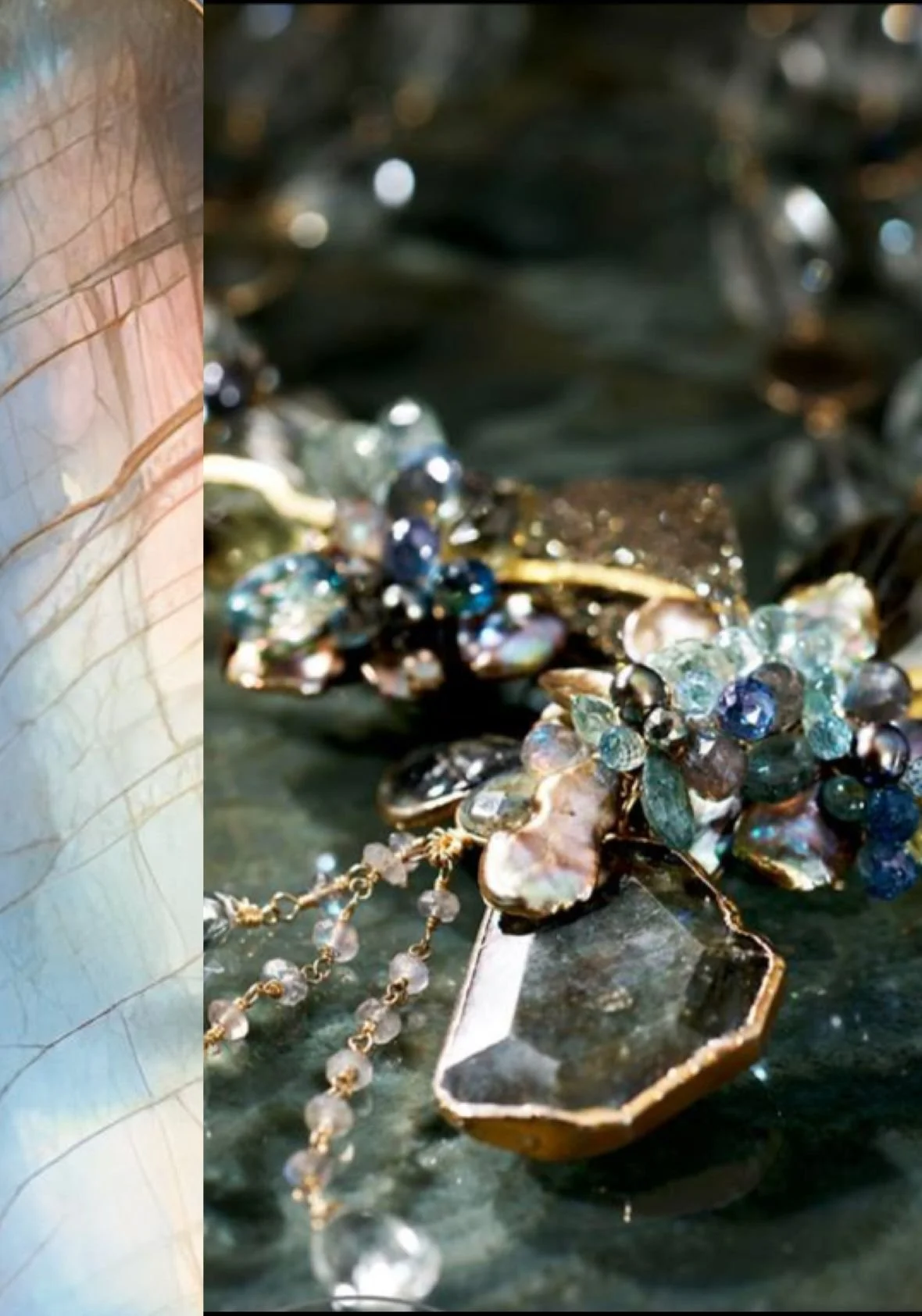
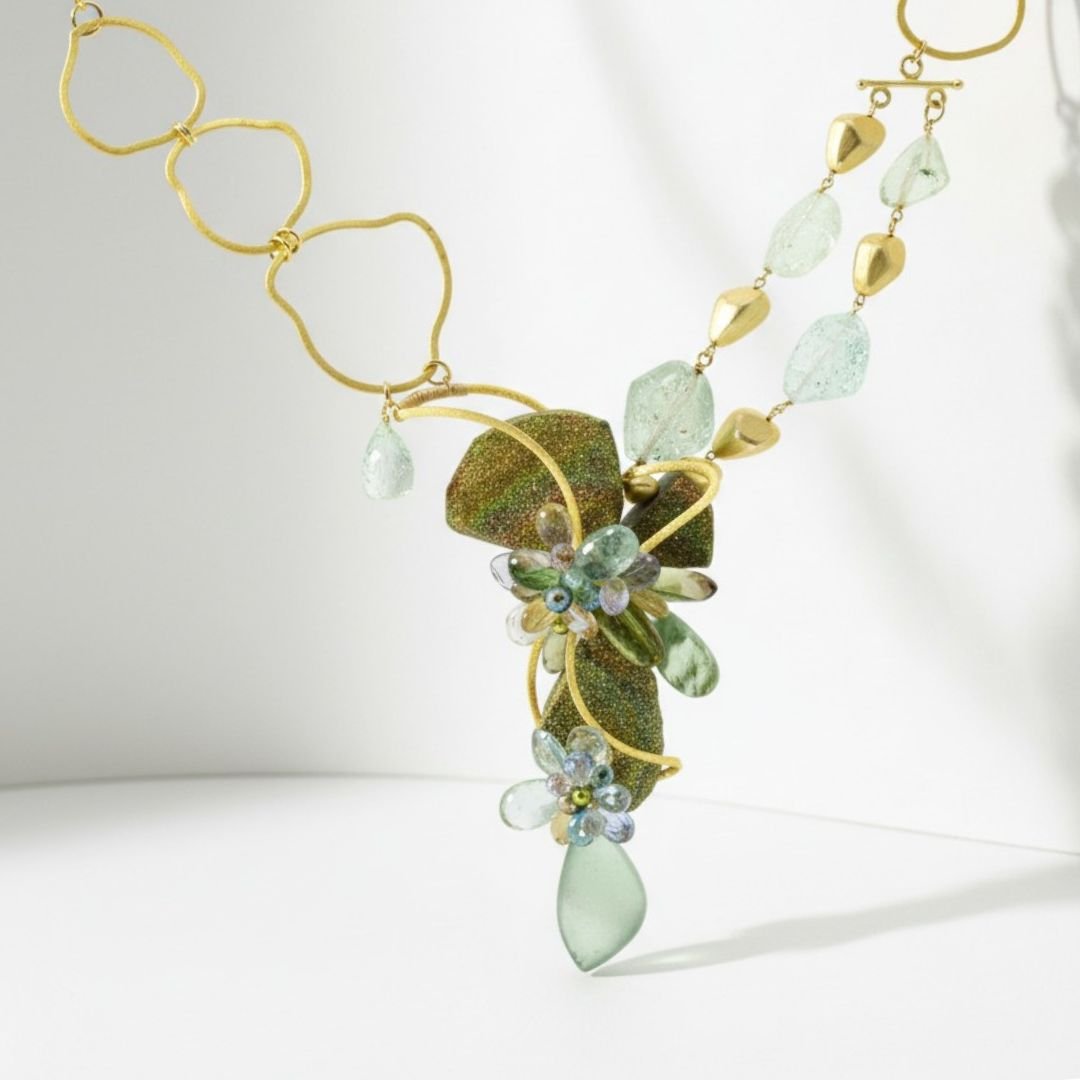
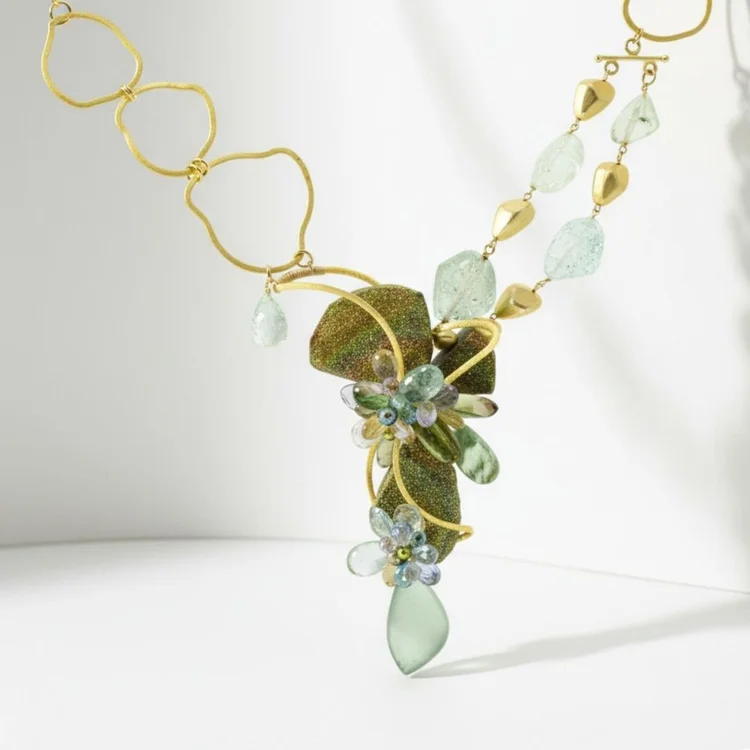
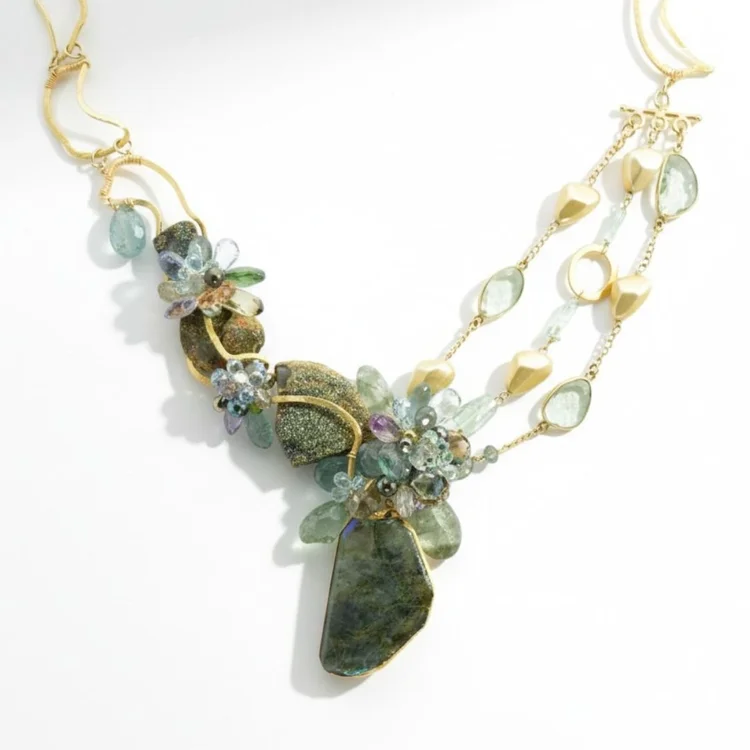
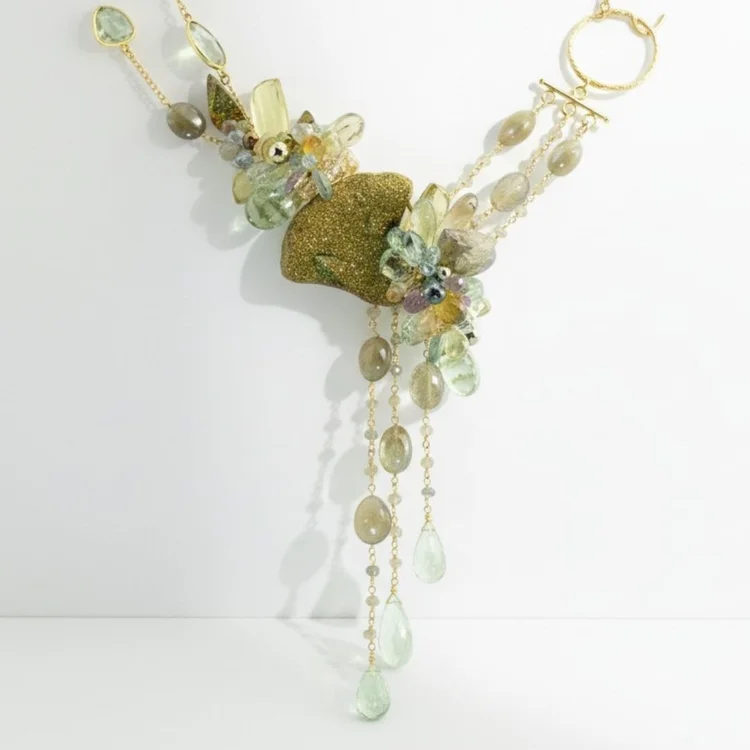
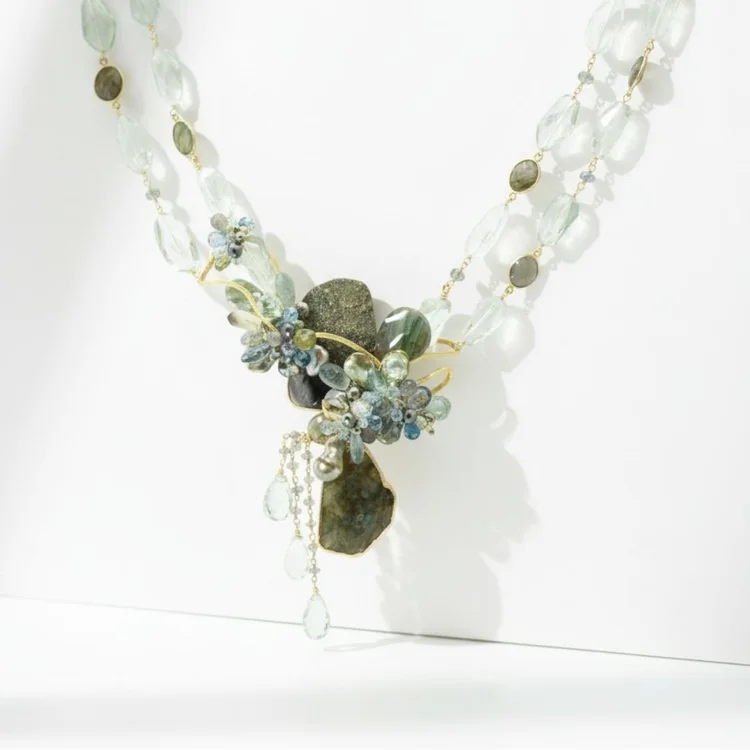
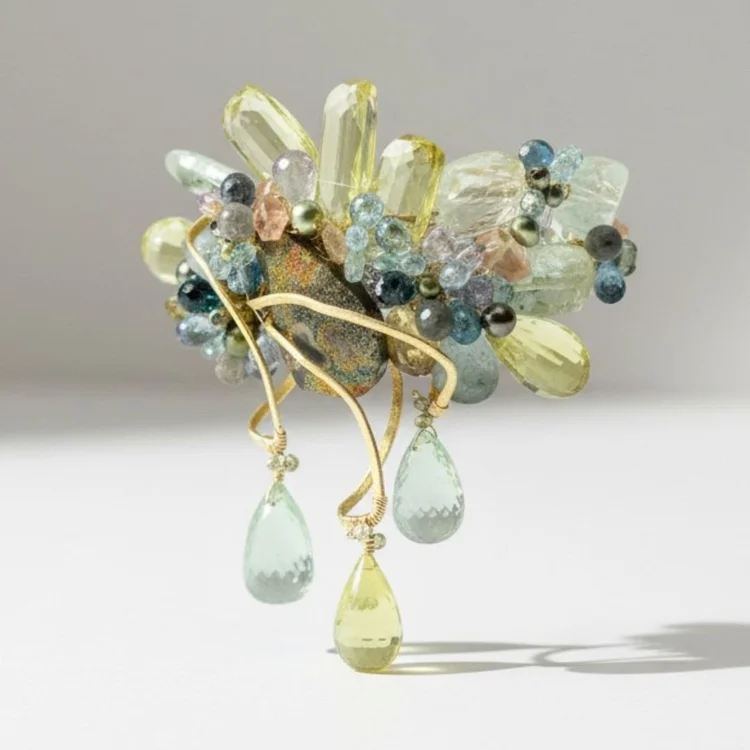
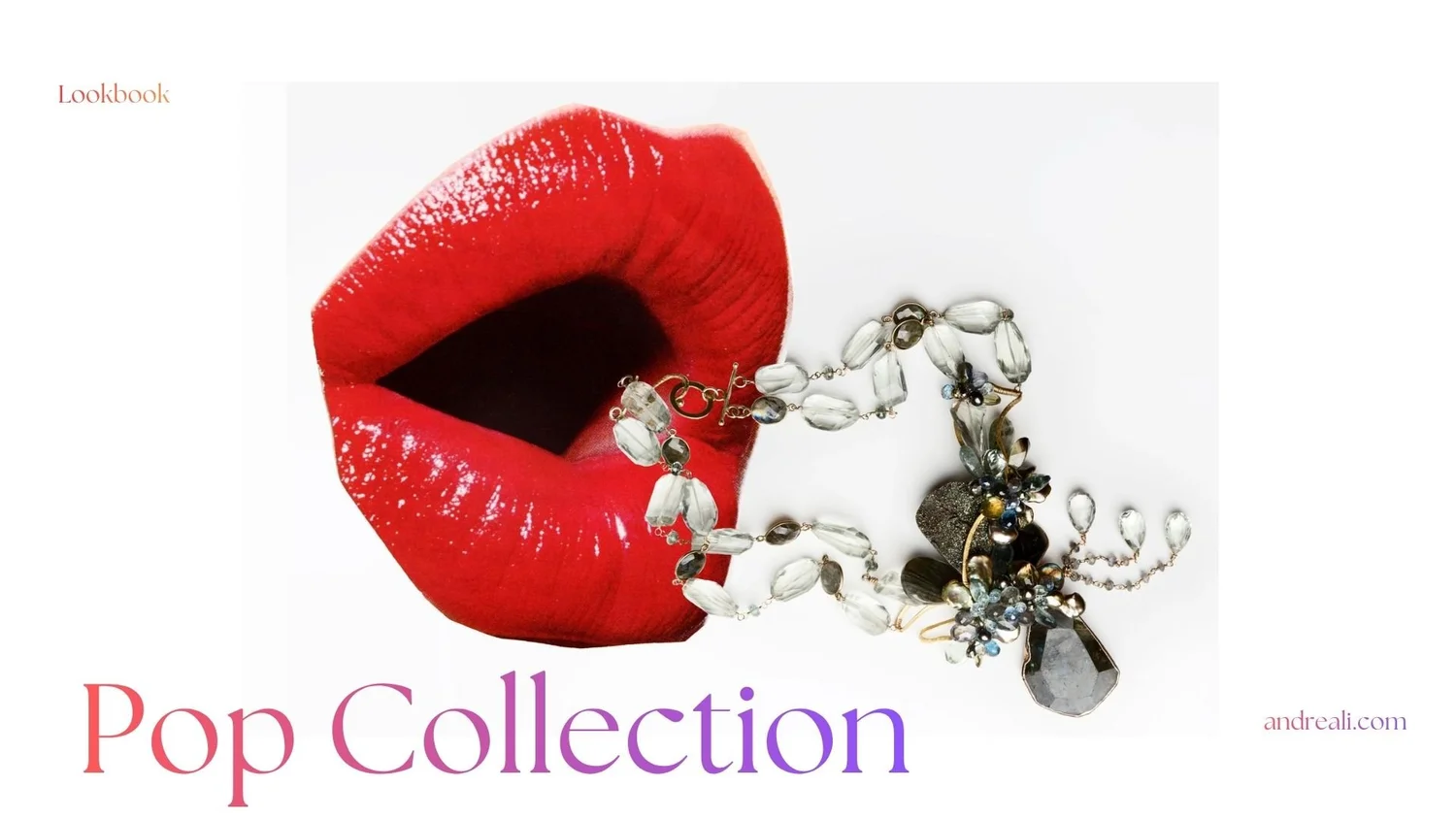
Ready to illuminate the world with a special necklace? Than this luminous piece is for you. Rare naturally occurring Rainbow pyrite is the main stone in this neck candy. Accented by gemstones inspired by gorgeous array of coloration in the scarce mineral. Made from aqua lodalite, rainbow pyrite, moss aquamarine, sky blue topaz, amethyst, swiss blue topaz, bio lemon quartz, Oregon sunstone, green amethyst, London blue topaz, mystic quartz, labradorite, aquamarine nuggets, freshwater pearls, golden Rutile, 22k gold vermeil and 14k gold filled.
Pyrite ranks 6–6.5 on the Mohs hardness scale. The iridescent surface is naturally occurring and permanent: no coating, no treatment. The most vibrant specimens command a premium because the color phenomenon is rare and unpredictable. Every piece in this collection was one of a kind, handcrafted in Denver.
Bracelets
Rainbow Pyrite · Natural & Untreated
Artful Sparkle
Wearable art jewelry
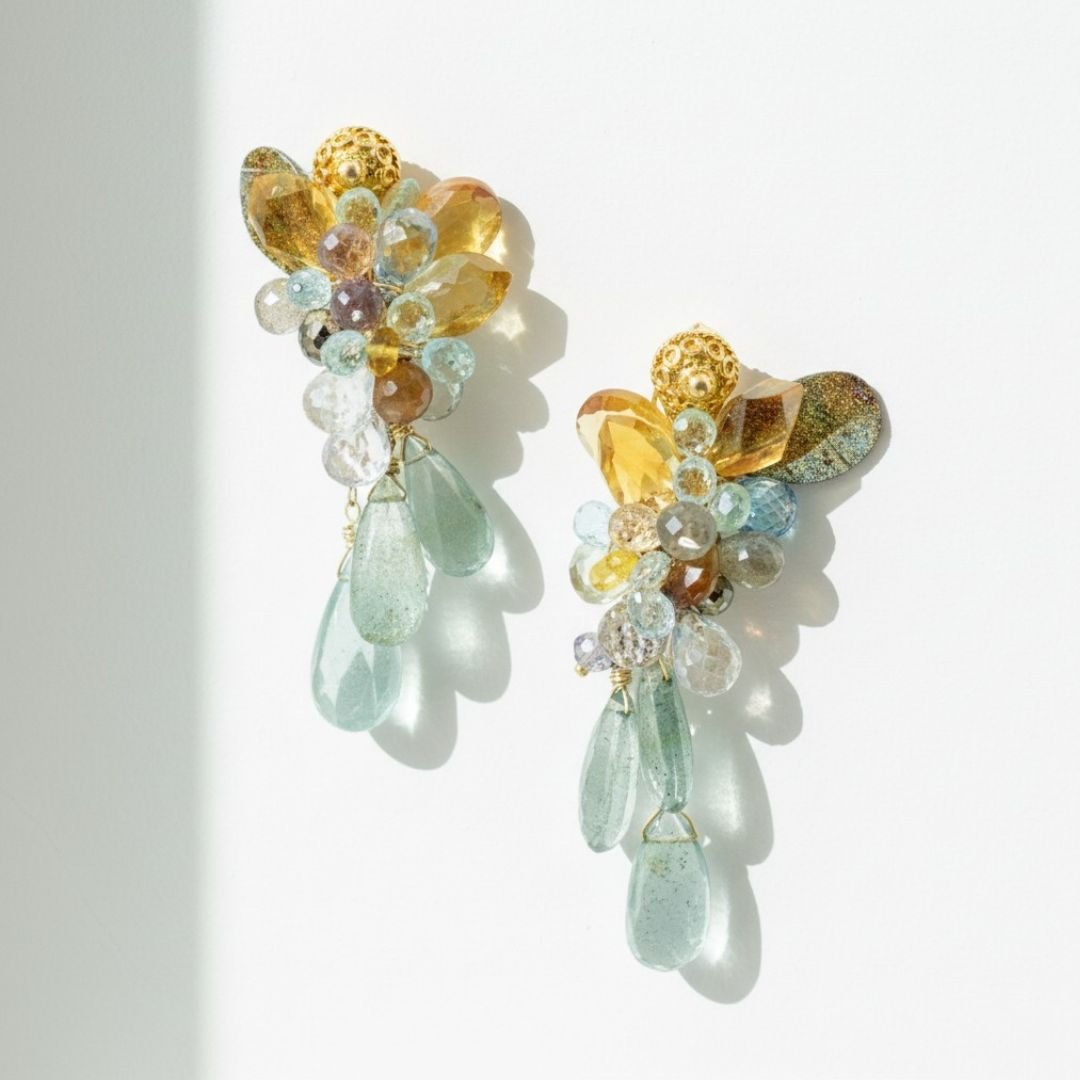
Rainbow pyrite at the wrist, its colors natural and untreated, set with moss aquamarine and topaz. Each piece is hand-fabricated in 14k gold-filled and 22k gold vermeil by Andrea Li in Denver.
Naturally iridescent rainbow pyrite at the throat, peacock fire over gold, paired with labradorite and blue topaz. Each piece is hand-fabricated in 14k gold-filled and 22k gold vermeil by Andrea Li in Denver.
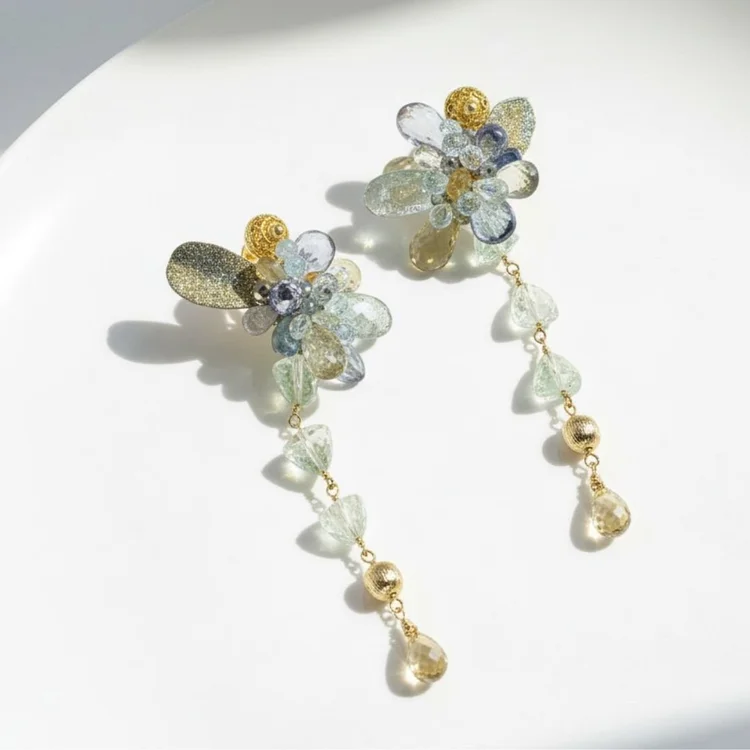
Rainbow pyrite set to catch the light, oil-slick color over raw gold, with moss aquamarine and labradorite. Each piece is hand-fabricated in 14k gold-filled and 22k gold vermeil by Andrea Li in Denver.
Shimmering with iridescent rainbow flashes, rainbow pyrite is playful and eye-catching, unlike anything else. Each piece is handmade and one-of-a-kind, sculpted by hand in my Denver studio.
Yes. Rainbow pyrite's iridescent peacock color is completely natural and untreated. The sheen comes from a very thin natural surface layer that splits light, so the gold, green, blue, and violet you see are the stone's own colors, not a coating or a dye.
What is rainbow pyrite?
It is a rare, naturally iridescent form of pyrite, an iron sulfide mineral, found in only a few places, with Russia the best known source. Most pyrite is plain brassy gold, so the rainbow variety is unusual and collectible.
How do I care for rainbow pyrite?
Keep it dry and handle it gently. Pyrite can tarnish with moisture, so take it off before washing, swimming, or working out, wipe it with a soft dry cloth, and store it somewhere dry, ideally with an anti-tarnish strip. Avoid water, chemicals, and ultrasonic cleaners.
What does Andrea pair with rainbow pyrite?
Her rainbow pyrite pieces often include labradorite, moss aquamarine, blue topaz, keshi and freshwater pearls, and golden rutile, set in 14k gold-filled and 22k gold vermeil, so the stone's metallic shimmer has color around it.
Which gems have a rainbow iridescence?
Several do, each for a different reason. Rainbow pyrite flashes gold, green, pink, blue, and purple from a thin natural film on its tiny metallic crystals. Labradorite shows blue, gold, and green flashes from light interfering between thin layers inside the stone. Peacock ore (bornite) shows purple, blue, and gold, but most of it sold in shops has been acid-treated to intensify its colors. At the gem show, Andrea laid her rainbow pyrite beside peacock pearls, whose surface looks like an oil slick, with an iridescence and luster that change as the light hits it.
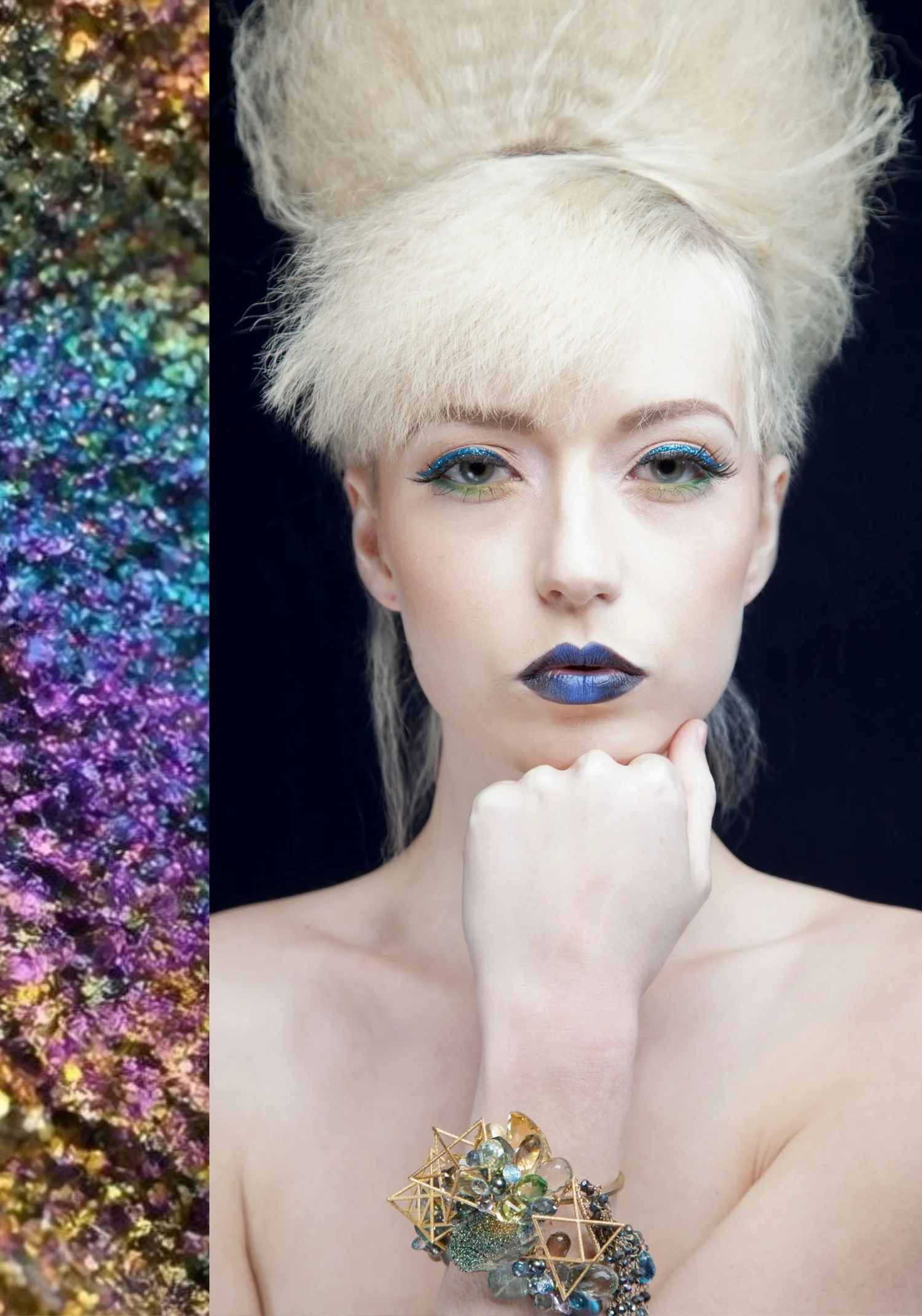



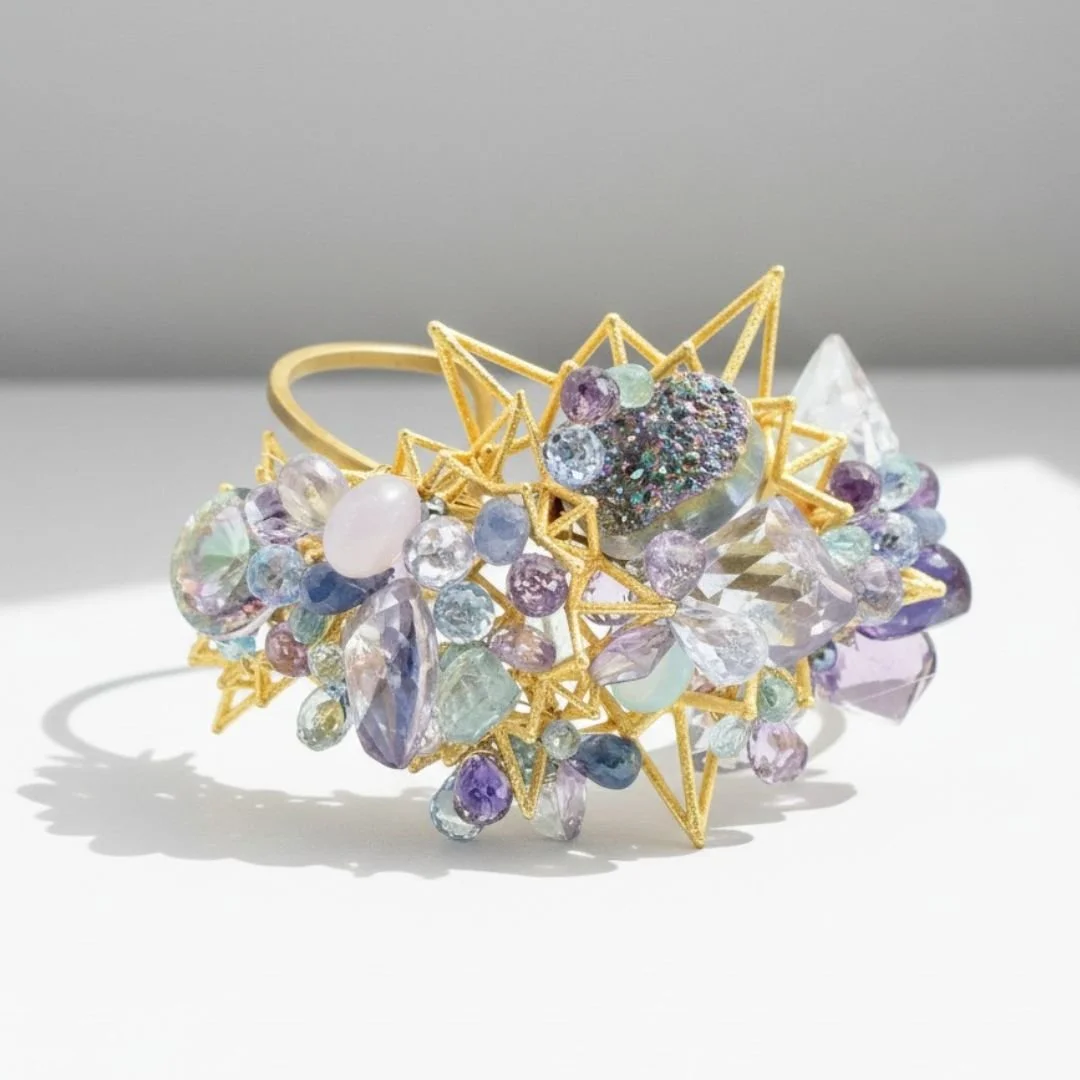
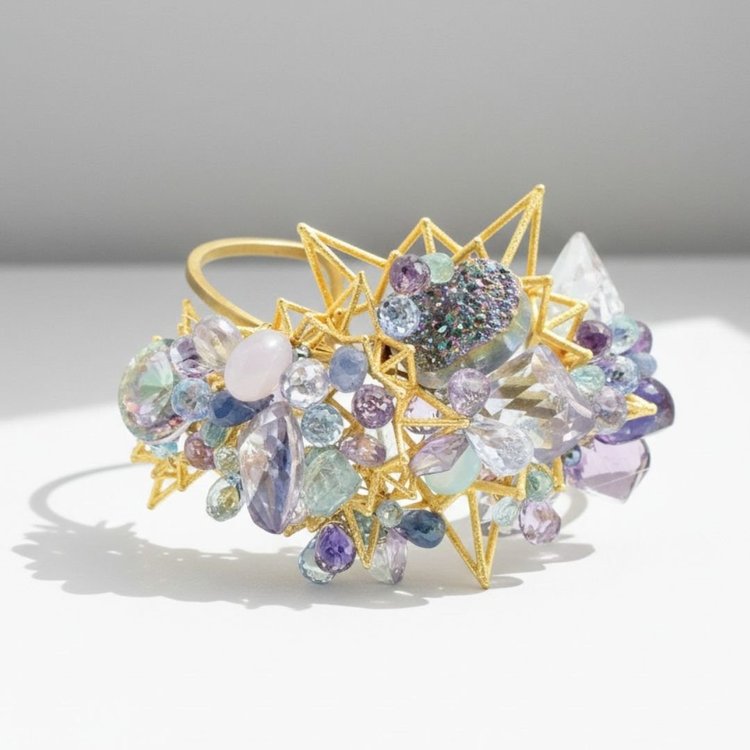
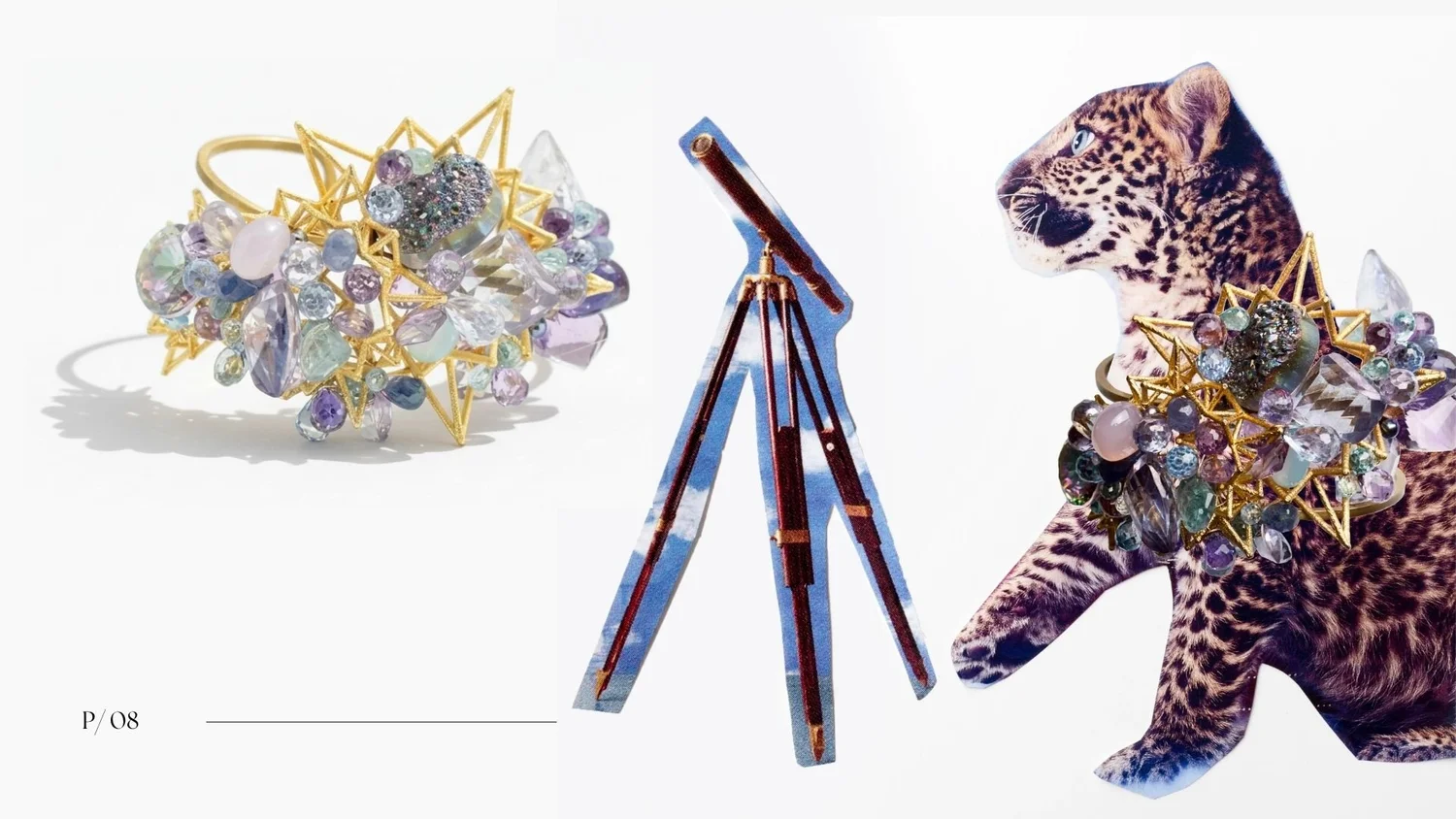
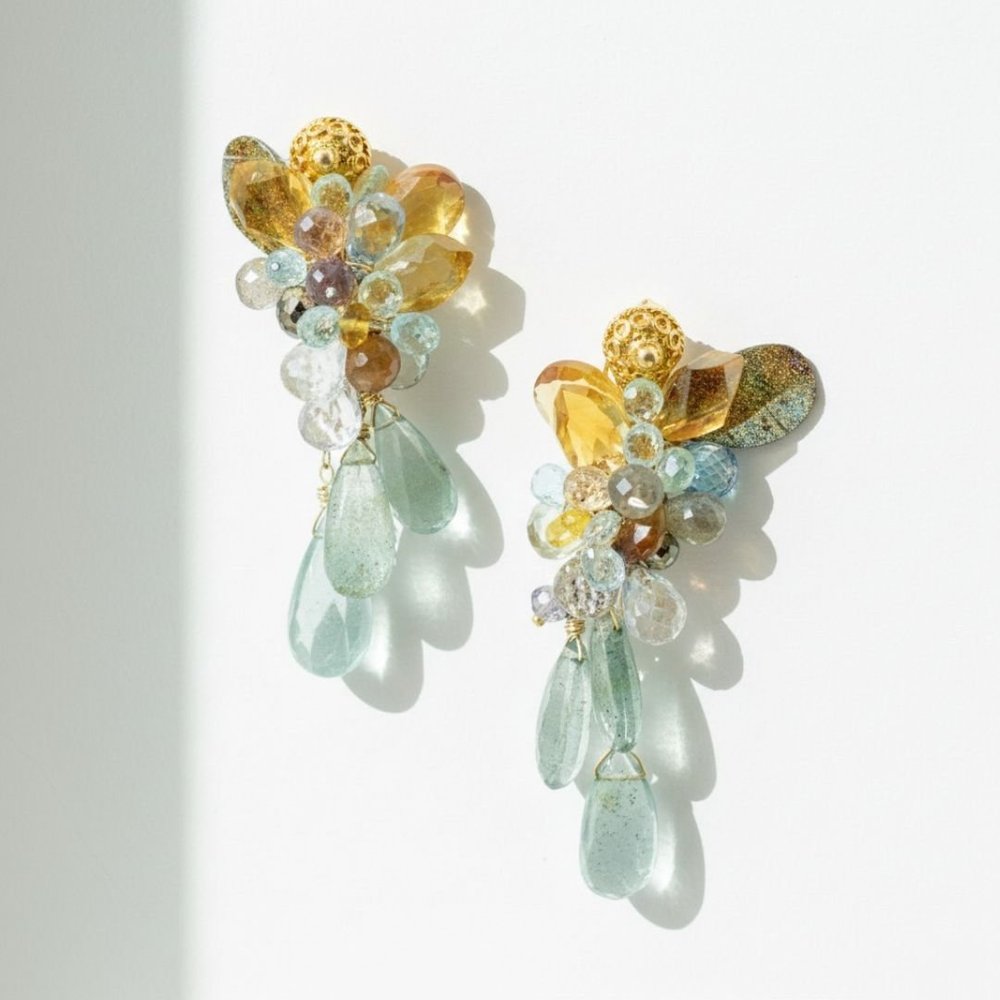
This design features three nesting 3-D printed gold vermeil starbursts. An array of gemstones give a fun color punch. Brass cuff backing and 14k gold filled wire. Gemstones include Druzy, tanzanite, sky blue topaz, amethyst, pink amethyst, swiss blue topaz, moss aquamarine, aquamarine, chalcedony, Ametrine, blue quartz and freshwater pearls.