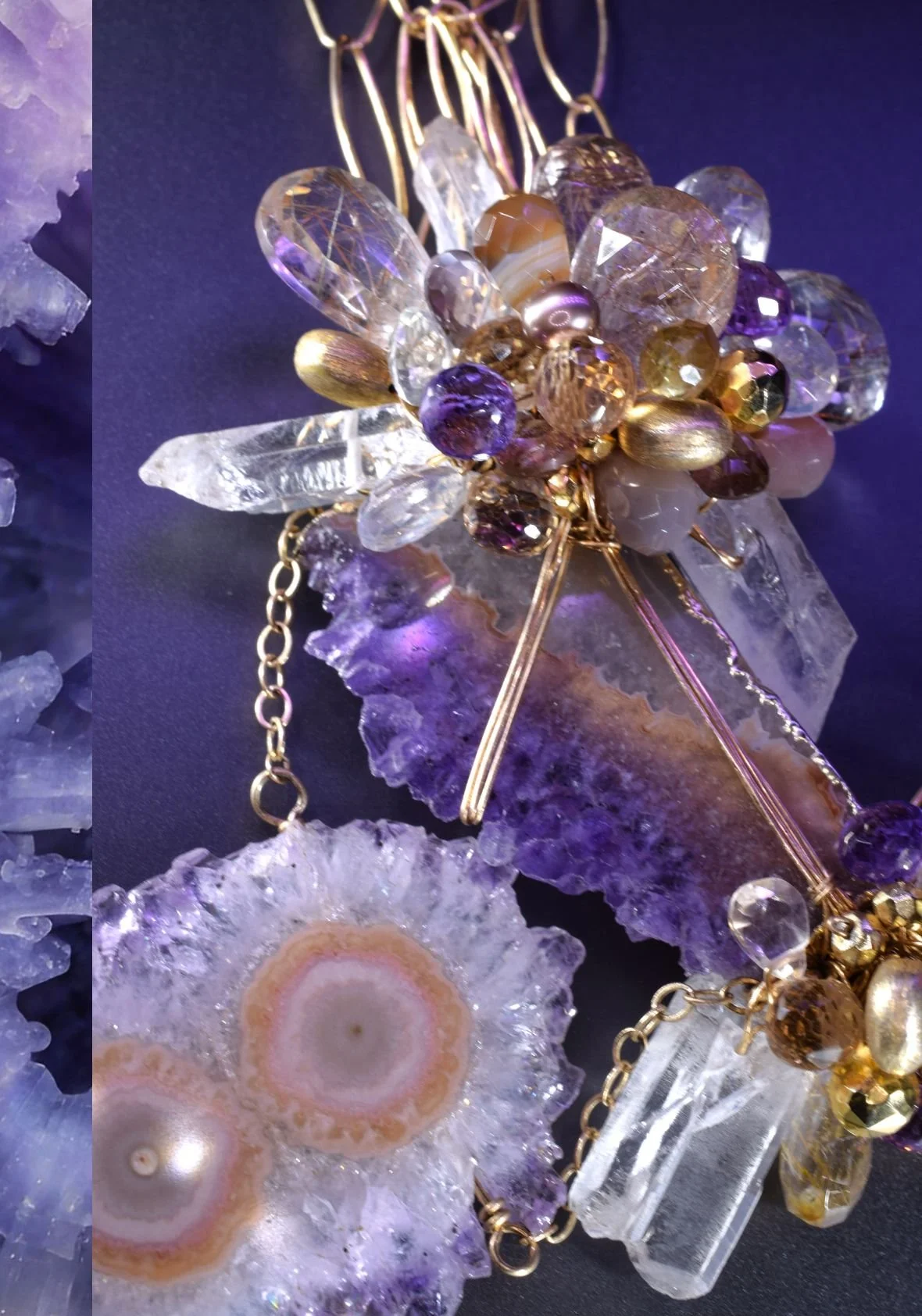
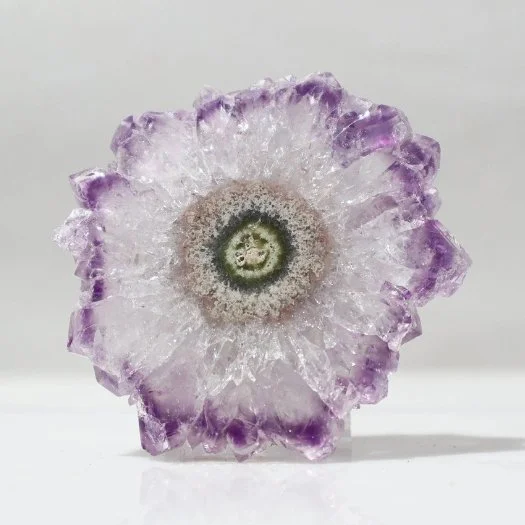
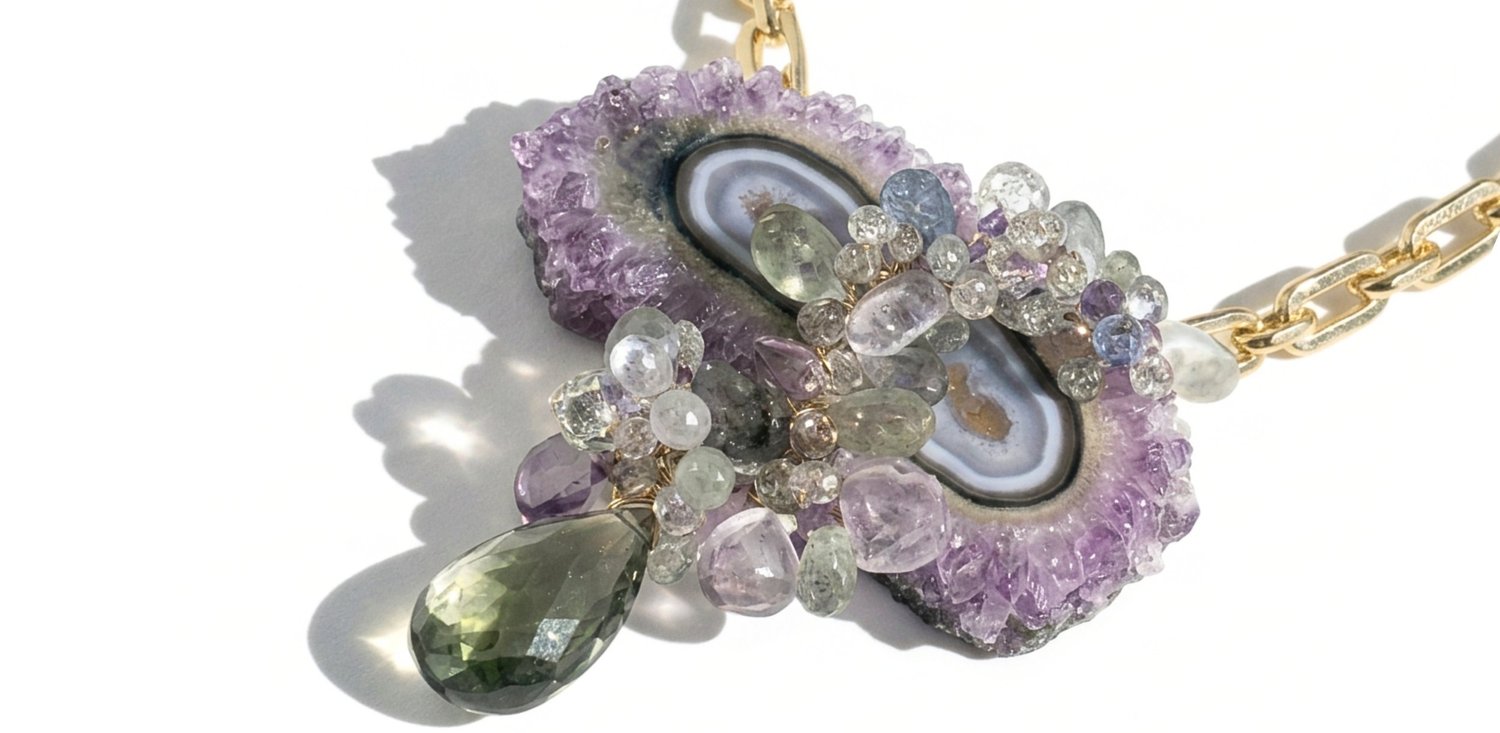
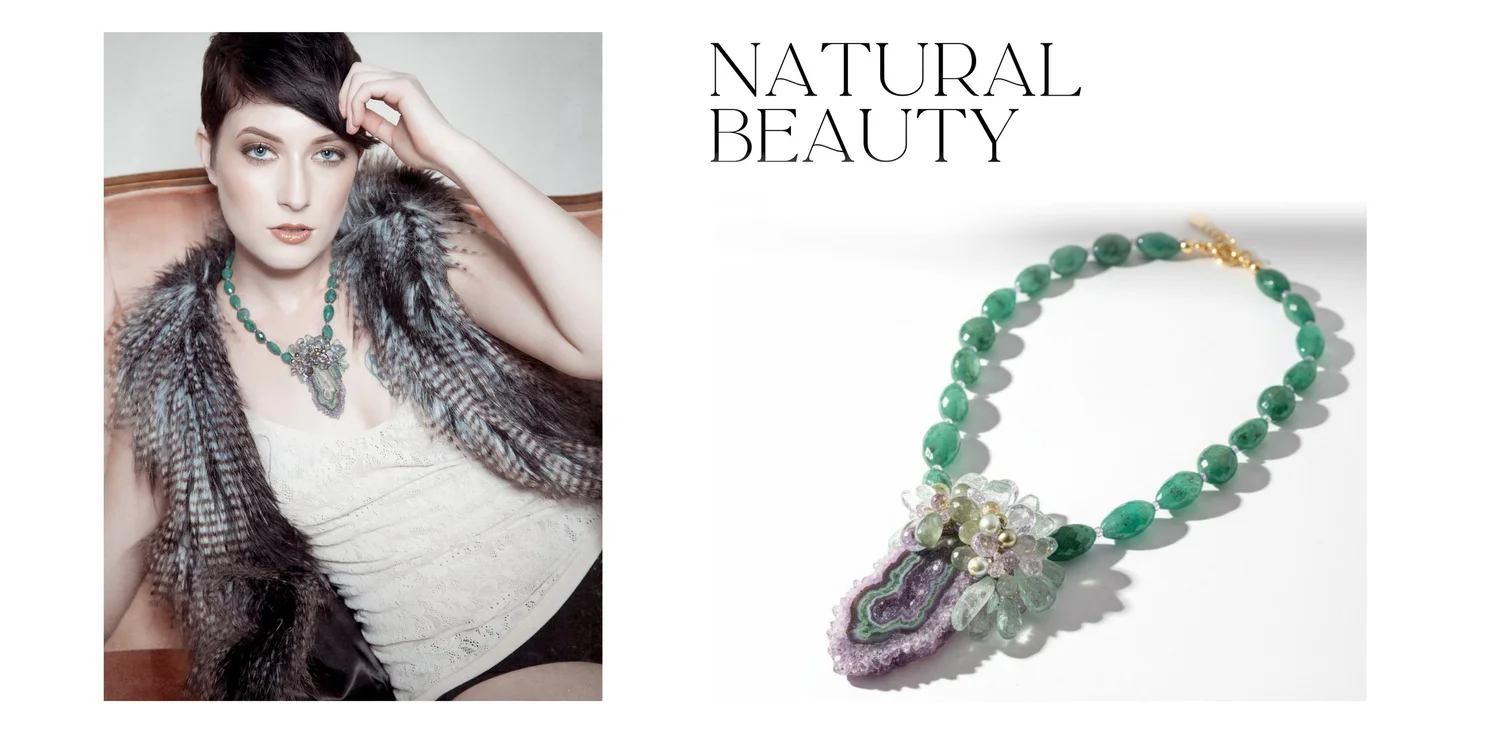
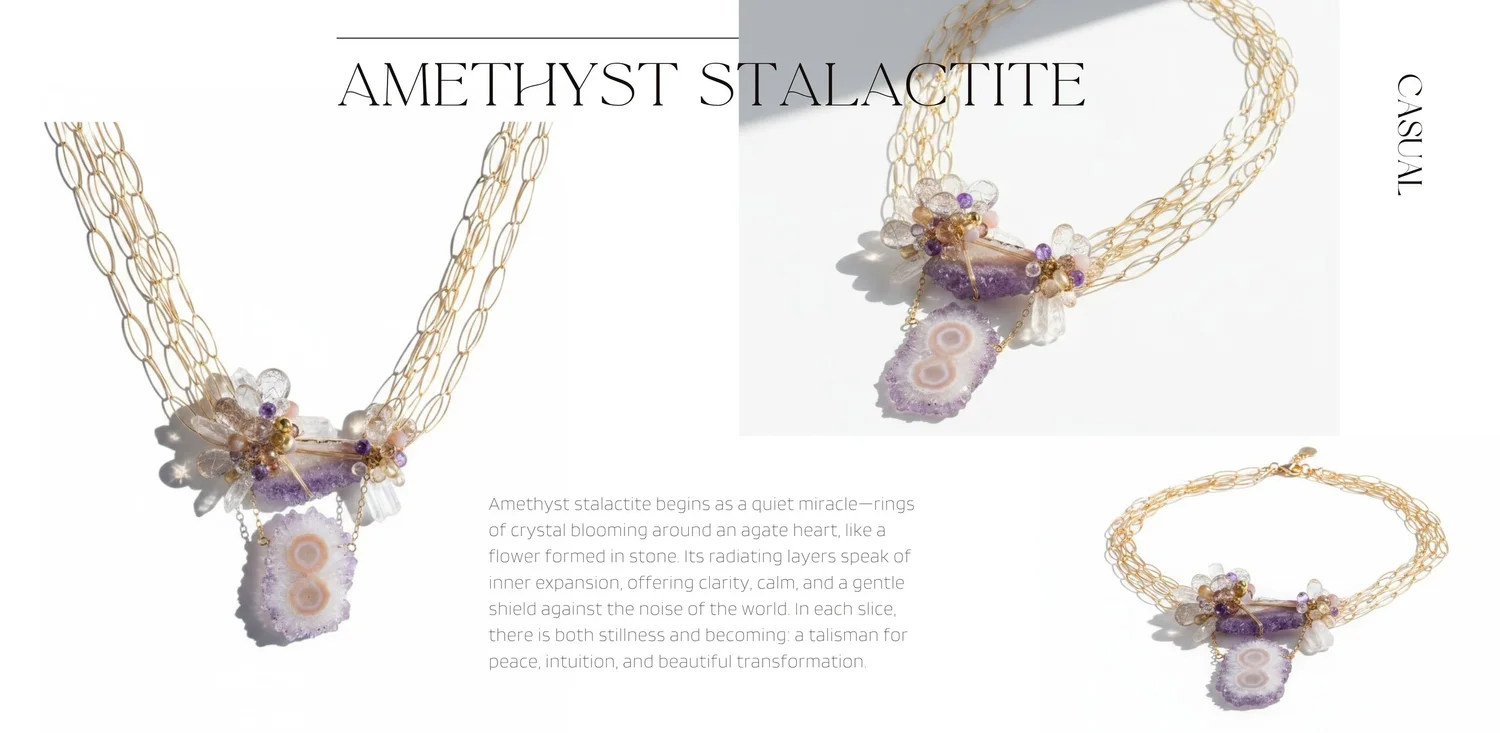
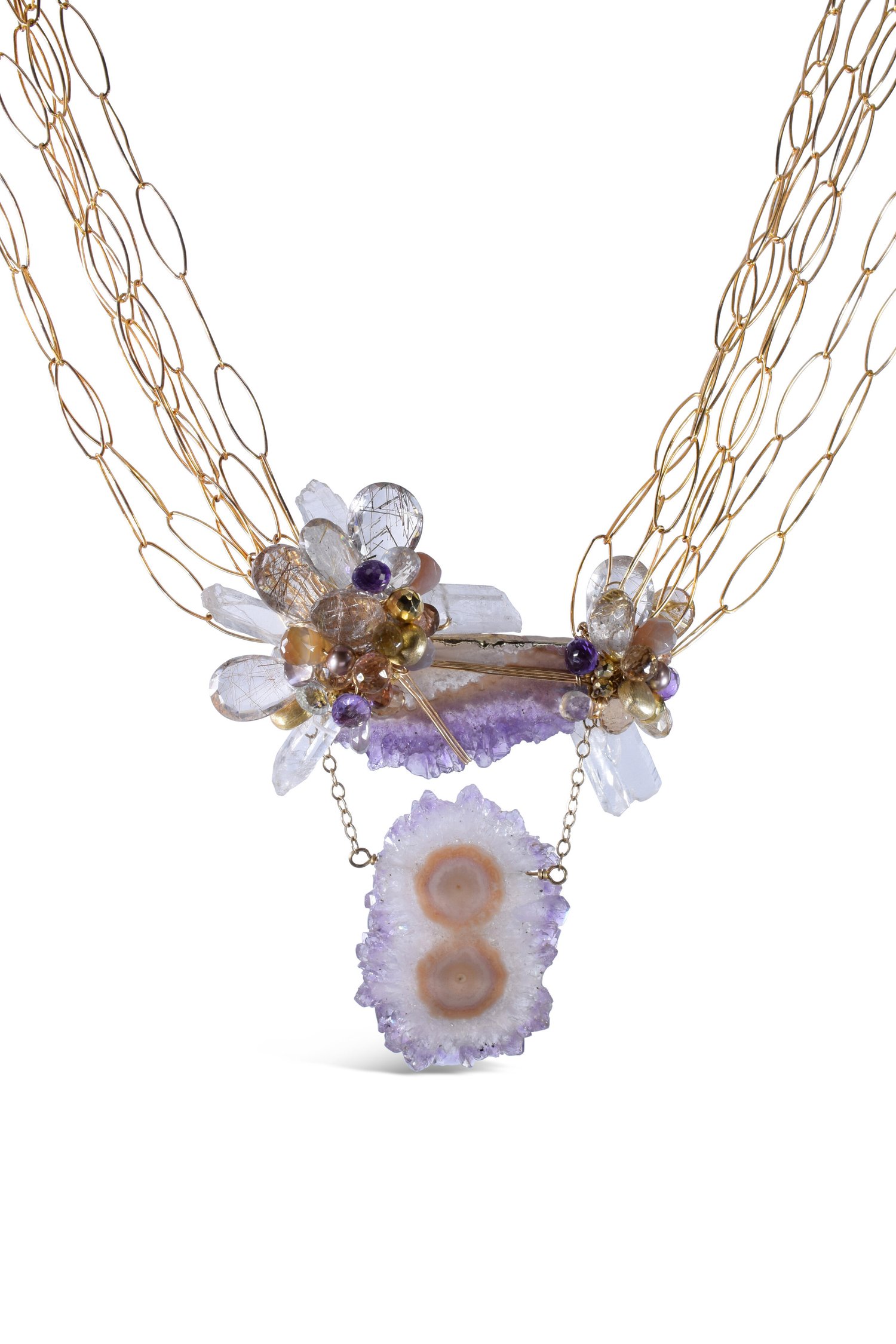
A thin slice of a geode, sealed with a tiny agate eye, a halo of purple crystal, and a raw sparkling rim. Tap a marker to see how the earth drew it, and why no two are ever alike.
Amethyst Stalactite Slice
Illustrative, not a photograph.
Tap a marker
No two slices are ever the same. Tap a marker on the stone to see the agate eye at its center, the amethyst halo around it, and the raw druzy edge I refuse to hide.
The eye · banded agate
At the center sits a concentric eye of banded agate, the microcrystalline quartz that filled the hollow stalactite first, drop by drop. It is the calm, banded heart of the slice, and people see an eye, a flower, or a small planet in it.
The halo · amethyst crystal
Around the eye, larger amethyst crystals grew outward into the open space, building the purple rim. Amethyst is simply quartz colored by traces of iron and natural irradiation, a 7 on the Mohs hardness scale.
The edge · raw druzy
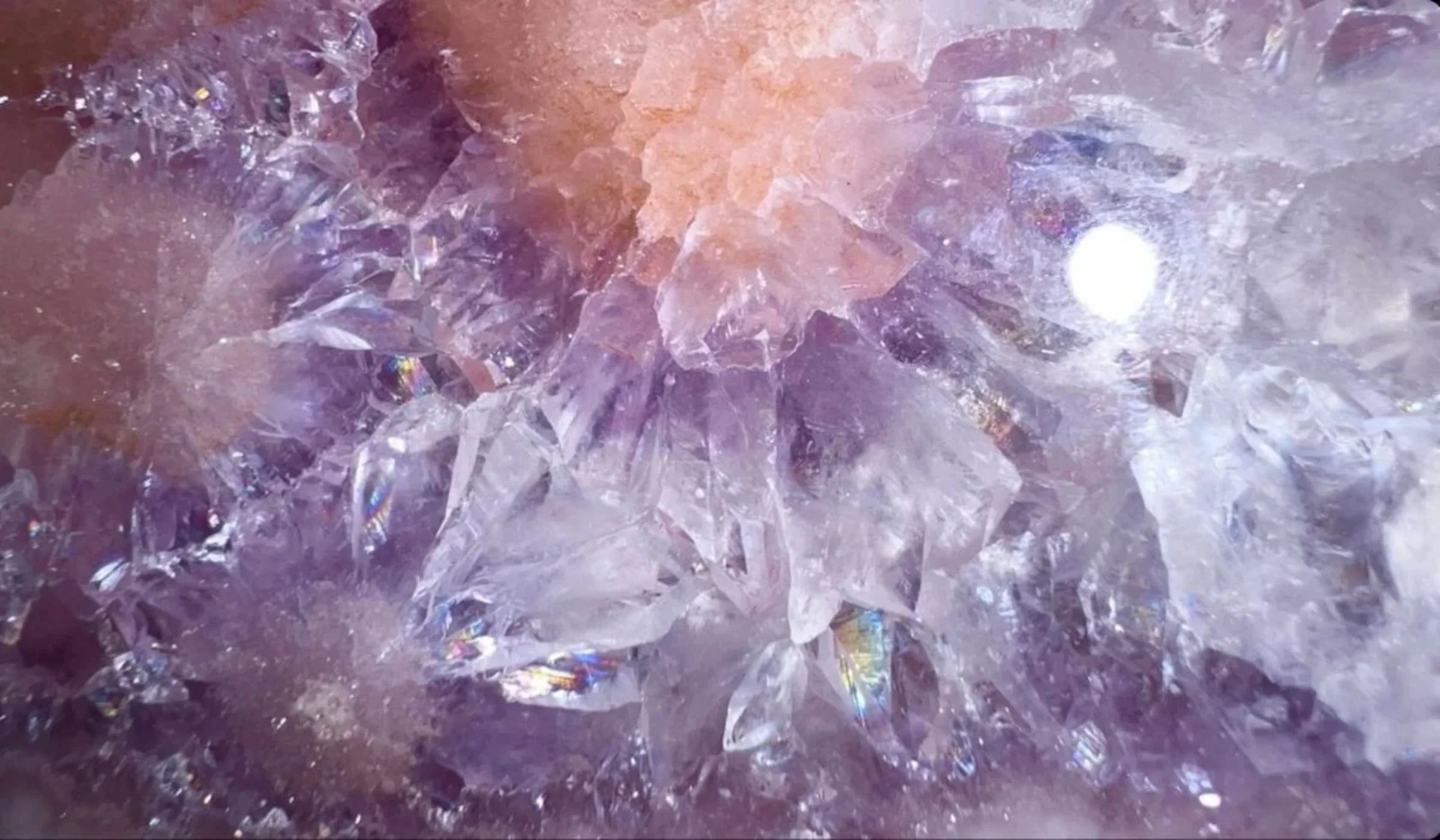
The outer rim is raw druzy, a band of tiny sparkling crystal tips. It is the most delicate part of the stone, and the part I refuse to hide, because that wild crystal edge is the whole reason to use the slice.
profile
Andrea Li
Gemstone Profile: Amethyst Stalactite
A one-of-a-kind slice · the flower in the stone
01
The Formation
Formed over millennia in volcanic pockets and mineral-rich caves. A unique stalactitic crystal growth, drop by drop.
02
Anatomy
A distinct core, often agate, followed by concentric bands, then radiating layers of amethyst crystals.
03
Color & Luster
Ranges from ethereal lavender to deep violet, with natural color zoning. A bright, vitreous luster.
04
Rarity & Unicity
A rare and coveted formation. Cross-sections resemble a natural flower or starburst. A one-of-a-kind natural design.
05
Symbolism
Commonly associated with clarity, calm energy, and deep grounding. Considered a stone of time and growth.
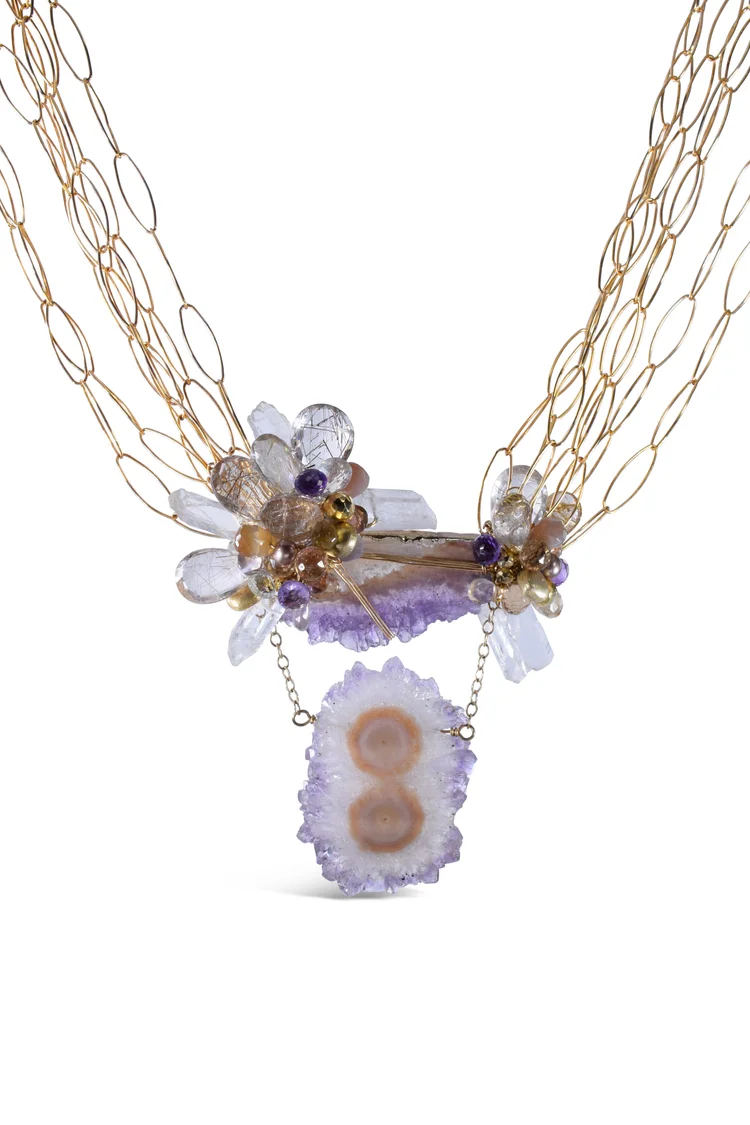
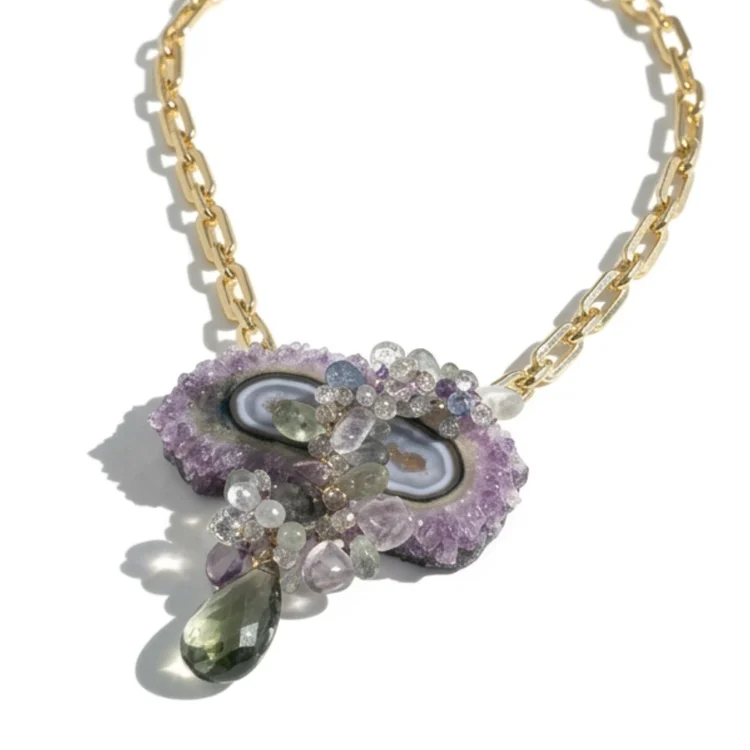
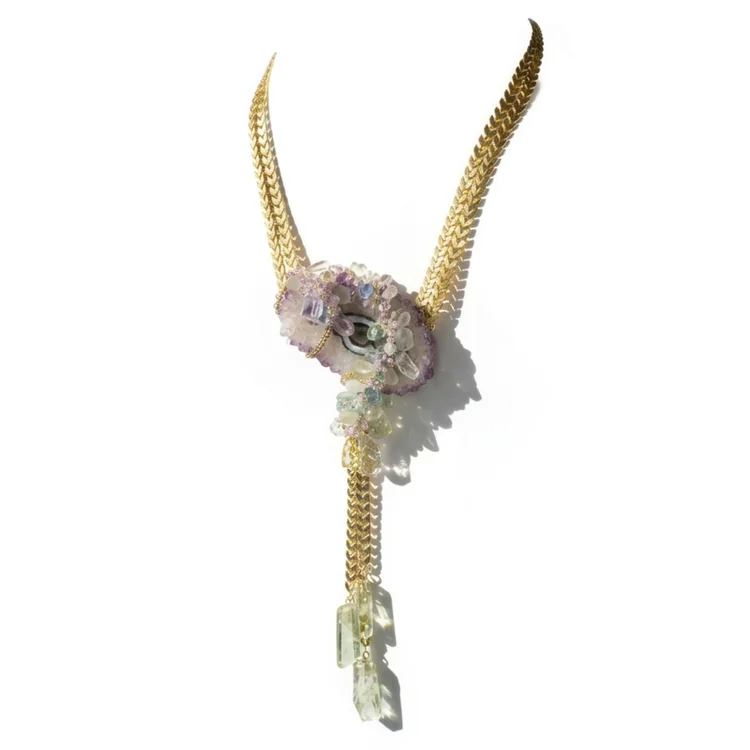
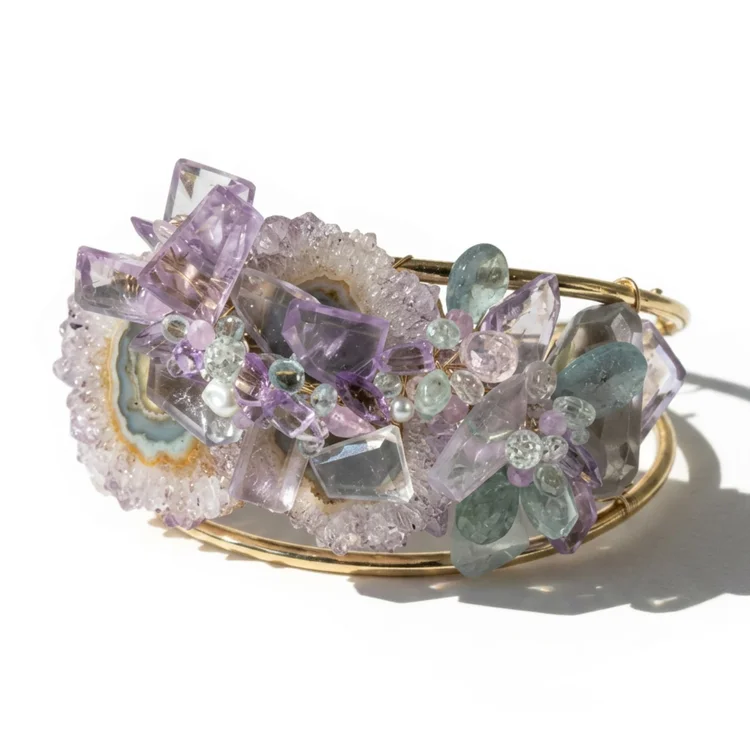
An amethyst stalactite slice does not behave like a faceted gem. It is a thin cross-section cut from a stalactite that grew inside a volcanic geode, so instead of a single clear stone you get a sealed little landscape: an agate eye, a halo of purple crystal, and a raw sparkling edge. No two are ever the same. Here is what the stone actually is, how the earth makes it, and how I set something this unusual.
An amethyst stalactite slice is one of the most unusual stones in all of fine jewelry. Instead of a single flat gem, you get a tiny landscape sealed in stone. At the center sits a concentric eye of banded agate, ringed by a halo of pale purple amethyst crystal, often finished with a sparkling druzy edge. People see different things in them: an eye, a flower, a small planet, a geode in miniature. They are sometimes called amethyst flowers or amethyst stalactite eyes.
Because the pattern forms entirely by chance, deep underground, over millions of years, no two slices are ever the same. That is what makes them so well suited to one-of-a-kind jewelry: the stone is already unrepeatable before it ever reaches the bench.
7On the Mohs scale
The same as all quartz.
From
Uruguay and southern Brazil.
Three zones
The eye, the halo and the rim.
How an amethyst stalactite forms
These slices come almost exclusively from the large volcanic geodes of Uruguay and southern Brazil. Silica-rich water seeps into a cavity in cooling basalt and, drop by drop, builds a hanging stalactite the same way a cave stalactite grows from dripping water. The core fills first with microcrystalline quartz, the banded agate and chalcedony you see at the center. Around that core, larger amethyst crystals grow outward into the open space, forming the purple rim. Slice the finished stalactite crosswise and the whole hidden history is revealed in rings.
Amethyst is simply purple quartz, colored by traces of iron and natural irradiation, and it sits at a 7 on the Mohs hardness scale, the same as all quartz.
Zone
What it is
What it means
The eye (center)
Banded agate and chalcedony, the microcrystalline quartz that filled the hollow stalactite first
The calm, banded heart. Its rings, symmetry, and color are different in every slice.
The halo (middle)
Pale purple amethyst crystal, grown outward into the open space
The color. Amethyst is quartz tinted by iron and natural irradiation, a 7 on the Mohs scale.
The rim (edge)
Raw druzy, a band of tiny exposed crystal tips
The wild edge, and the most delicate part. I feature it rather than hide it.
From the bench: setting a stone with an eye
Are they durable enough to wear?
Yes, with a little awareness. As a quartz, an amethyst stalactite is a solid 7 on the Mohs scale, hard enough for everyday wear and a high polish across the agate and amethyst faces. The one thing to mind is the druzy rim: those tiny exposed crystal tips are the most delicate part and can chip against a hard knock. So these pieces love a gentler life, a pendant or earrings over a ring that takes daily impact. Keep it from sharp blows, and from very long stretches of direct sunlight, which can slowly soften amethyst's purple over years.
Why each one is one of a kind
The agate banding and the amethyst halo form by chance as the stalactite grows, so the eye at the center, its rings, its symmetry, and the depth of the purple are different in every single slice. When I set one into a piece, that exact pattern will never appear again. It is the same reason a lodolite or an opal is unrepeatable, taken to an even rarer extreme: you are not just choosing a color, you are choosing a one-of-a-kind composition that the earth drew once.
Awakening, Cascade and Ember are from Second Light, the collection that opens November 4.
One of a kind · Built once
From the bench · Andrea Li
The weave behind the rawest stone I set
A note from Andrea Li, who sets amethyst stalactite slices by hand in her Denver studio.
On the back of my work there is a weave, a web of wire where every connection is made and held under tension. People told me for years to hide it. I never could. It is the truest part of what I make, the place where I turn chaos into something more beautiful for having come through it. No stone tests that idea like an amethyst stalactite.
“
The stone is upheaval, crystallized. My only honest answer to it is the weave.
”
An amethyst stalactite is a cross-section of slow violence. Deep in ancient volcanic rock, trapped gas and water hollowed out pockets, and over millions of years mineral-rich fluid grew icicle tubes of agate that finally erupted into purple quartz. Then someone sliced the whole record open. I found mine years ago on my way out of a Tucson show with my budget already spent, and they waited in a drawer until I was ready for them. You do not tame a stone like that. You hold it honestly.
So behind each slice is that weave, layer upon layer of fine gold wire threaded by hand until it can cradle the raw crystal without hiding a thing. I do not polish the upheaval away. I let a gemstone cluster grow up out of it, the way something green pushes through hard ground, and the tangle you were never meant to see is exactly what carries the beauty you were. That is the throughline in everything I make, whether the upheaval is the earth's or my own: chaos, endured, and turned into something more refined for having survived it.
FAQ
Frequently asked questions
01What is an amethyst stalactite slice?
It is a cross-section cut from a stalactite of amethyst that grew inside a volcanic geode. The slice shows a concentric pattern: a center of banded agate, ringed by a halo of purple amethyst crystal, often with a sparkling druzy edge. Each one looks like a small eye or flower, and no two are alike.
02How are amethyst stalactites formed?
Silica-rich water drips into a cavity in volcanic rock and slowly builds a hanging stalactite, the same way a cave stalactite grows. The center fills with microcrystalline agate, and amethyst crystals grow outward around it. These slices mostly come from Uruguay and southern Brazil.
03Are amethyst stalactite slices durable enough for jewelry?
Yes. Amethyst is a quartz, a 7 on the Mohs hardness scale, durable for everyday wear. The one delicate part is the druzy crystal rim, whose tiny tips can chip, so the slices do best in pieces that take fewer hard knocks, like pendants and earrings.
04Why is every amethyst stalactite slice different?
The agate center and amethyst halo form by chance as the stalactite grows underground over millions of years, so the eye pattern, the rings, and the color are unique to each slice. That makes every piece set with one genuinely one of a kind.
05How do you care for an amethyst stalactite piece?
Clean it gently with warm water and a soft brush, never an ultrasonic or steam cleaner, and keep it from sharp knocks against the druzy edge and from very long, direct sun exposure, which can slowly fade amethyst over years.
Discover
Jewelry that feels like you.
Two minutes. The quiz tells me how you want jewelry to feel in your life, and the messages that follow walk you through pieces I think you'll love.
Google now lets you choose your favorite sources so they show up labeled in AI search answers. If you enjoy discovering handcrafted gemstone jewelry here, add Andrea Li Designs and we'll be easier to find next time you search.