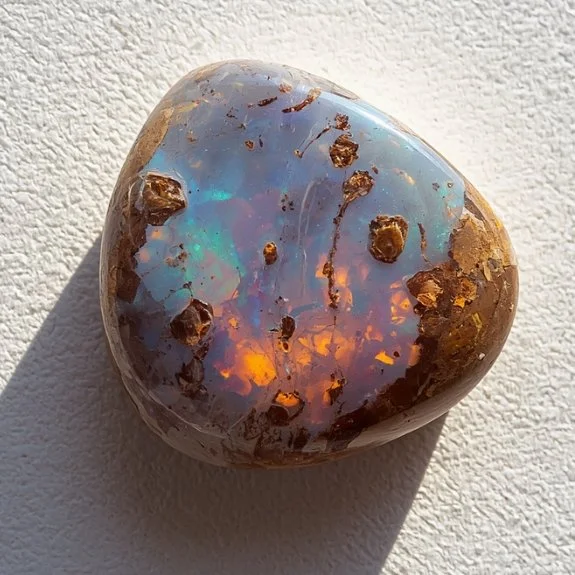
Opal flashes with every color in the spectrum. Tap a marker to see where the fire comes from, and why it is the most delicate stone I set.
Opal
Tap a marker
No two opals flash the same way. Tap a marker on the stone to see what gives opal its color, what it is made of, and why it asks for such gentle handling.
1Play-of-Color. Those flashing patches of green, blue, and violet are play-of-color. Light bends as it passes through microscopic silica spheres stacked inside the stone, splitting into the spectrum. Red is the rarest flash of all.
2Silica & Water. Opal is hardened silica gel with water still trapped inside, sometimes up to a fifth of the stone. It never grew into a crystal, which makes it unlike any other gem you own.
3Delicate. At 5.5 to 6.5 on the Mohs scale, opal is soft and brittle. It can craze, a fine web of surface cracks, if it dries out or meets sudden heat. It is the most fragile stone I set.
This one-of-a-kind Pastel Gemstone Multi-Strand Statement Necklace is handmade by Andrea Li in her Denver studio: a layered design built across multiple gold-filled chains and hand-composed from a soft, full-spectrum pastel palette.
The cluster carries Green Amethyst (Prasiolite), Aqua Hydro Quartz, Mystic Prehnite, Moonstone, Kunzite, Morganite, Yellow and Blue Aquamarine, Spinel, Topaz, Japanese Akoya Keshi Pearls, Australian Opal, and Green and Grey Sapphires. Every stone is set on recycled 14/20k gold-filled components, strung across 14k gold-filled sequin and circle link chains. The colors lead, not any single hero stone, and the strands are layered so the whole piece moves and catches light from every angle.
The necklace is cold-connected, assembled with wire and never with heat, which is what lets pearls and an opal share a single layered piece without putting either at risk. Opal is the most fragile stone here, so I seat it last and by hand, leaving deliberate give in the surrounding cluster so no single point of pressure ever reaches the stone. Keshi pearls get the same care: wire-seated, never glued, so they sit secure but unstressed.
One of a kind. Built once, never replicated, never manufactured. When it sells, it’s gone. Explore more in the Pastel Gemstone Jewelry collection.
Gemstones: Green Amethyst (Prasiolite), Aqua Hydro Quartz, Mystic Prehnite, Moonstone, Kunzite, Morganite, Yellow and Blue Aquamarine, Spinel, Topaz, Japanese Akoya Keshi Pearls, Australian Opal, Green and Grey Sapphires
Precious Metals: Recycled 14/20k gold-filled components, 14k gold-filled sequin and circle link chains
This pastel gemstone drop necklace represents the sweet spot where comfort meets artistic risk. Drawing on familiar construction techniques and signature forms, this necklace was born from a place of confidence, yet I knew it had to go further. With every component, from the 18k gold vermeil leaves to the abstract statement cluster nestled at its heart, I challenged my own design instincts to reimagine what a statement necklace could be.
Creating this multi-chain necklace meant weaving in contrasting elements: Akoya Keshi Pearls against mystic quartz, sculptural amethysts alongside baroque pearls, and strands of recycled gold-filled chain layered with intention. The asymmetry is deliberate, an invitation to embrace the unpredictable beauty of design that honors the creative process. Whether worn solo or paired with gemstone cuff bracelets or companion earrings, this piece speaks directly to the collector who seeks individuality, depth, and handmade artistry.
Each section of the necklace was meticulously assembled using an instinctual balance of weight, color, and shape. It’s wearable sculpture, elevated jewelry for those who view adornment as a form of personal expression.
Materials:
Gemstones: Pale amethyst, Hydro Quartz, Baroque Pearls, Australian Opal, Mystic Quartz, Amethyst, Akoya Keshi Pearls, Moss Aquamarine, Ametrine, Spinel, Morganite, Aquamarine, Purple Sapphire, Moonstone, Topaz, Kunzite, and Mystic Labradorite
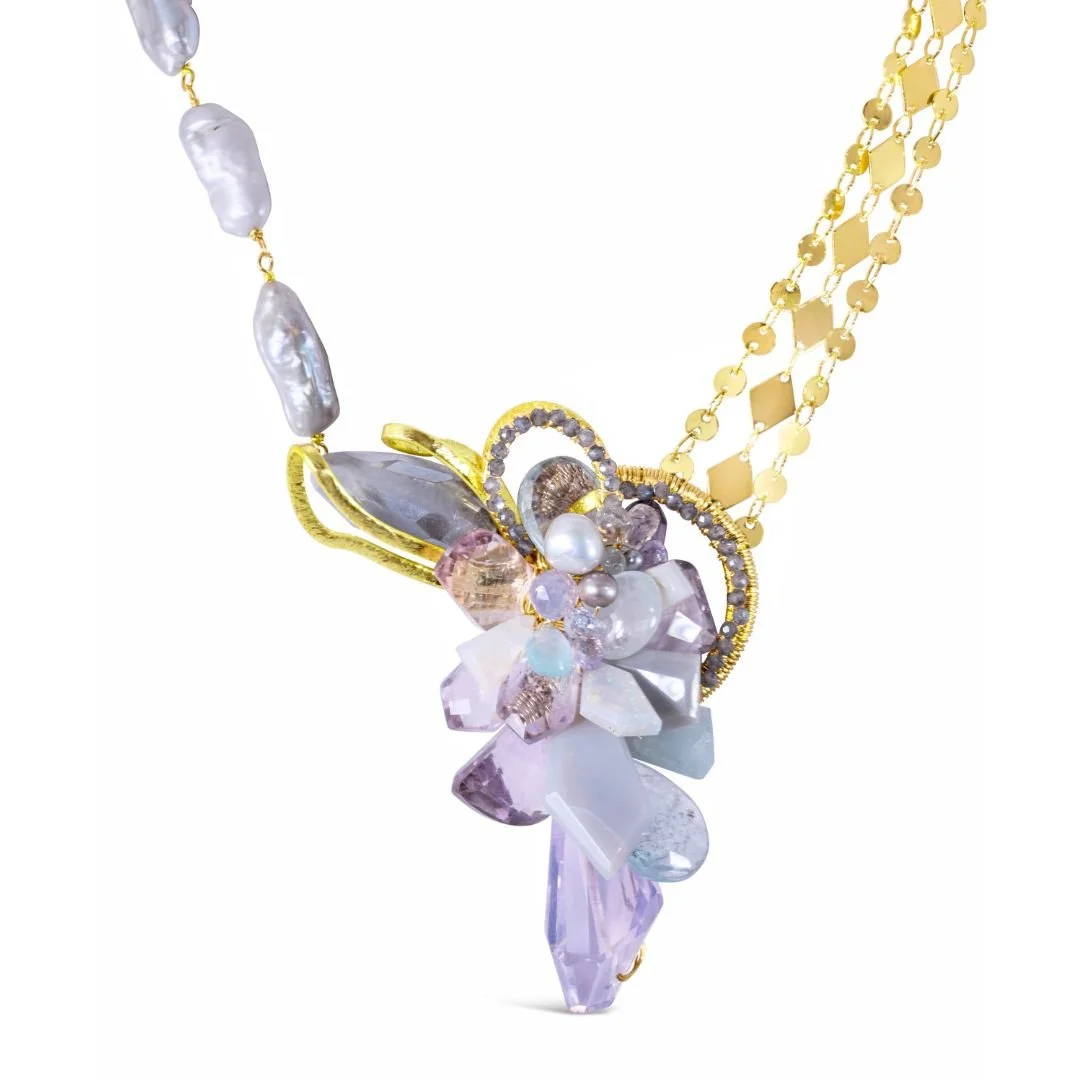
This pastel gemstone statement necklace marks the inception of the entire collection, the alpha in the journey of creative rebirth. Jewelry designer Andrea Li brought this wired necklace prototype to the Tucson gem show to hand-select and match gemstones, each chosen for their unique cut and expressive clarity. The piece sparked immediate reactions from fellow designers: “You’re crazy”—a compliment in the world of bold, boundary-pushing art jewelry.
Combining a Biwa pearl chain, shimmering Australian opals, and faceted scorolite with dramatic sequin and diamond-cut 14k gold-filled link chains, this necklace dares to challenge convention. Kunzite, mystic quartz, amethyst, and grey sapphires cluster at the center in an asymmetrical flourish, pushing the boundaries of what a statement necklace can be. Finished with recycled 14/20k gold-filled and 18k gold vermeil components, this piece is built to inspire, crafted not for mass appeal, but for collectors who crave original design with emotional resonance.
Materials:
Gemstones: Pale amethyst, Aquamarine, Australian Opal, Amethyst, Mystic Quartz, Kunzite, Zircon, Mystic Labradorite, Purple and Grey Sapphire
Precious Metals: Recycled 14/20k Gold-Filled Components, 14k Gold-Filled Diamond and Sequin Chains, 18k Gold Vermeil Elements, and 14k gold-filled Biwa Pearl Chain
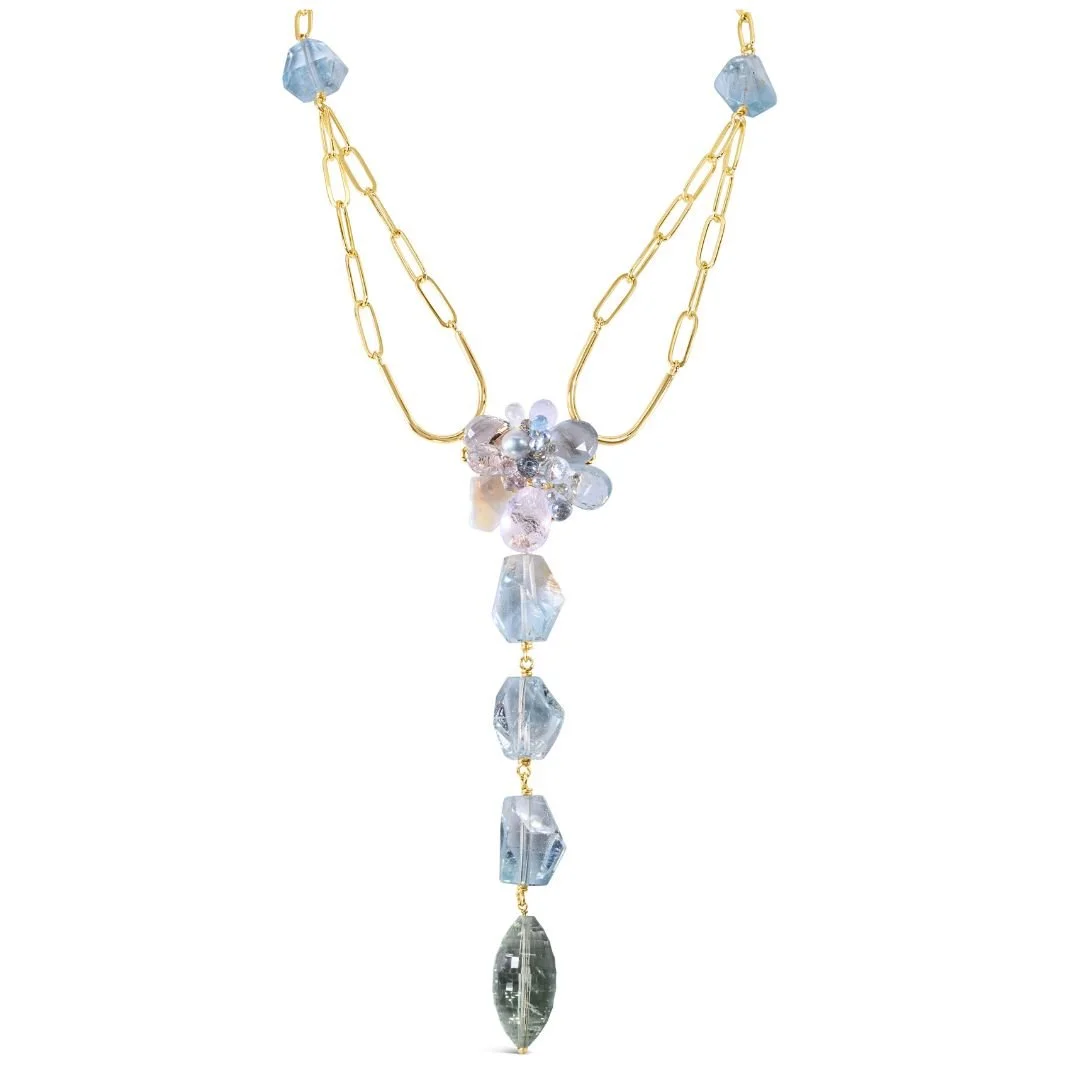
This pastel gemstone drop necklace is a masterclass in delicate balance and bold design. Featuring a prominent AAA-quality green amethyst concave olive gemstone, this statement necklace resolves in a cascading vertical line that draws the eye and elongates the silhouette. The sculptural gemstone cluster, anchored by Japanese Akoya Keshi Pearls, iridescent Australian opals, and yellow aquamarine, sits at the center of a recycled 14k gold-filled paperclip chain necklace, flanked by decorative U-shapes for added architectural presence.
The design emerged from a vision of symmetry and surprise. The artist, Andrea Li, utilized familiar materials in unfamiliar ways, creating a fresh design language that merges traditional craftsmanship with wearable sculpture. A key moment of inspiration was sparked at the Tucson gem show, where the topaz stones were selected for their luminosity and perfectly paired with the gemstone cluster to form a dramatic, yet refined drop necklace. This is a piece for collectors who appreciate jewelry that speaks in both whispers and declarations.
Materials
Gemstone: ***AAA Green Amethyst Concave Olive, Yellow Aquamarine, Aquamarine, Australian Opals, pale amethyst, Kunzite, Topaz, Mystic Quartz, Japanese Akoya Keshi Pearls, Purple and Grey Sapphires
Precious Metals: Recycled 14/20k Gold-Filled Paperclip and Circle Link Chains
*** AAA grade for a gemstone signifies the highest quality, characterized by exceptional color, clarity, and a precise cut. These stones are considered near-perfect and are among the top 10% of gemstones, with very few to no visible inclusions, vibrant color, and maximum brilliance.
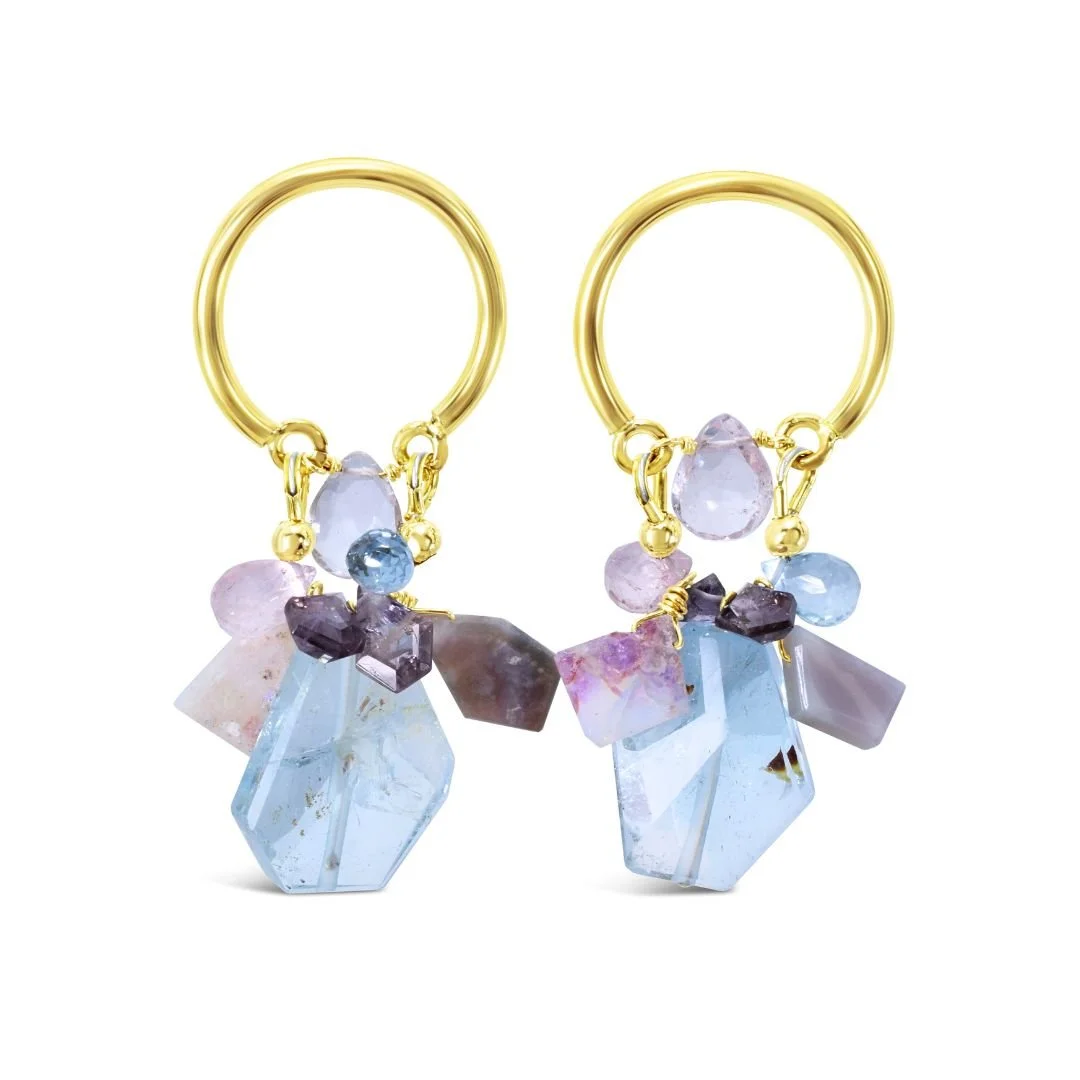
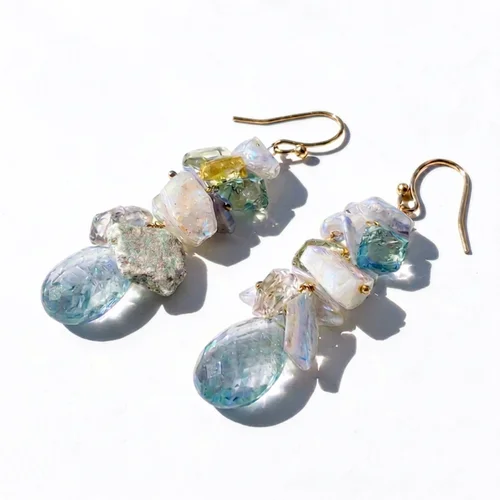
These one-of-a-kind gemstone dangle hoop earrings are an intentional echo of the pastel statement necklace featured in this collection. Handcrafted by artist and jewelry designer Andrea Li, these hoops were forged with care from 14/20k recycled gold-filled wire, reshaped into delicate circles with an airy openness that recalls the movement of the sequin chains in the coordinating statement necklace.
Each earring is accented with pastel-hued Kunzite, luminous aquamarine, Morganite, and Australian opal, carefully crimped into place using wire guardians and crimp covers, a technique Andrea used to avoid visual weight while maintaining artistic cohesion. The cluster is suspended just below the gold hoops, offering a subtle nod to her signature gemstone cluster earrings technique, but with a cleaner silhouette.
These dangle hoop earrings are wearable art for the collector who values originality, craftsmanship, and subtle luxury.
Materials:
Gemstone: Kunzite, Australian Opal, Spinel, Aquamarine, and Morganite
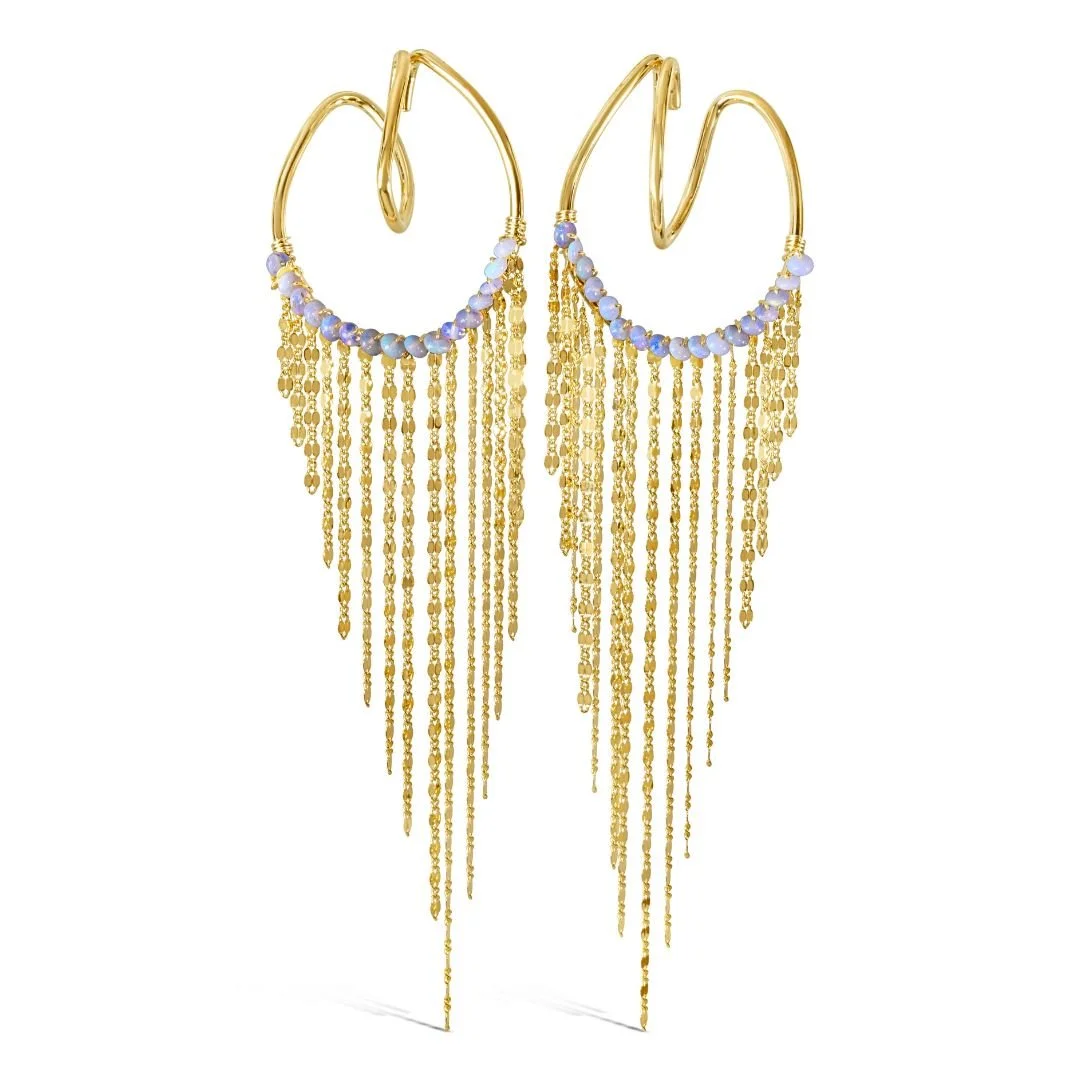
No piercings, no problem, these sculptural ear cuffs deliver high-impact glam without commitment. Inspired by ethereal lightplay, this pair fuses glimmering opal rondelles with a waterfall of 14k gold-filled sequin chains that shimmer with every turn.
Crafted by Andrea Li, this jewelry designer’s work draws on elements from her signature style, unexpected, romantic, and unapologetically expressive. The hoops are structured to hug the ear gracefully, while the dangle tassel earrings dance just at the jawline, creating captivating movement and energy. The chain tassels were sourced at the Tucson gem show, a favorite hunting ground for the artist’s rarest finds.
Wearers seeking unique statement earrings that combine modernity with softness will find these ear cuffs a dream. The opals catch the light with pastel flashes of teal, blush, and violet, like a candy-glazed rainbow whispering against the skin.
A Field Guide to Fire, Water, and the Most Delicate Stone I Set
Opal does not behave like other gems. It never grew into a crystal, it still holds water inside it, and it flashes with every color in the spectrum from a body that can be milky white, glassy, or midnight black. It is the most beautiful stone I work with, and the one I break the most. Here is what opal actually is, the kinds you will meet, and how to live with a stone this delicate.
What gives opal its fire
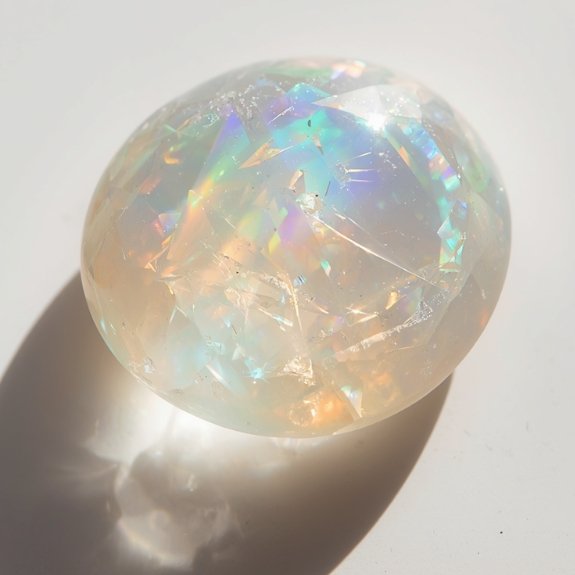
Hold an opal to the light and tilt it, and you see patches of color flash and shift across the stone: green, blue, violet, sometimes a rare and prized red. That is called play-of-color, and it is opal's signature.
It happens because opal is built from millions of microscopic spheres of silica, stacked in an orderly grid. When light passes through that grid, it bends and splits into its component colors, the same way a film of oil or a butterfly wing throws color without holding any pigment. The size and spacing of the spheres decide which colors you see. Tiny spheres flash blue and violet; larger ones reach all the way to orange and red, which is why red play-of-color is the rarest.
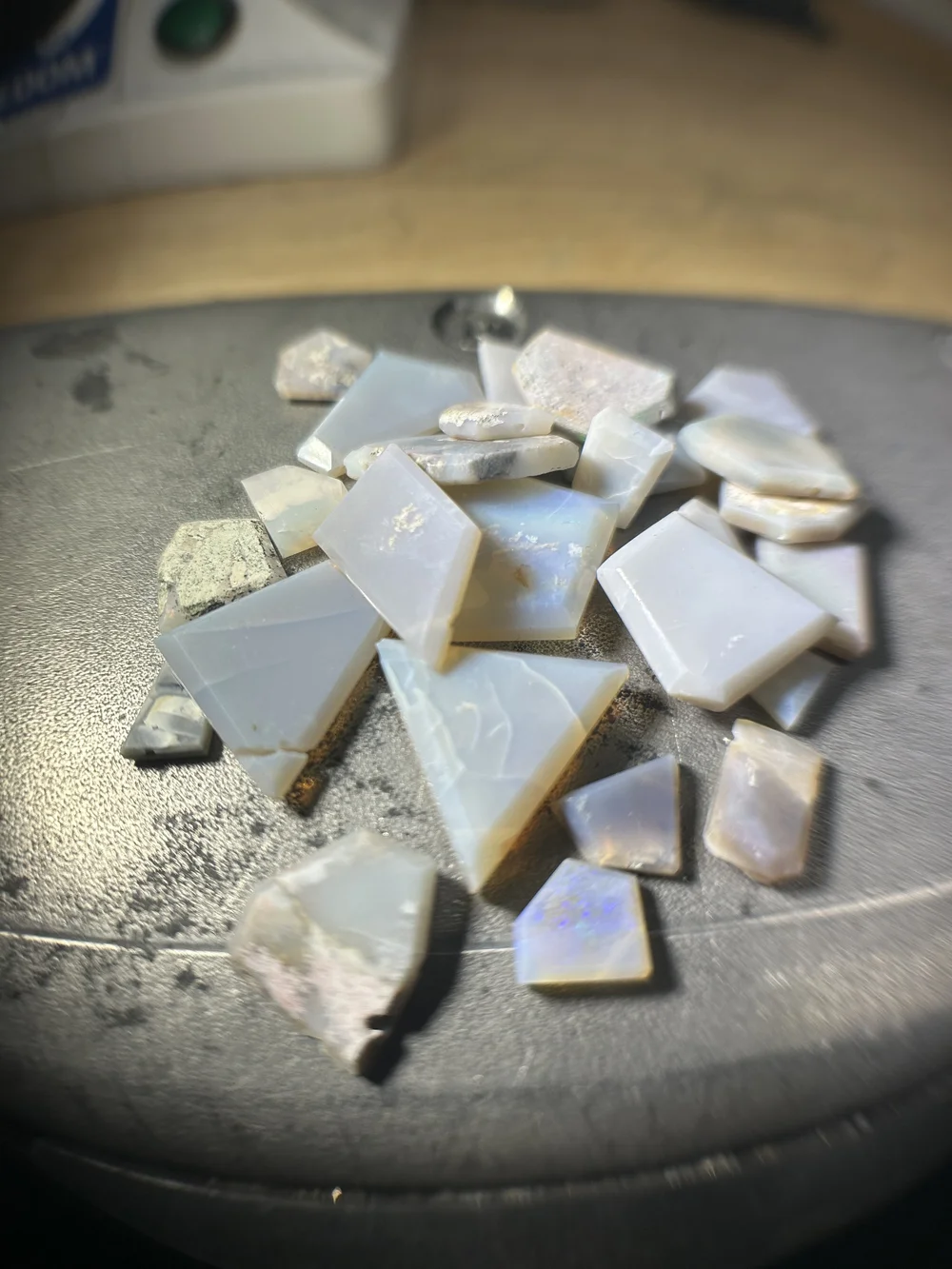
Not every opal does this. Plain opal with no play-of-color is called potch, or common opal. The stones I set are precious opal, the ones that catch fire.
“
It is the most beautiful stone I work with, and the one I break the most.
”
The kinds of opal
Opal is really a family of stones, and they behave so differently they are almost separate gems.
Type
Body
What sets it apart
Australian / white / crystal
Light to translucent
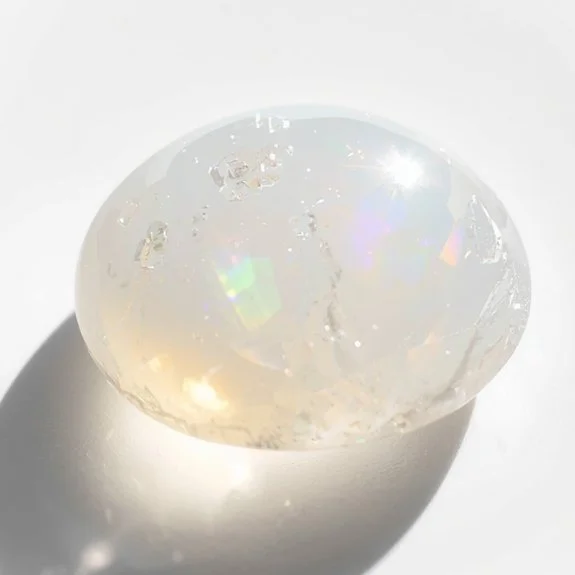
The classic. Pastel flashes on a pale or glassy body. Generally stable, not hydrophane.
Black opal
Dark gray to black
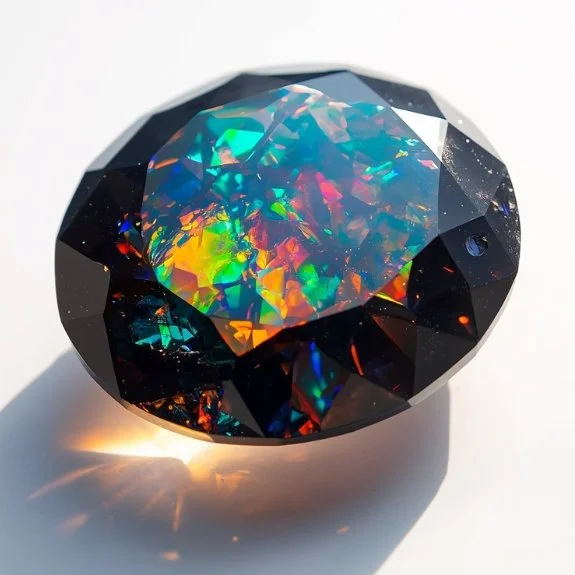
The most prized. A dark body makes the play-of-color blaze. Most comes from Lightning Ridge, Australia.
Boulder opal
Thin opal on brown ironstone
The opal is left on its natural host rock, so the dark backing gives black-opal drama in thin natural seams.
Ethiopian / Welo
Honey to colorless, often very bright
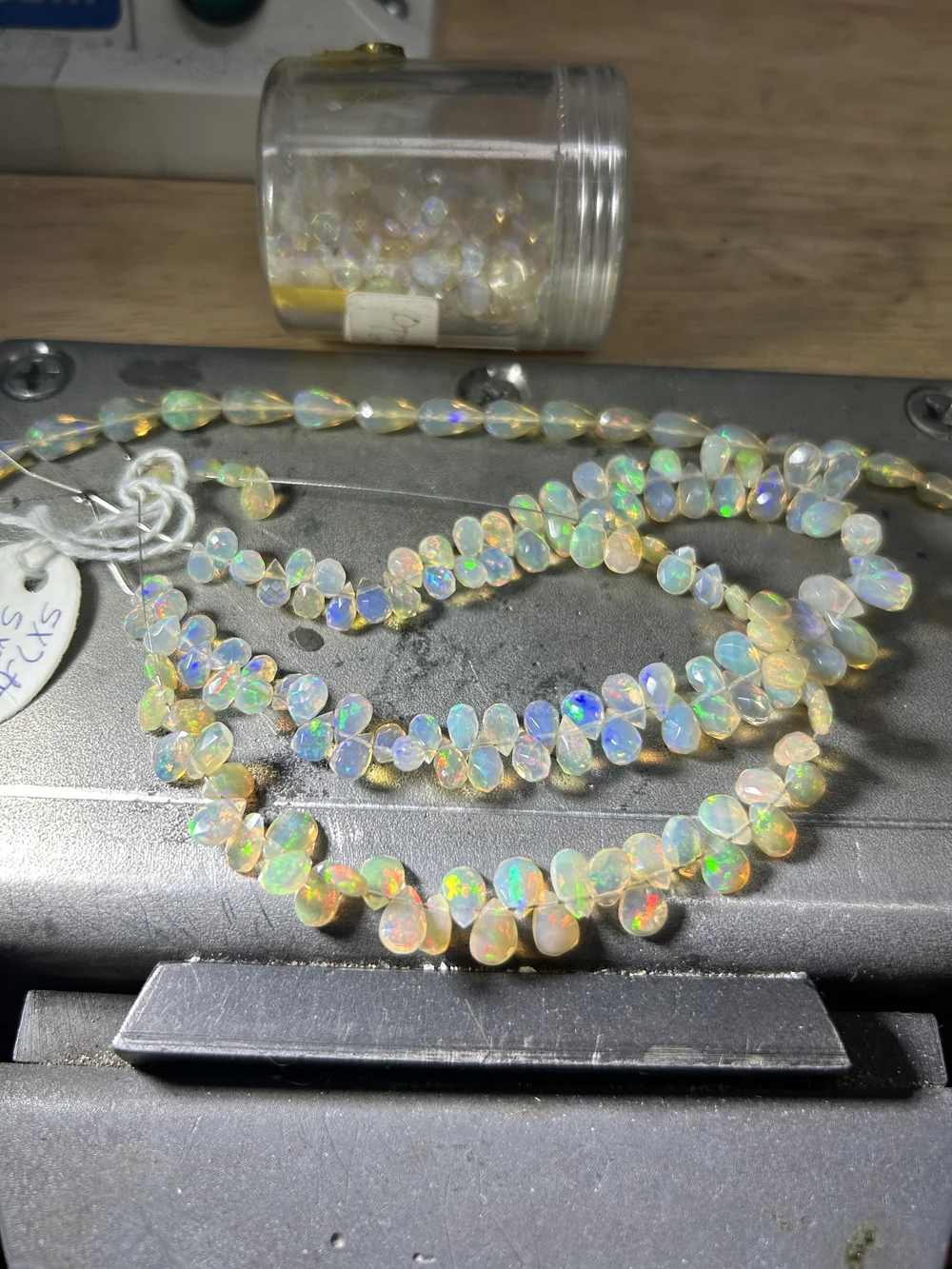
Vivid and more affordable, but hydrophane: it drinks in water and can turn clear or change color when wet, then returns as it dries.
That last property has a name worth knowing. Hydrophane opal, which most Ethiopian Welo is, is porous enough to absorb water and even oils. Get it wet and it can go temporarily transparent or shift color, recovering only once it fully dries. It can also drink in lotions, perfume, or dye and hold a stain, so a hydrophane opal asks for more caution than a stable Australian stone.
01
The mostdelicatestone I set
I will be honest with you: opal is the stone I break more than any other. It is soft, between 5.5 and 6.5 on the Mohs scale, and it is brittle, so it has very little tolerance for stress at a single point.
This is also why you will not find opal in every collection I make. It currently lives in my Pastel collection and a few Signature pieces, but it is not a staple the way amethyst, aquamarine, or sapphire are. When I use opal, it is a deliberate choice for a stone that earns its fragility.
02
Caring foropal
Opal needs more gentleness than almost anything else you own.
Keep it away from all heat and from sudden changes in temperature, which can shock the stone and cause crazing, the fine network of surface cracks opal can develop. Never put opal in an ultrasonic or steam cleaner. Keep it away from harsh chemicals, and with hydrophane opal, away from prolonged soaking, perfume, and lotion.
To clean it, I use the same gentle process I recommend for all my pieces: warm water, a soft toothbrush, and a drop of Dawn to lift away oils and dust, then the polishing cloth tucked into every order to bring the metal back. No heat, no chemicals, no shortcuts. Treated kindly, an opal will hold its fire for generations.
03
Wearingopal
Opal is the October birthstone, which makes it a meaningful choice for an autumn birthday, and tradition has long linked it with imagination and individuality, fitting for a one-of-a-kind piece.
Because it is delicate, opal is happiest in pieces that live a gentler life: earrings, a pendant, a brooch, a ring saved for occasions rather than everyday knocks. If you are drawn to a stone that is genuinely unlike any other, that holds a whole spectrum in a single cabochon, opal is for you. No two ever flash the same way.
From the bench · Andrea Li
Just how fragile opal is, ranked against what I set next to it
A note from Andrea Li, who sets opal by hand in her Denver studio.
People lump opal and moonstone together as the delicate stones. They are not in the same league. Opal is by far the more fragile of the two. I only learned how fragile when I started working it regularly, and I broke dozens of opals making my Pastel collection before it sank in.
That cost changed how I build. Now I never set opal the way I set everything else. With most stones I wind a cluster tight, because the tension is what makes the structure stable. With opal I do the opposite on purpose: I do not fully tighten the cluster. I leave intentional empty spaces, finish the surrounding structure first, and then set each opal last, individually, by hand, so nothing around it can stress it as it goes in. It is slower, and it is the only way I have found to keep October's stone in one piece.
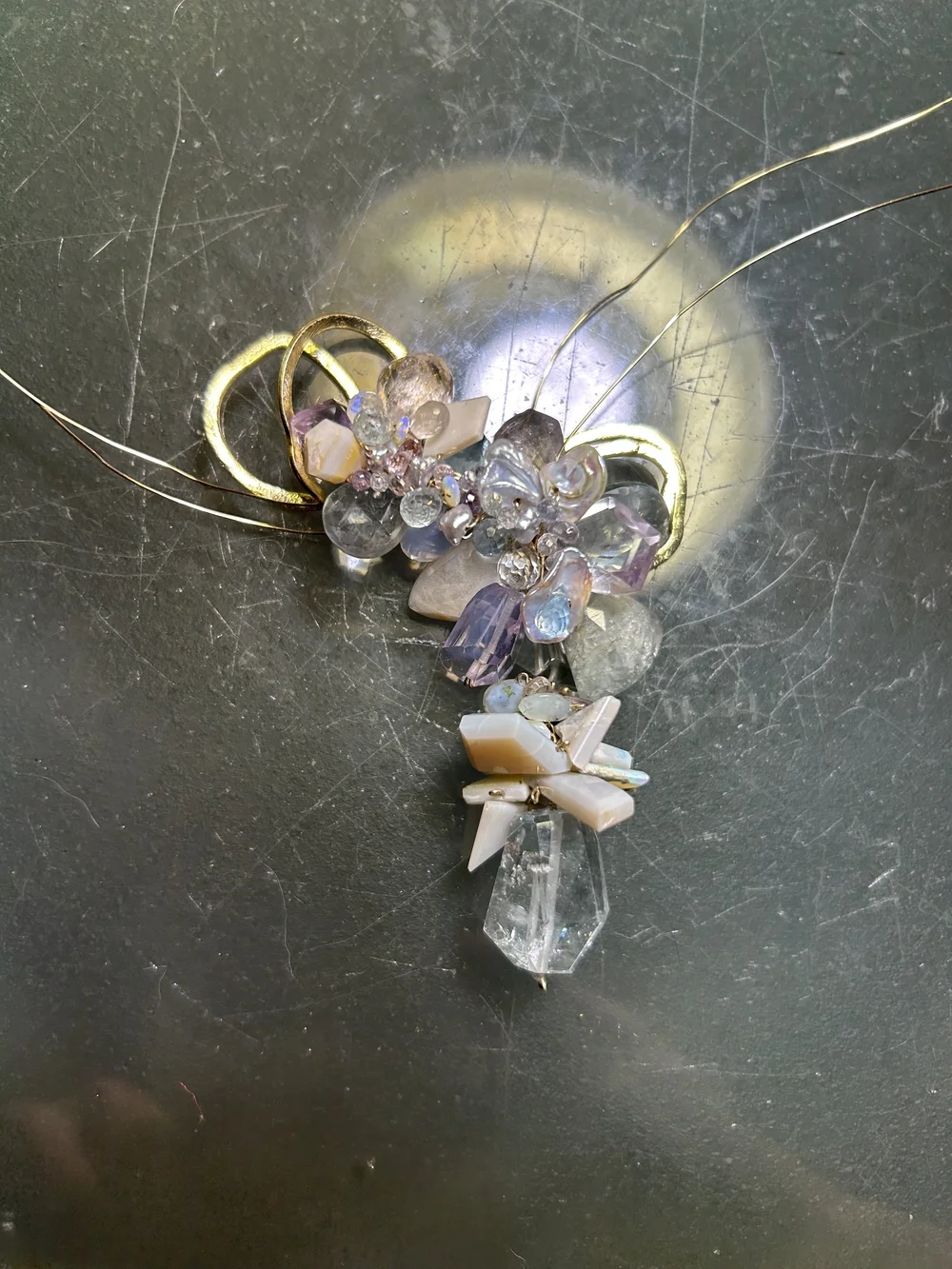
This one-of-a-kind Australian opal statement necklace is handmade by Andrea Li in her Denver studio: an asymmetric design built across multiple sterling silver chains and anchored by an Australian opal pendant.
Around the opal sits a hand-placed cluster of tanzanite, iolite, chalcedony, labradorite, mystic topaz, pink amethyst, natural sillimanite cat’s eye, purple amethyst, and pearl. The off-balance composition is intentional, designed to move and catch light from every angle. From the Signature Collection: built once, never replicated, never manufactured, made for a collector who wants something genuinely unrepeatable.
Opal is the most fragile stone I work with, and I learned that the hard way building my pastel collection, where I broke more than a few before I changed my approach. Now I set the opal last and seat it by hand, leaving deliberate give in the surrounding cluster so no single point of pressure ever reaches the stone. The whole necklace is cold-connected, assembled with wire and never with heat, which is what lets an opal anchor a piece this layered without putting the stone at risk.
One of a kind. When it sells, it’s gone. Explore more in the Signature Collection.
From the Signature Collection. A line born from pure artistic expression. Unbounded by rules or limitations of mass market appeal. These are meant for serious collectors. They are never to be replicated or manufactured. These works of art stand alone as originals. They are as authentic as their potential owners. These masterpieces require hours of intensive labor and thoughtful design. Each with a story unique to its development.
Your next heirloom piece awaits with my selection of unique wearable pieces of art. This Australian opal and gemstone cuff is an excellent piece of jewelry to add to your collection. It features a wide range of gemstones, including Australian opal, tanzanite, iolite, chalcedony, labradorite, mystic topaz, pink amethyst, Natural Sillimanite Cat's Eye, purple amethyst, and pearl.
A note from Andrea Li, who sets opal by hand in her Denver studio.
On the back of my work there is a weave, a web of wire I was told for years to hide and never could. It is the truest part of what I make, and I usually wind it tight, because the tension is what holds a cluster stable. Opal is the one stone that makes me set that tension down.
“
With opal I loosen the weave on purpose. It is the only way October's stone survives my hands.
People lump opal and moonstone together as the delicate stones. They are not in the same league. Opal is by far the more fragile of the two. I only learned how fragile when I started working it regularly, and I broke dozens of opals making my Pastel collection before it truly sank in.
So I changed how I build. With most stones I wind the cluster tight and let the tension do the work. With opal I do the opposite, on purpose. I do not fully tighten. I leave intentional empty spaces, finish the surrounding structure first, and set each opal last, by hand, so nothing around it can stress it as it goes in. It is slower, and it is the only way I keep October's stone whole. The weave still holds. It just learns, for this one stone, exactly where to loosen its grip.
Frequently asked questions
What is opal made of?
Opal is hydrated silica, which means silica with water still trapped inside it, sometimes as much as twenty percent. Unlike most gems, it never formed a crystal. It is hardened silica gel, which is part of why it is both so unusual to look at and so delicate to wear.
What is play-of-color in an opal?
Play-of-color is the flashing, shifting patches of color you see when you tilt an opal. It is caused by light bending and splitting as it passes through microscopic spheres of silica stacked inside the stone. The spacing of those spheres decides which colors appear, with red being the rarest.
Why do opals crack or craze?
Opal can develop a fine network of surface cracks, called crazing, usually from drying out, from heat, or from a sudden change in temperature. It is also brittle and can chip or crack from a sharp knock or from stress at a single point. This is why opal should be kept from heat, ultrasonics, and impacts.
What is a black opal?
A black opal is an opal with a dark gray to black body tone. The dark background makes its play-of-color look especially vivid and electric, which is why black opal, most of it from Lightning Ridge in Australia, is the most prized and valuable type.
What is Ethiopian or Welo opal?
Ethiopian opal, much of it from the Welo region, is known for very bright, vivid play-of-color at a more accessible price. Most of it is hydrophane, meaning it absorbs water and can temporarily turn clear or change color when wet, returning to normal as it dries. It needs more careful handling than stable Australian opal.
Is opal too fragile to wear?
Opal is soft and brittle, but it is absolutely wearable with care. It does best in pieces that take fewer knocks, like earrings, pendants, and brooches, or rings worn for occasions. Keep it away from heat, ultrasonic cleaners, and hard impacts, and it will last for generations.
How do you clean opal jewelry?
Use only warm water, a soft toothbrush, and a drop of Dawn dish soap to remove oils and dust, then a soft polishing cloth for the metal. Never use heat, steam, ultrasonic cleaners, or harsh chemicals, and avoid soaking hydrophane opal for long.
What color is opal?
An opal's body can be milky white, glassy, honey, or dark gray to black, and precious opal flashes every color in the spectrum across it: green, blue, violet, and sometimes a rare red. The body tone sets how vividly that color reads, which is why a black opal blazes. When I choose opals at the Tucson Gem Show, I look for brilliancy, the most vibrant flash I can find.
Discover
Jewelry that feels like you.
Two minutes. The quiz tells me how you want jewelry to feel in your life, and the messages that follow walk you through pieces I think you'll love.
Google now lets you choose your favorite sources so they show up labeled in AI search answers. If you enjoy discovering handcrafted gemstone jewelry here, add Andrea Li Designs and we'll be easier to find next time you search.
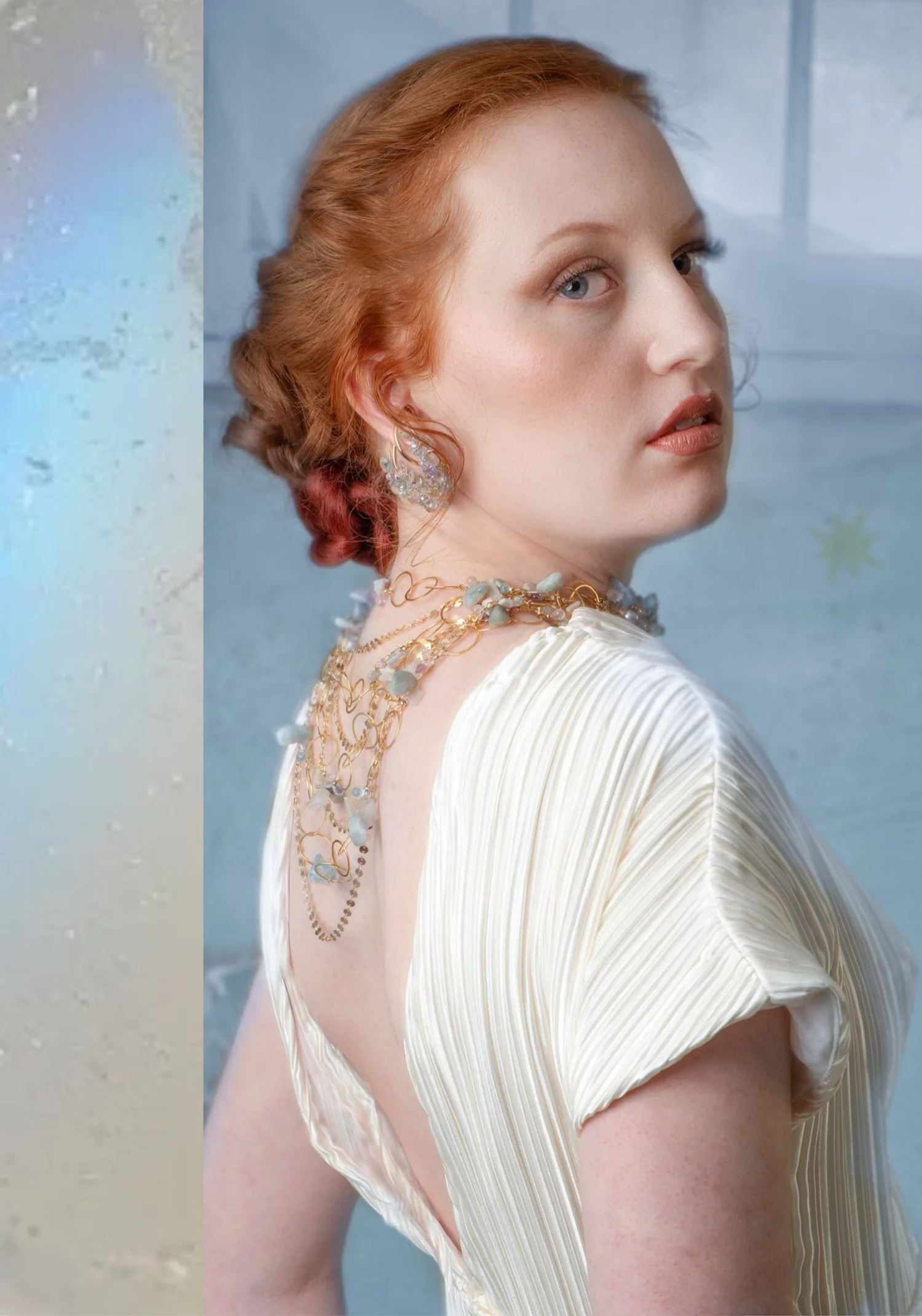


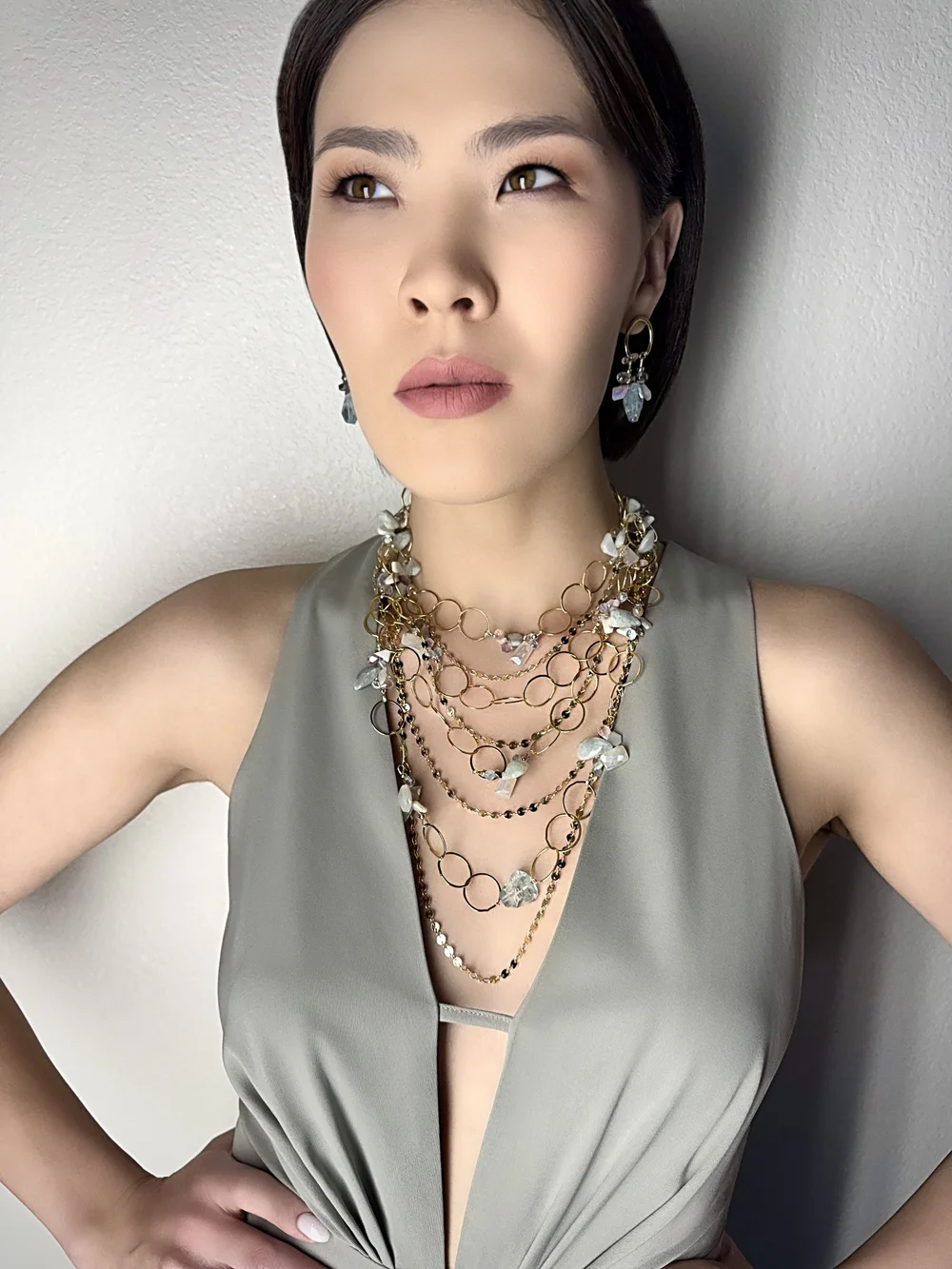


This one-of-a-kind Pastel Gemstone Multi-Strand Statement Necklace is handmade by Andrea Li in her Denver studio: a layered design built across multiple gold-filled chains and hand-composed from a soft, full-spectrum pastel palette.
The cluster carries Green Amethyst (Prasiolite), Aqua Hydro Quartz, Mystic Prehnite, Moonstone, Kunzite, Morganite, Yellow and Blue Aquamarine, Spinel, Topaz, Japanese Akoya Keshi Pearls, Australian Opal, and Green and Grey Sapphires. Every stone is set on recycled 14/20k gold-filled components, strung across 14k gold-filled sequin and circle link chains. The colors lead, not any single hero stone, and the strands are layered so the whole piece moves and catches light from every angle.
The necklace is cold-connected, assembled with wire and never with heat, which is what lets pearls and an opal share a single layered piece without putting either at risk. Opal is the most fragile stone here, so I seat it last and by hand, leaving deliberate give in the surrounding cluster so no single point of pressure ever reaches the stone. Keshi pearls get the same care: wire-seated, never glued, so they sit secure but unstressed.
One of a kind. Built once, never replicated, never manufactured. When it sells, it’s gone. Explore more in the Pastel Gemstone Jewelry collection.
• Moonstone
• Pastel Gemstone Jewelry collection
Materials:
Gemstones: Green Amethyst (Prasiolite), Aqua Hydro Quartz, Mystic Prehnite, Moonstone, Kunzite, Morganite, Yellow and Blue Aquamarine, Spinel, Topaz, Japanese Akoya Keshi Pearls, Australian Opal, Green and Grey Sapphires
Precious Metals: Recycled 14/20k gold-filled components, 14k gold-filled sequin and circle link chains
Read the story →