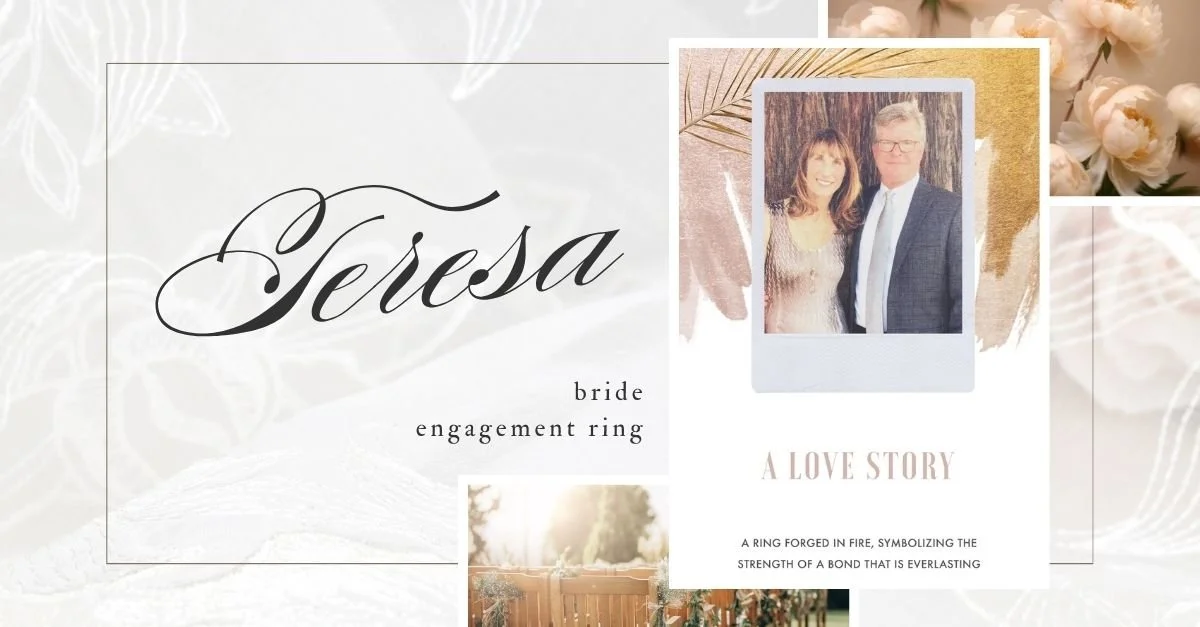
A custom engagement ring hand-carved from wax, cast in solid 14k gold, and set with 3.9 carats of champagne diamonds
This story hits close to home. The commission came from John, who at the time was dating my husband's mother. His first message was simple: he'd been thinking about rings. Could I make one by mid-February?
I told him to send over some ideas. Pinterest is a great place to start for inspiration. What followed was a months-long collaboration that became one of the most technically demanding and personally meaningful pieces I've ever made.
The stolen ring
Before I could carve anything, I needed Terri's ring size. There was just one problem: this was going to be a surprise.
I asked John if he could mail me one of her rings so I could size it, promising I'd send it back before she noticed it was gone. He was traveling in Albuquerque at the time ("Filming an episode of Breaking Bad, no doubt," I texted him. "Say hello to Bryan Cranston for me — we go way back.") and couldn't get to a ring right away.
When he finally measured, his first estimate was a size 8. That sounded big. I told him I needed to validate it with proper ring sizers at the academy. His response: "I'm off to the jewelry store with the stolen ring. Stay tuned!"
He came back with the answer: 7 to 7.5. I knew the design would be a wider band, and wider rings can get away with a slightly larger size, but for a thinner ring like this one, a straight 7 was the call.
The logistics of secretly sizing someone's ring while they're not looking is one of those behind-the-scenes moments that never make it into a product photo. But it's the kind of thing that makes a custom engagement ring feel like a conspiracy between the designer and the person who loves her.
Carved from wax, cast in fire
Most of my work involves wire-wrapping, fabrication, and gemstone setting at the bench. This ring required a different process entirely: lost wax casting.
I started by hand-carving the ring from a block of jeweler's wax, shaping the angular, geometric form one cut at a time. Wax carving is unforgiving work. There's no undo, no solder joint to reflow. Every facet of the ring's architecture had to be resolved in wax before it ever touched metal.
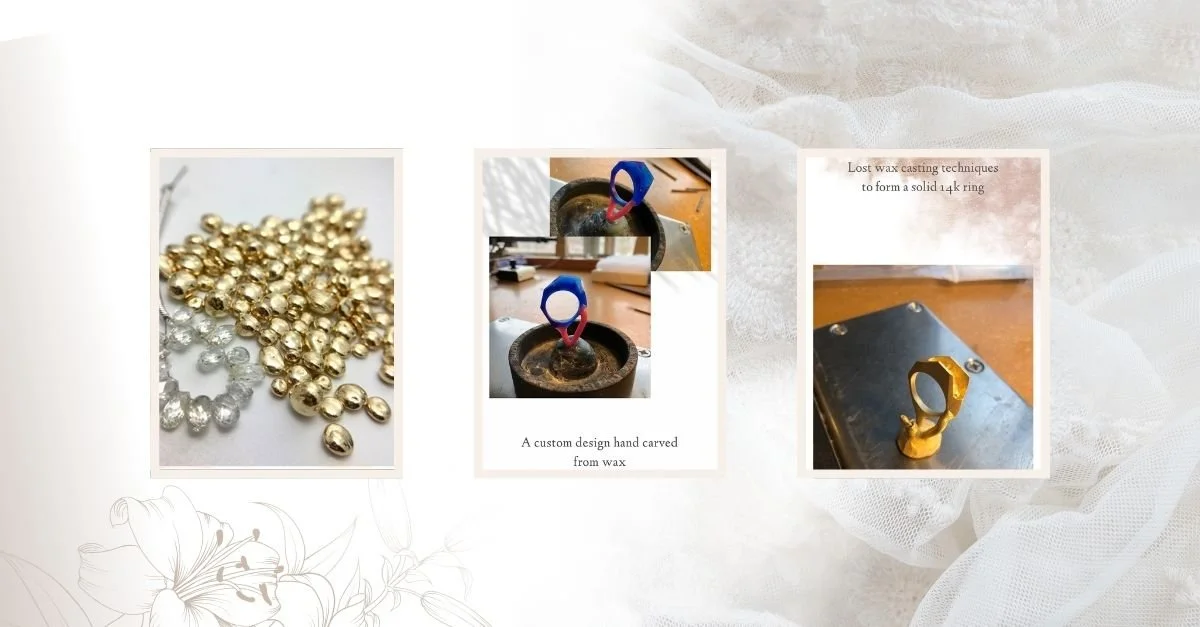
Once the wax model was finished, I cast it using the lost wax method, a technique that's been used for thousands of years. The wax original is encased in plaster, heated until the wax melts away, and then molten metal is poured into the void left behind. The wax is lost. The metal takes its place. What remains is a solid 14k gold ring, one continuous piece with no seams, no joins, no assembly.
I was studying metalsmithing at a local academy at the time, which gave me access to the casting equipment. The ring went from my hand-carved wax to a rough gold casting to a finished, polished piece, all under my hands.
The champagne diamonds
For the stones, I chose champagne diamonds: 3.9-carat C1-C2 grade briolettes that I'd sourced from one of my vendors at the Tucson Gem Show. Champagne diamonds have a warmth that white diamonds don't. They glow rather than flash. Against the angular geometry of the solid gold band, they softened the ring's sharp lines without diminishing its presence.
The diamonds are set in a crown formation at the top of the ring, clustered briolettes that catch light from every direction. The contrast between the sculptural gold architecture below and the organic diamond cluster above is what gives the piece its tension. It's structural and alive at the same time.
"Holy cow. Wow. I have no words."
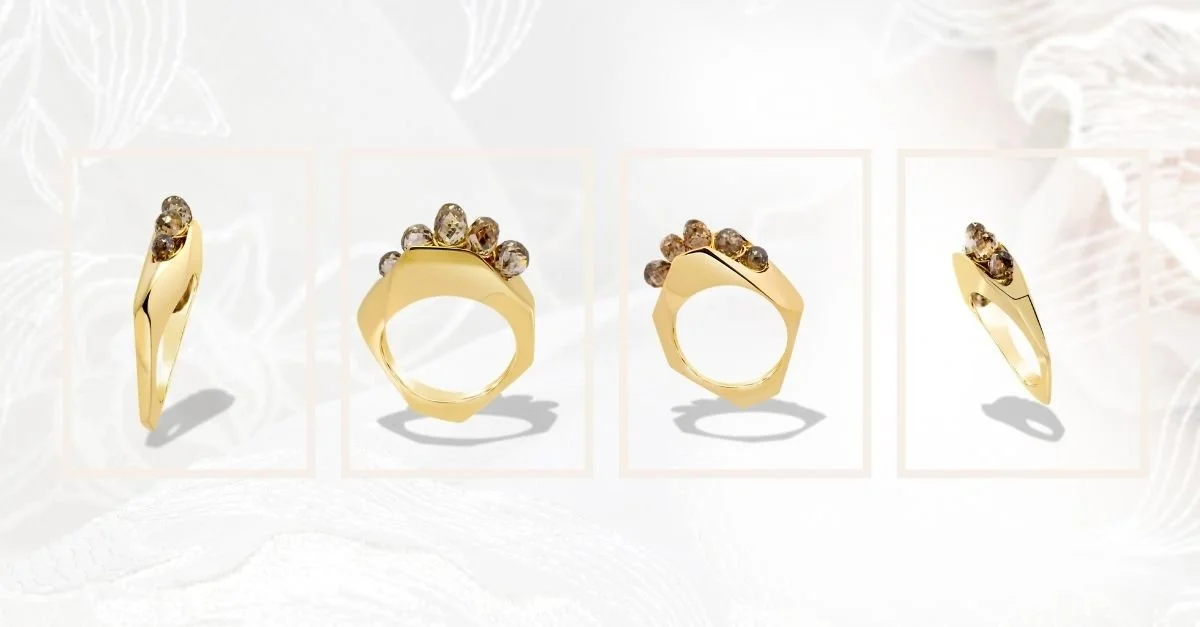
That was John's text when I sent him photos of the finished ring. Then: "Gorgeous!!" Then: "You are a love." Then a string of emojis that told me everything I needed to know.
I apologized that it had taken longer than expected, the project started before Valentine's Day, but I'd only had the bandwidth to finish it after. The ring never left my mind, though. I'd tried to incorporate a little mid-century modern into the design, and those champagne diamonds had turned out even more striking than I'd imagined against the angular gold.
John debated whether to show her the photos or wait and surprise her. He chose to wait.
A few months later, I was in San Francisco for my Pinterest presentation at their headquarters. My husband and I stayed with John and Terri. The ring was on her finger. The ceremony, intimate and lovely, happened shortly after.
Seeing my work on the hands of someone in my own family, at their wedding, knowing the weight of what that ring represents to them, is a different feeling than shipping a piece to a client across the country. It's closer. It stays with you.
What this piece represents
I don't currently offer lost wax casting as a standard service; the equipment lives at the academy where I studied, and my practice has evolved in other directions since then. But this ring is proof of what's possible when the commission demands it: hand-carved wax, solid gold casting, diamond-grade gemstone sourcing, and the kind of structural design that most independent jewelers send out to a casting house.
Every piece I make is built by my hands. Sometimes that means wire and gemstones at the bench. Sometimes it means carving wax and pouring molten gold. The method follows the vision, not the other way around.
The piece: Eternity Circle, solid 14k gold ring, hand-carved wax casting, 3.9 carats C1-C2 champagne diamond briolettes. The process: Wax carving → lost wax casting → gold finishing → diamond setting. The occasion: A love story, symbolizing the strength of a bond that is everlasting
Every piece Andrea Li makes is one of a kind. If you have a vision that requires something beyond what you've seen before, get inspiration for your project or fill out the form to start a conversation.
Love What You See? Keep Finding Us.
Google now lets you choose your favorite sources so they show up labeled in AI search answers. If you enjoy discovering handcrafted gemstone jewelry here, add Andrea Li Designs and we'll be easier to find next time you search.
Add Andrea Li Designs as a Preferred SourceOne click. Works across Google Search, AI Overviews, and AI Mode.