ANDREA LI

LIMITED COLLECTIONS

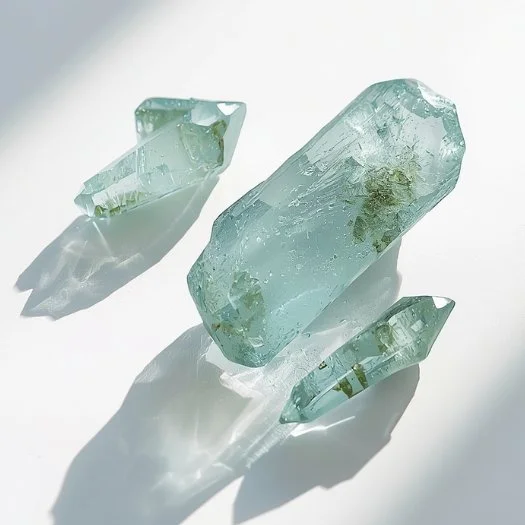
aquamarine

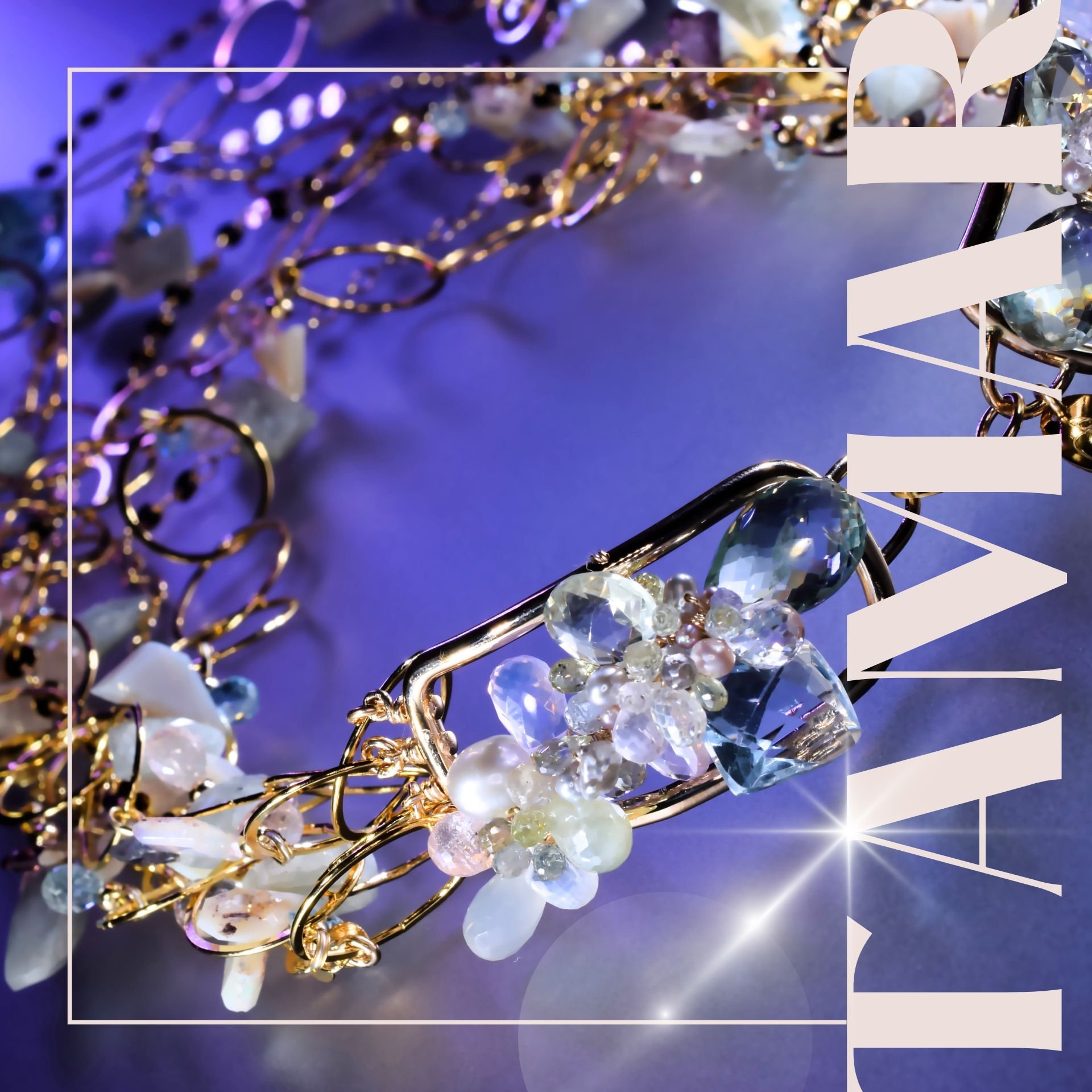
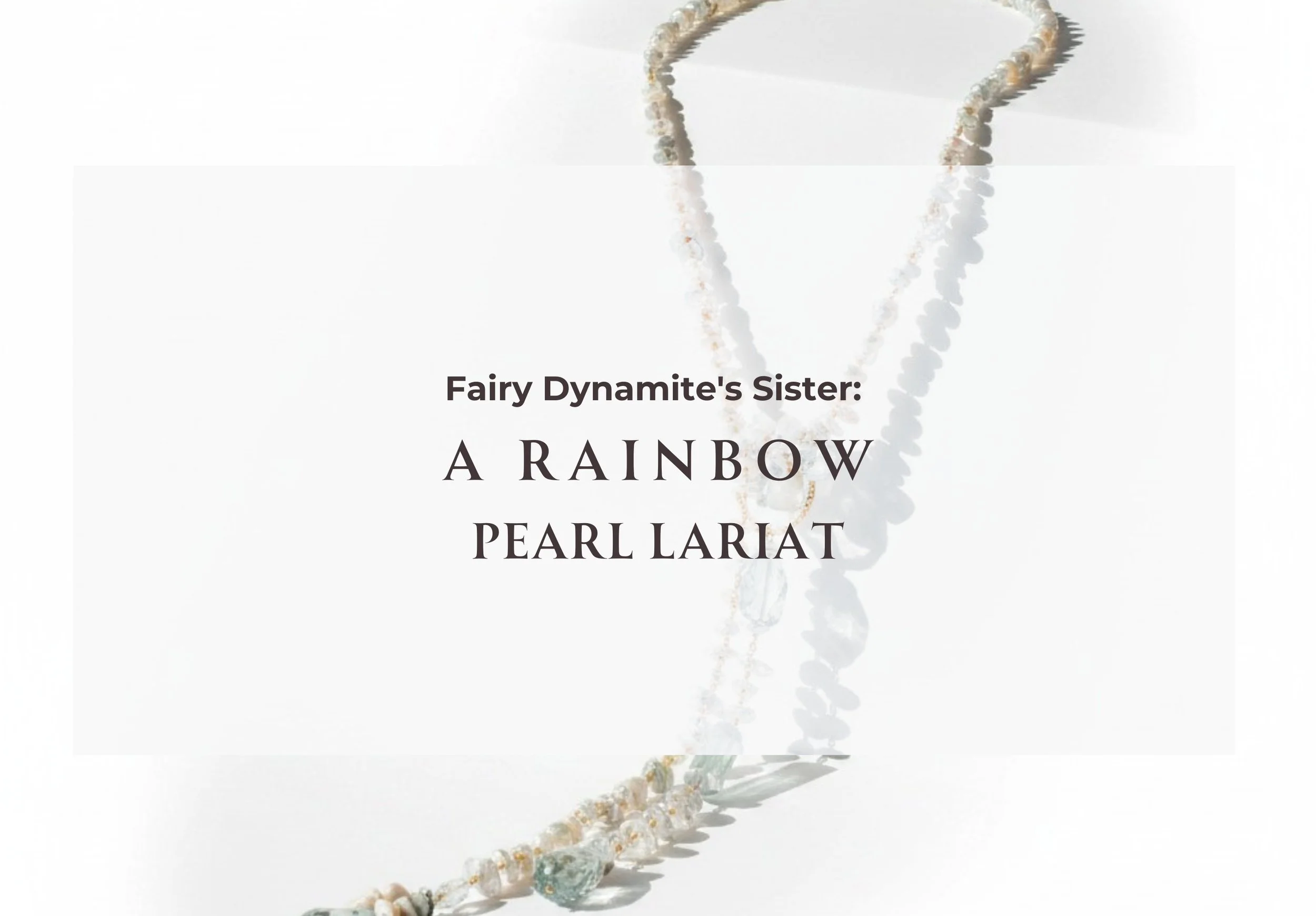
Fairy Dynamite's Sister: A Rainbow Pearl Lariat

Tamar: Second LightAndrea Li

Every necklace in this collection picks up where the last one left off, and this one began with what Fairy Dynamite did not use.

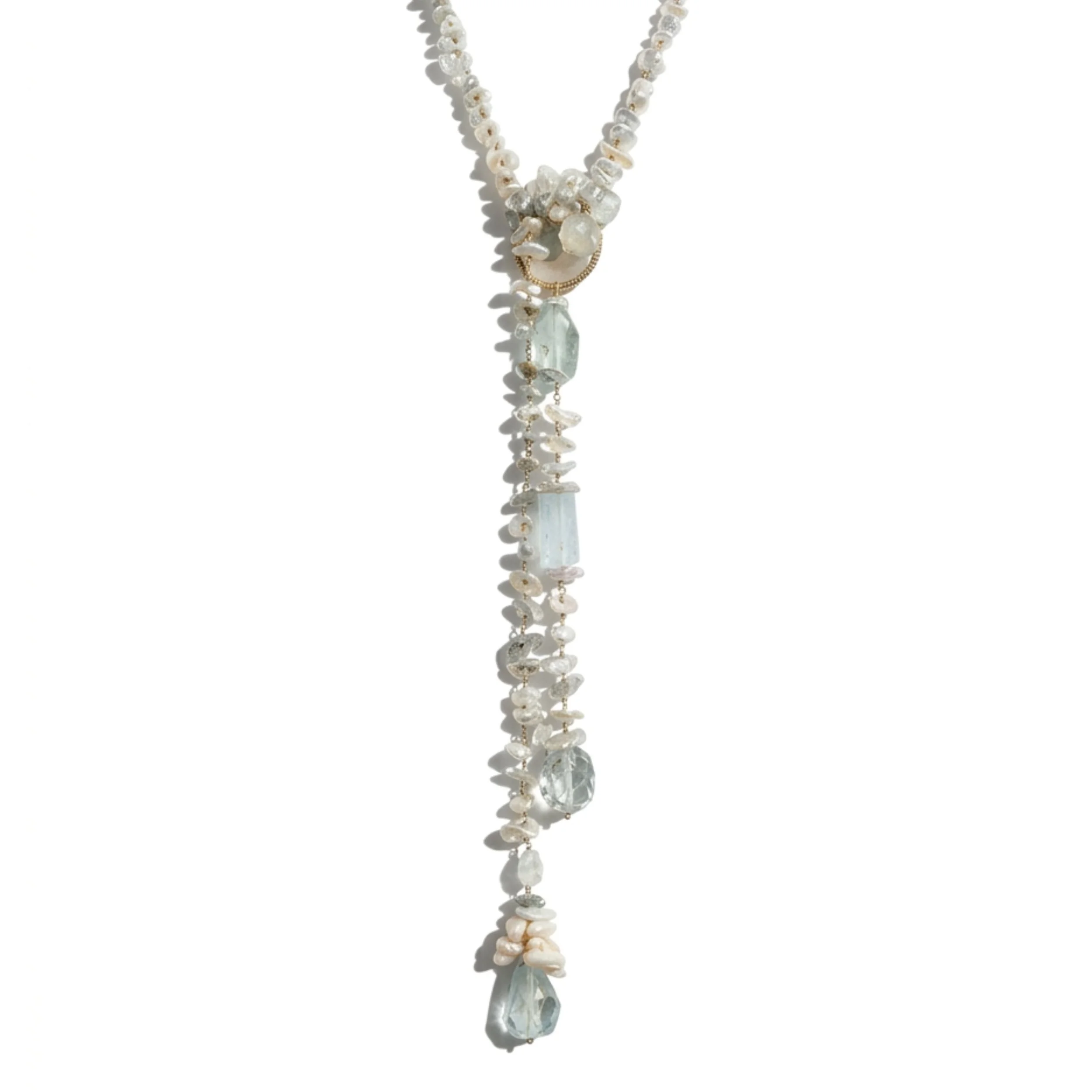
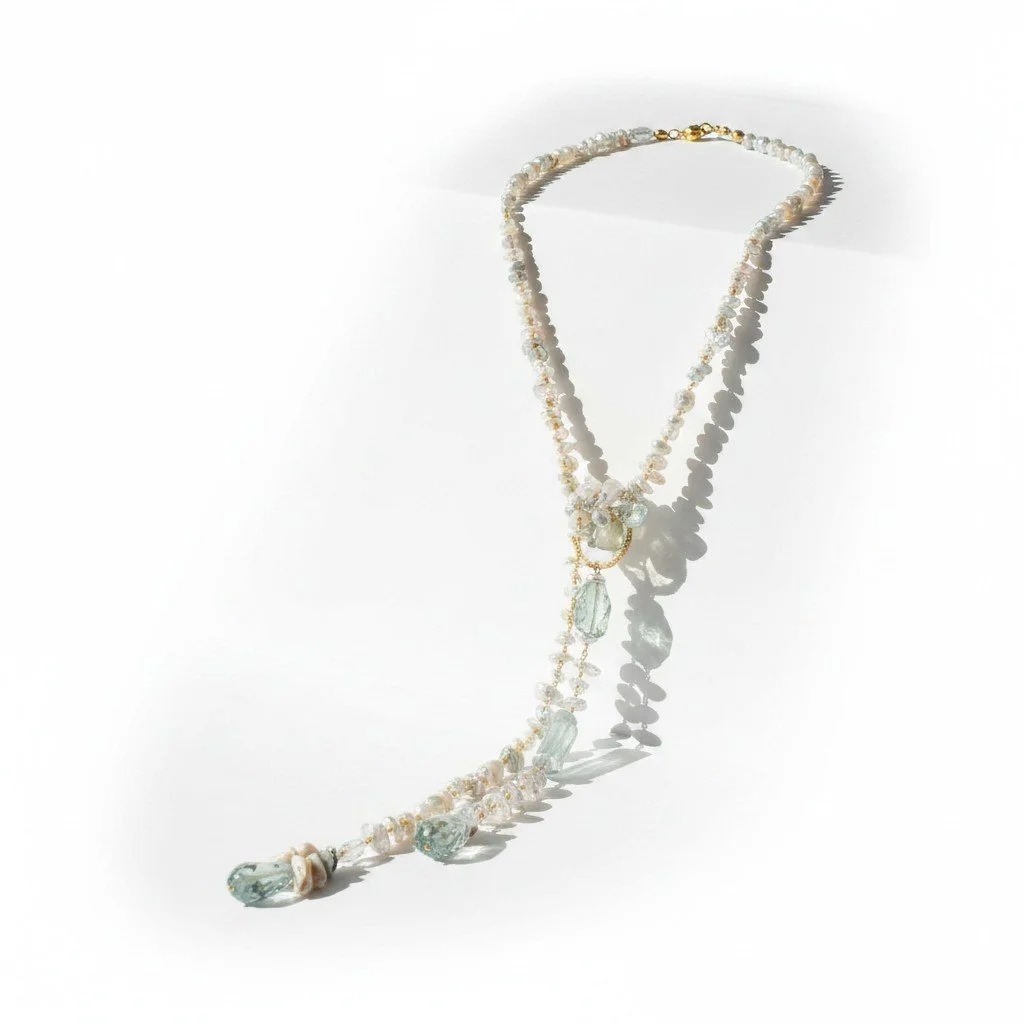
When I finished Fairy Dynamite, I still had a length of hand-bailed pearl chain left over, bought at the Tucson gem show for this collection. It is a soft, light grey, with a subtle rainbow iridescence riding across it, exactly the palette to mirror the pastel stones I had been working with. I did not want to repeat Fairy Dynamite. I wanted a sister to it, something from the same world spoken in an entirely different voice.

A different shape for the same family

This time I reached for a lariat, the kind of necklace that threads through itself and falls in a long, easy drop. And I wanted to build it around another 24k gold vermeil oval, the same component family that runs through this whole collection.

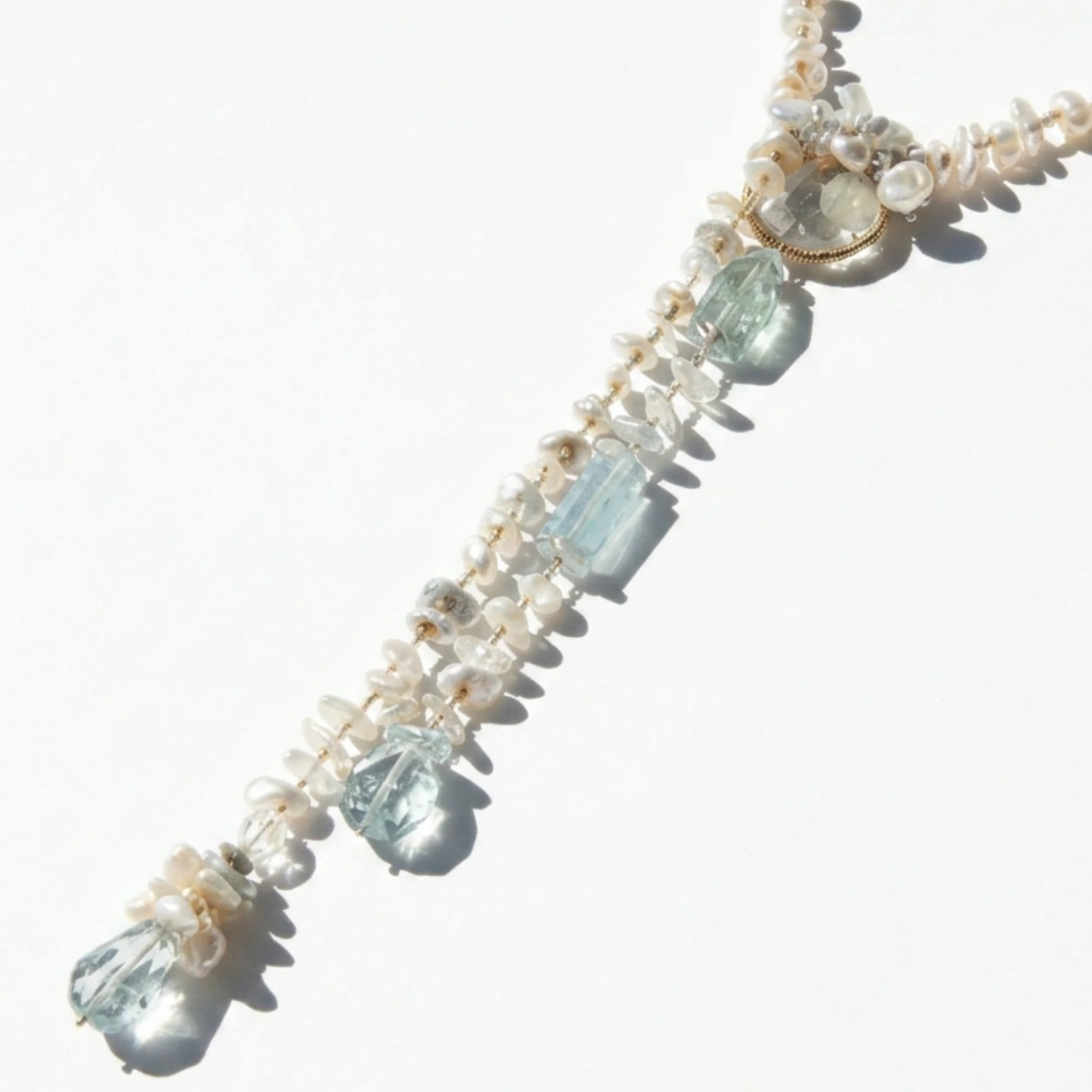
The pearl chain would pass through the oval and loop back on itself, so the oval became the heart of the design. I built a gemstone cluster right into it, gathered around larger center stones: blue topaz, green amethyst, and kunzite. Then I edged the oval with tiny sparkling mystic labradorites to give it a finished frame.

Gemstone science: the delicate one

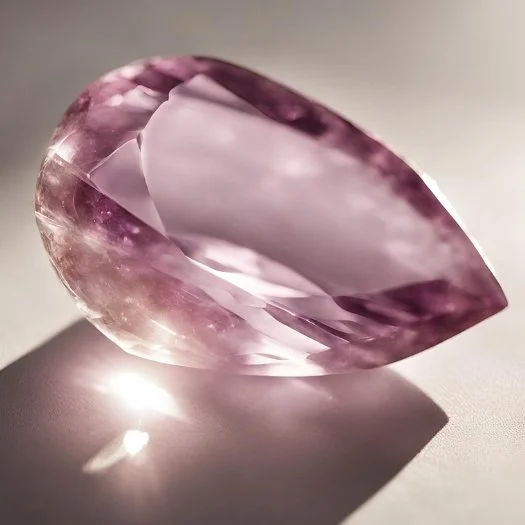
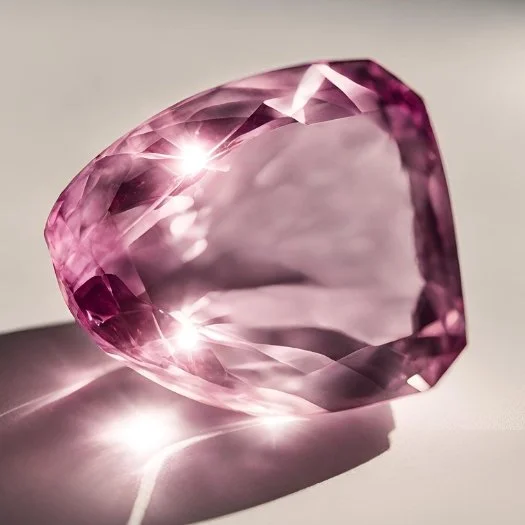
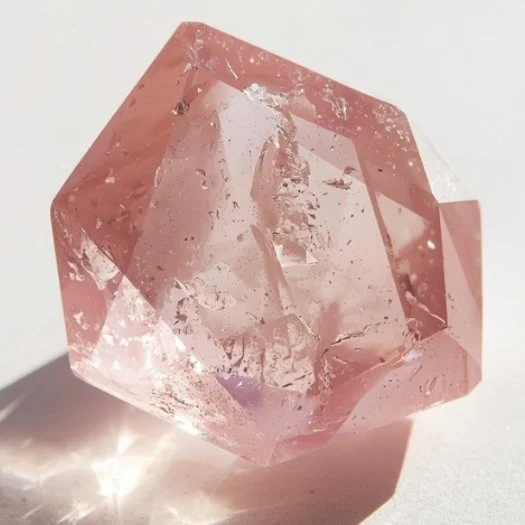
Kunzite is the quiet risk in this piece. It is a pink-to-lilac variety of the mineral spodumene, and it is pleochroic, which means it shows you different colors from different angles, soft pink one way and a hint of violet another. It also has what gemologists call perfect cleavage, a built-in plane where the crystal will split cleanly if it is struck wrong. That makes kunzite one of the more delicate stones I set, and one of the most rewarding when it is handled gently.
The piece inside the piece

There is a thread of continuity here that I love. The tassel at the end of the looped pearl chain is an old ear-cuff component whose twin lives inside Fairy Dynamite. Two halves of the same forgotten pair, finally finished, in two sister necklaces.

I thought I was done. Then I hung the whole thing up, and the clustered oval sat crooked, tilting in a way no amount of adjusting would fix. It simply needed weight to pull it straight.

So I built a second drop to give it that weight: two large blue topaz pieces and a single simple-cut aquamarine nugget, each one capped with a pearl cut from the same chain, and spaced with short lengths of that pearl chain between them. The new drop fell into perfect alignment beside the lariat's own drop, and the oval finally hung straight and true. It was meant to be invisible engineering. Instead it became the part people notice first. The necklace needed that second drop, and I had not even known it.
Why this one is one of a kind

A lariat made from a leftover length of chain that exists in no other piece. A tassel that only carries meaning because its other half is in another necklace. A second drop that was never planned, born because a finished piece refused to hang quietly. This is what one of a kind really means. Not just that I made one, but that the piece could only have become itself through the exact small accidents that built it.

It is Fairy Dynamite's sister, and like all sisters, entirely her own.

The Matching Earrings

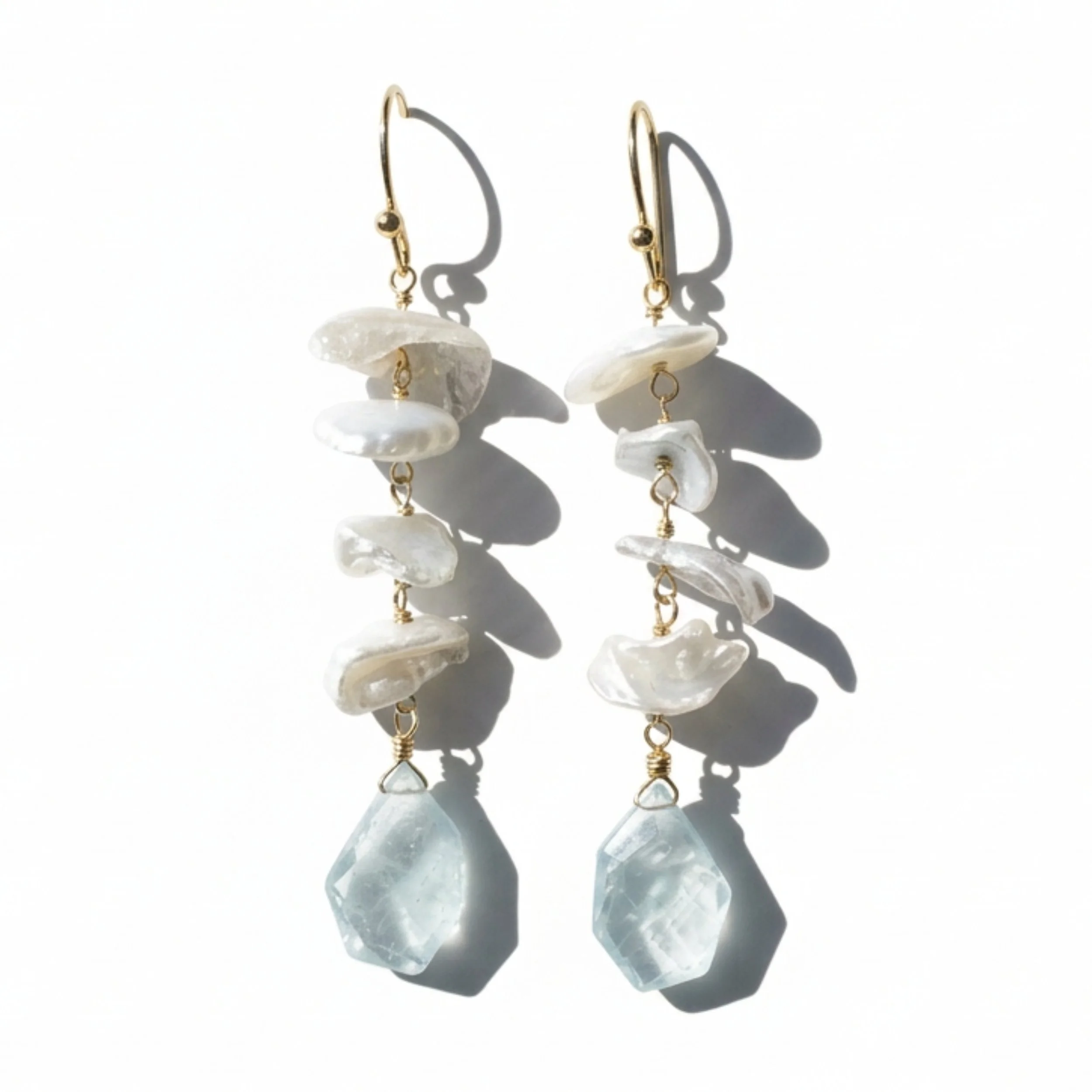
I make a coordinating pair of earrings for every necklace in a collection, meant to be worn together or apart. The lariat is a long, quiet statement, so its earrings had to stay out of its way. Rather than compete, I kept them simple: a small gemstone drop of aquamarine crown-cut beads that accents the minimal, opera-length spirit of the necklace without ever shouting over it.
Questions

What is kunzite?
Kunzite is a pink to lilac variety of the mineral spodumene. It is pleochroic, meaning it shows different colors from different angles, and it has perfect cleavage, a built-in plane where the crystal can split if it is struck wrong. That makes it one of the more delicate stones to set.
What is a lariat necklace?
A lariat is a long, open-ended necklace that threads through itself and falls in a long drop rather than fastening with a clasp.
Is this piece one of a kind, and can I commission something similar?
Yes. Each piece is made once. If you would like something in the same family, you can begin a commission through the custom shop.

Discover

Jewelry that feels like you.

Two minutes. The quiz tells me how you want jewelry to feel in your life, and the messages that follow walk you through pieces I think you'll love.

Take the Style Quiz

Two minutes. I take it from there.

Stay Close

Love what you see? Keep finding us.

Google now lets you choose your favorite sources so they show up labeled in AI search answers. If you enjoy discovering handcrafted gemstone jewelry here, add Andrea Li Designs and we'll be easier to find next time you search.

Add Andrea Li Designs as a Preferred Source

One click. Works across Google Search, AI Overviews, and AI Mode.
The Ovals That Found a New Home: A Vermeil Collar Necklace

Tamar: Second LightAndrea Li
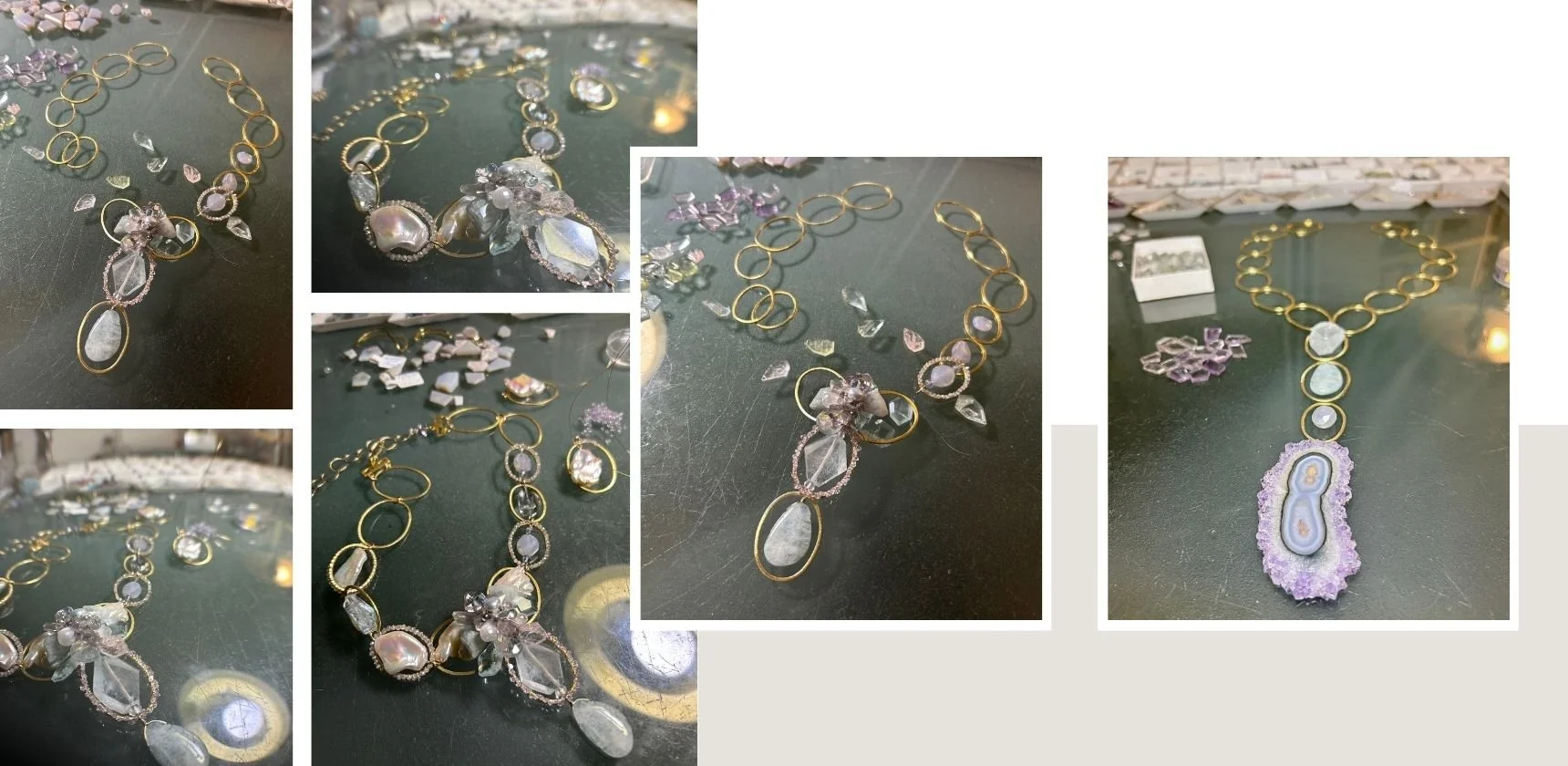
Close-up of a pastel gemstone necklace in progress, arranged on a jeweler’s workbench with softly scattered stones and gold findings.

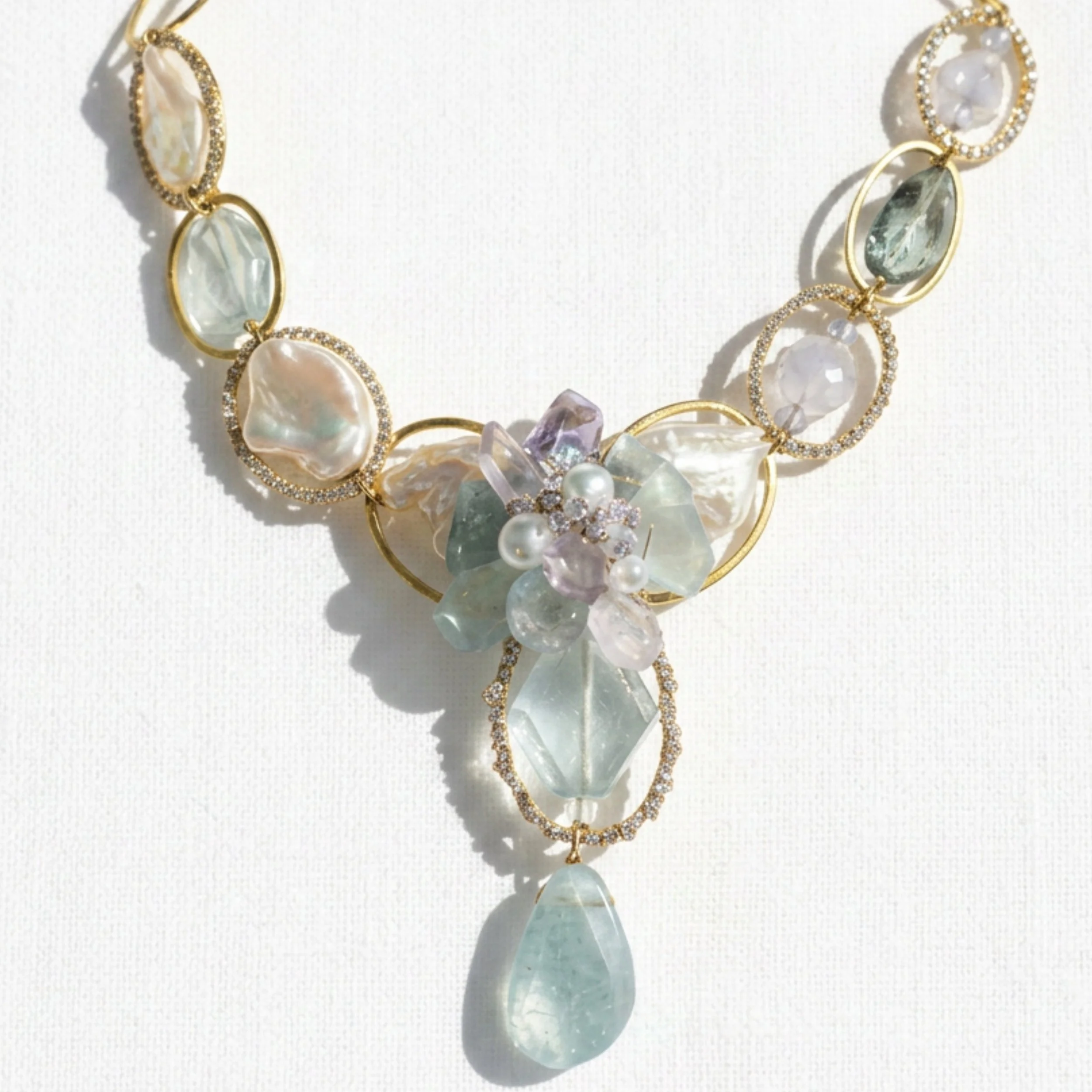
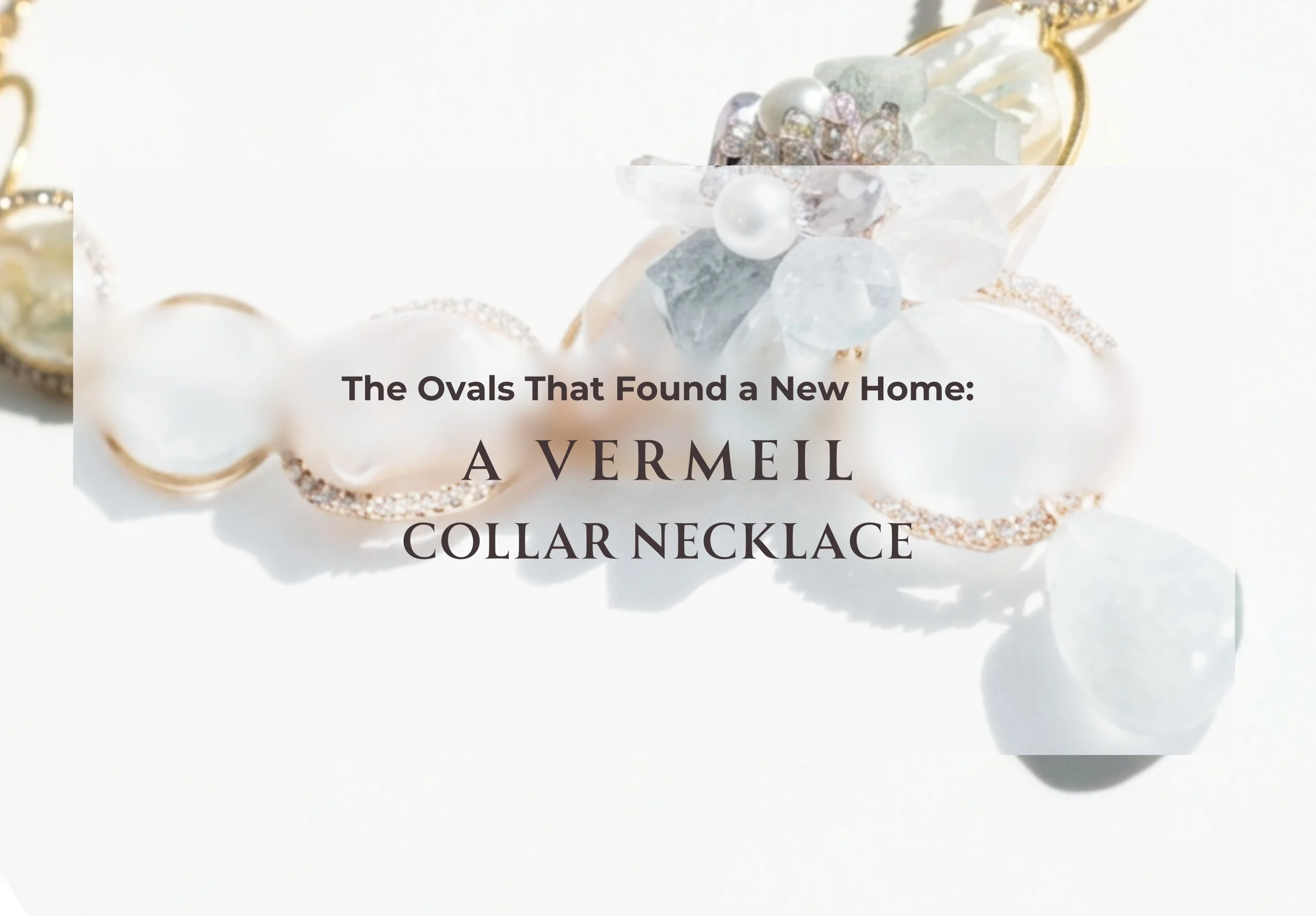
This necklace started with a box of gold ovals that were never meant to be mine.

A fellow jeweler had been sitting on a large inventory of 24k gold vermeil ovals. She had bought them for her best-selling design at the time, a boho earring called Feather Leathers, where custom-cut leather hung whimsically from the ovals with gemstones draping below. Then she pivoted her whole business to custom engagement rings and retired the earrings for good. The ovals had nowhere to go. I took a number of them off her hands, because I cannot watch a beautiful material go unused, and I knew they would find a home in my one-of-a-kind work.

I just had to figure out what that home was.

Finding the shape

I played with the ovals for a while, arranging and rearranging, until a pattern emerged that wanted to be a collar. A collar sits differently than my usual asymmetric pieces. It asks for symmetry, for a center that anchors everything, so I knew from the start it needed a cluster at its heart.

I was excited, because I had just bought something perfect to build that cluster around: strands of Mixed Beryl crown-cut beads, tiny faceted geometric stones in aquamarine, morganite, and heliodor.

Gemstone science: one mineral, three colors

Here is something I love about those beads. Aquamarine, morganite, and heliodor are all the same mineral, beryl. The color is the only thing that separates them: aquamarine is beryl tinted blue by iron, morganite is beryl blushed peach by manganese, and heliodor is beryl warmed to yellow. So a single strand of them is one stone wearing three moods, which makes them a quietly perfect foundation for a cluster where color is meant to lead.

The part the stones decided

I had a grand plan for the center, and the stones talked me out of it.

The first idea was dramatic: a large amethyst stalactite slice suspended from a cascade of ovals dropping from the center point, turning the collar into an opera-length statement. I built toward it, but the proportions never came right. The drop fought the collar instead of flowing from it. So I let the grand version go and kept it simpler, a single graceful drop instead of a cascade.

Then the beryls fought me too. The first two crown-cut beads I tried to wire in snapped under the tension. They are lovely but delicate at that tiny size, so I changed my whole order of operations. I built the cluster's structure first with sturdier stones to set the shape, then threaded the fragile beryls in one at a time, after the framework could protect them. A stone always teaches you how it wants to be handled. You just have to listen before you have broken two.

Building outward

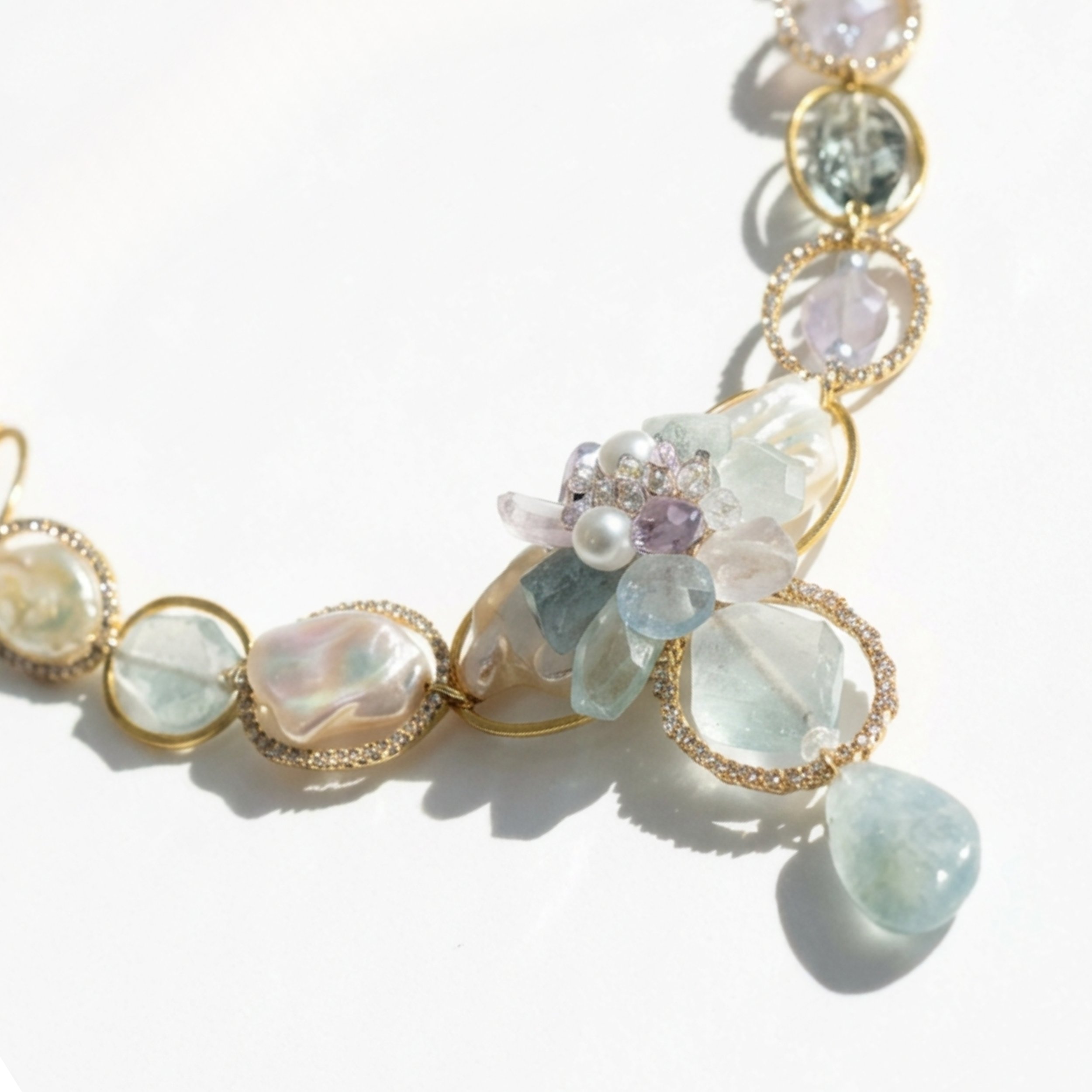
With the drop simplified, I framed a large aquamarine nugget inside the central oval, edged that oval with tiny sparkling purple Herkimer diamonds, and secured the cluster to both the drop and the two ovals flanking it.

I had meant to leave those flanking ovals open, but once the cluster and drop came together, the empty space inside them looked unfinished. So I reached for baroque pearls shaped almost like little angel wings and let them extend the cluster outward on either side, filling the openness with movement. That accident of proportion became one of my favorite parts of the piece.

From there I set a rhythm down the length of the collar: ovals edged in 3mm mystic labradorite beads with gemstones threaded through the center, alternating with open ovals each holding a single larger stone. One held a blue topaz, the next a copper aquamarine, chosen because they echoed each other in size, shape, and watery color. I carried the pattern to the point where the necklace slips behind the neck, then finished the rest of the length with bare gold ovals, letting the design quiet down before it disappears.

Why this one is one of a kind

This necklace could not happen twice. The ovals came from a design that no longer exists, bought in a quantity that will eventually run out. The beryls that survived the bench are set in an order I worked out by breaking the ones that did not. The angel-wing pearls are there because an empty space asked to be filled. Every choice was a response to the one before it, which is the only way I know how to work, and the reason no two of my pieces are ever the same.

It is a collar built entirely from beginnings that belonged to someone else, made wholly into something that is only mine.

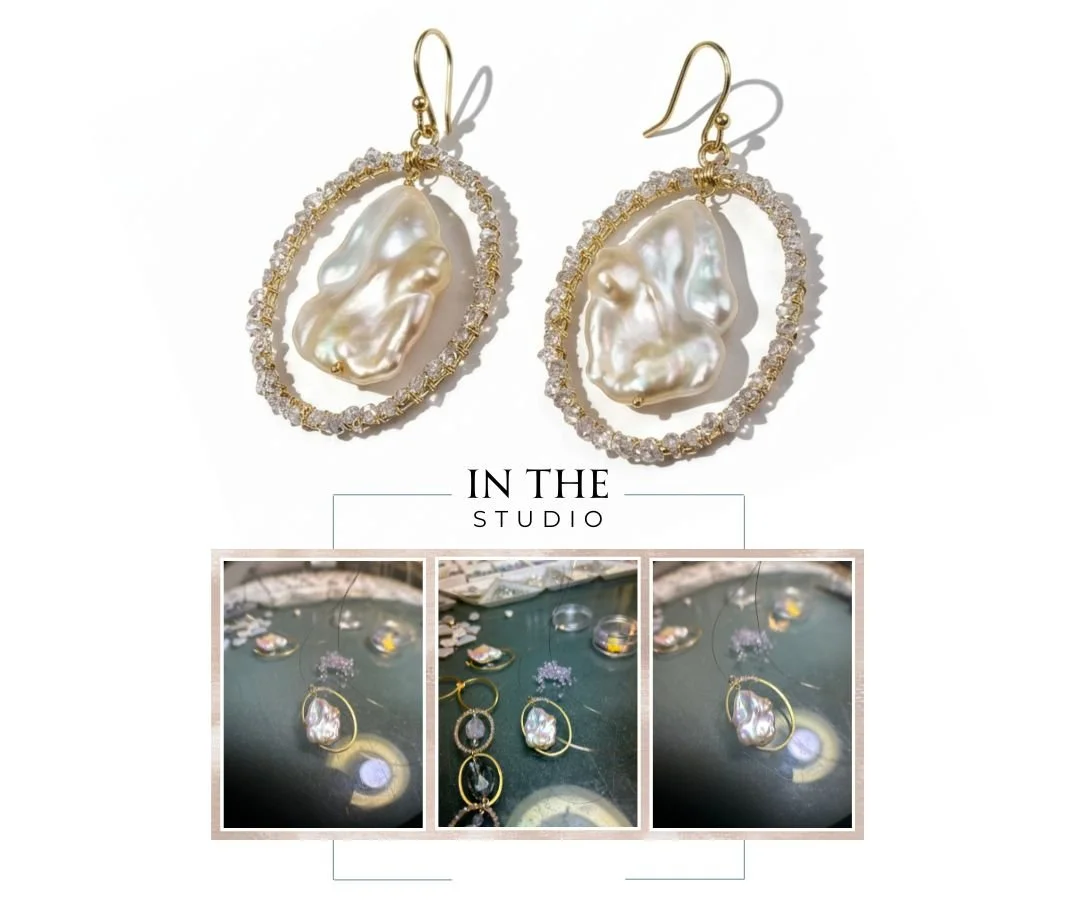
Vermeil Oval earrings (mate to the Vermeil Oval Collar necklace)

These carry one quiet detail straight from the necklace's body. I edged each 24k gold vermeil oval with tiny sparkling purple Herkimer diamonds and suspended a single baroque pearl to hang in the center, the same gesture that runs along the collar, distilled into a single oval per ear.

Questions

What are the Mixed Beryl crown-cut beads in this necklace?
They are tiny faceted beads of aquamarine, morganite, and heliodor, which are all the same mineral, beryl. Only the color separates them. Iron tints aquamarine blue, manganese blushes morganite peach, and heliodor warms to a soft yellow.
What is 24k gold vermeil?
Vermeil is sterling silver coated in a thick layer of gold. The ovals at the heart of this collar are 24k gold vermeil, rehomed from a fellow jeweler's retired earring design.
Is this necklace one of a kind, and can I commission something similar?
Yes. Every Andrea Li piece is built once, and when it sells it is gone. If you would like something made in the same spirit, you can begin a commission through the custom shop.

Discover

Jewelry that feels like you.

Two minutes. The quiz tells me how you want jewelry to feel in your life, and the messages that follow walk you through pieces I think you'll love.

Take the Style Quiz

Two minutes. I take it from there.

Stay Close

Love what you see? Keep finding us.

Google now lets you choose your favorite sources so they show up labeled in AI search answers. If you enjoy discovering handcrafted gemstone jewelry here, add Andrea Li Designs and we'll be easier to find next time you search.

Add Andrea Li Designs as a Preferred Source

One click. Works across Google Search, AI Overviews, and AI Mode.
When Monet Meets the Bench: Reading Sara Mrad's Fleur de Lumière Through Tamar

Tamar CollectionAndrea Li
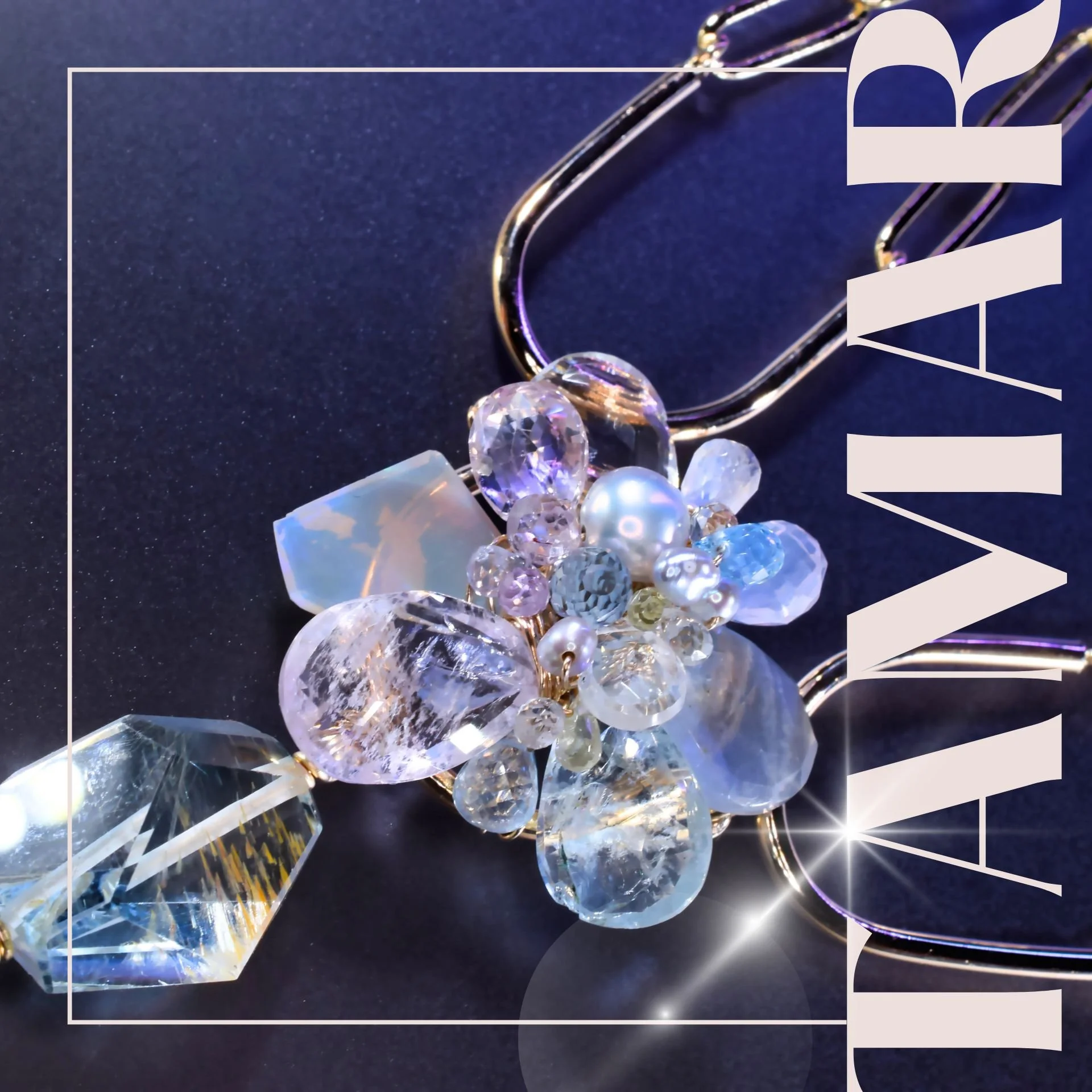
Collage pairing editorial fashion inspiration, jewelry close-ups, and earrings beneath the title “When Monet Meets the Bench.”

Sara Mrad's Spring 2025 Couture collection, Fleur de Lumière, reaches for the same Impressionist light I was chasing when I made the Tamar collection. Same Monet. Different mediums. Different fabrication languages, couture beadwork, and cold-connection gemstone clusters. This is what I see when I look at her work as a maker.

Photo Credits from Reddit

How I came to the work


A good friend, who is also a client, sent me Sara Mrad's Fleur de Lumière the way most of us encounter couture now: via someone else's tab, late at night, half-distracted. The thing that stopped me wasn't the dress. It was a single close-up where the beading behaved like brushwork—watercolor in glass. Light not so much captured as held still.


That stopped me because it's the same thing I was trying to do with Tamar. Different problem, same solution: make a flower that doesn't pretend to be a flower. Make the quality of looking at a flower, that softness at the edges where color bleeds, the way light dissolves a petal at the right angle. That's Monet's language. Mrad reads it through textile. I was reading it through gemstones.


This was the perfect setup to carry over to a recent shoot, collaborating with talented artists who each brought that same language into their craft to create a cohesive vision to communicate the ethereal nature of Sara’s collection and mine.

Published in Artells Magazine

Fashion & Glamour May Issue, Vol 4062  ·  Print & Digital

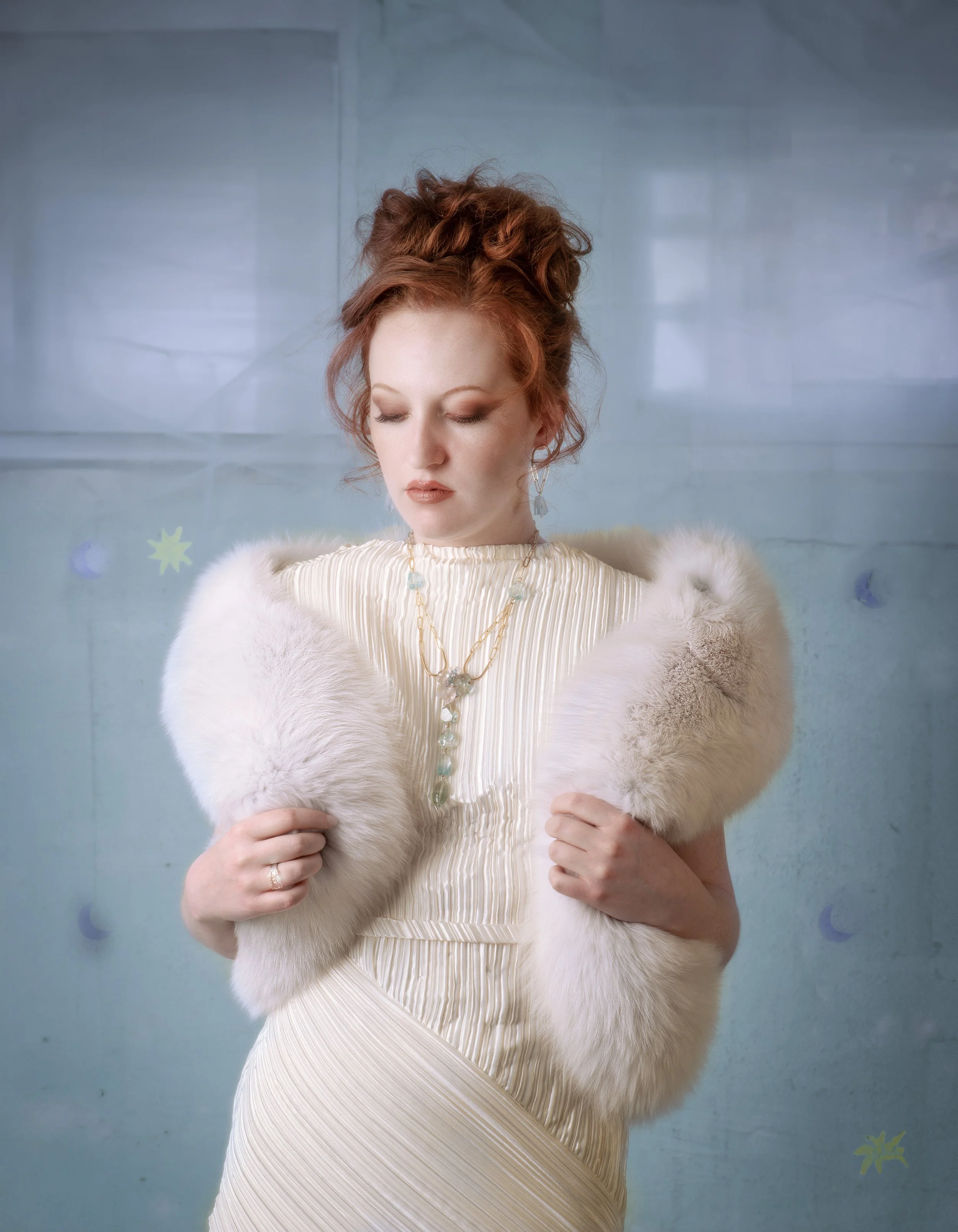
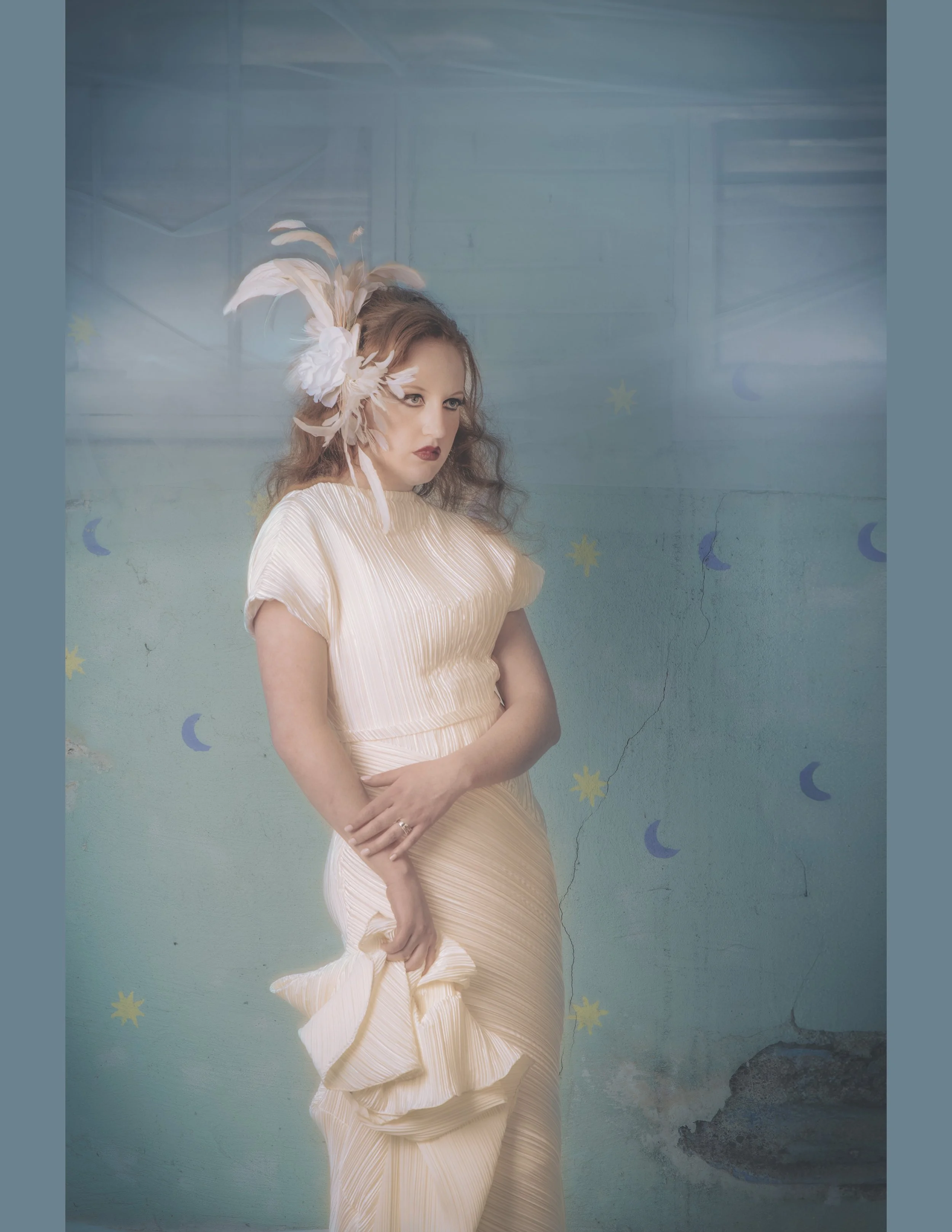
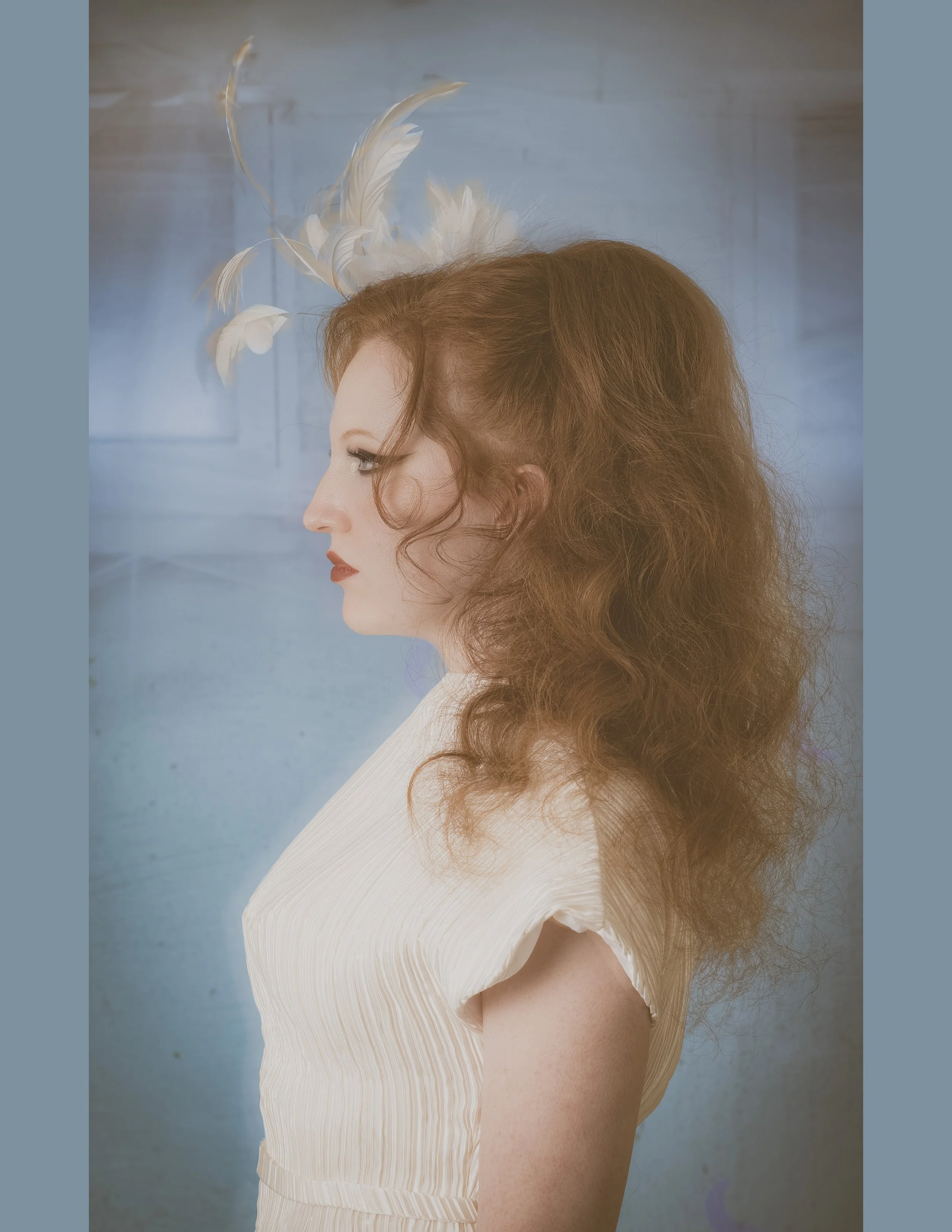
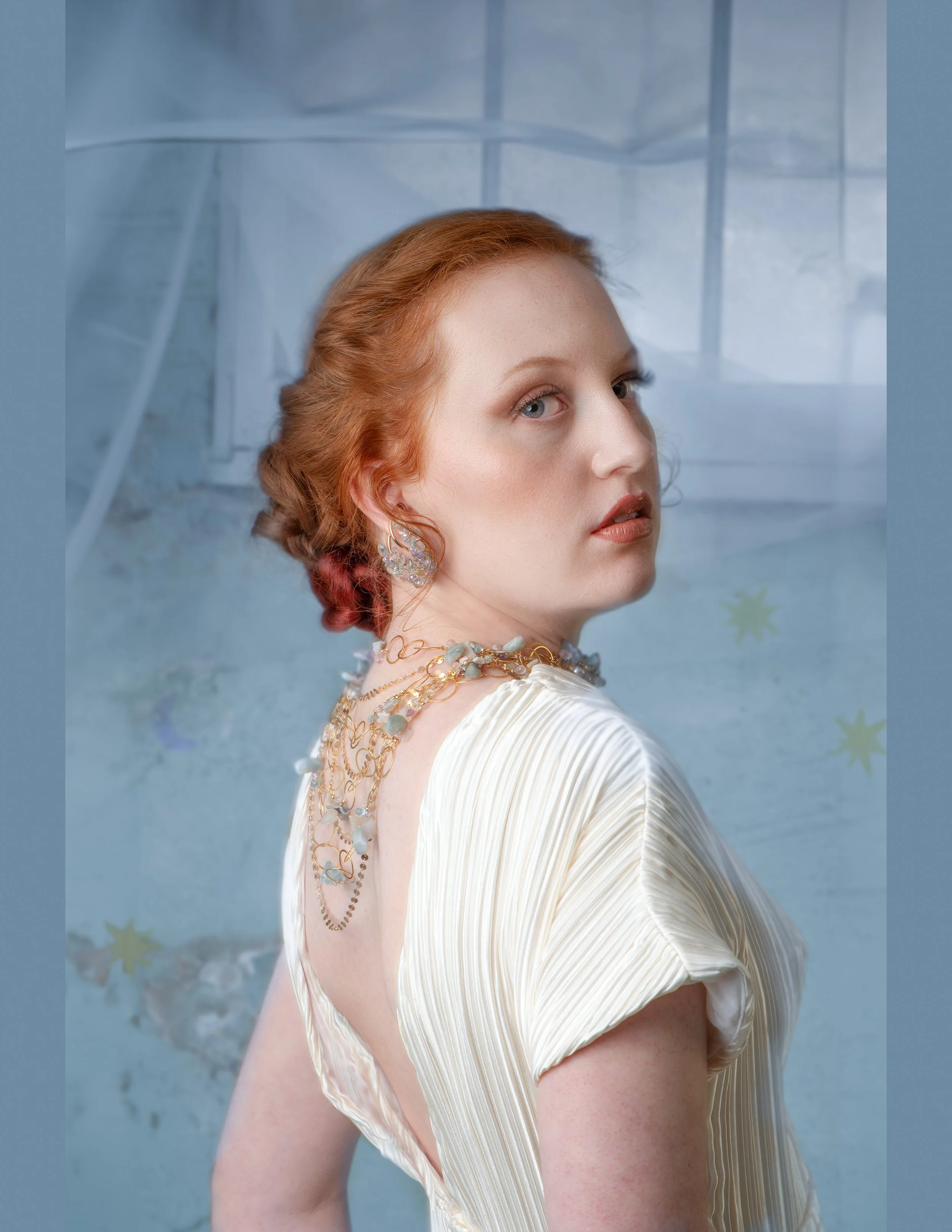
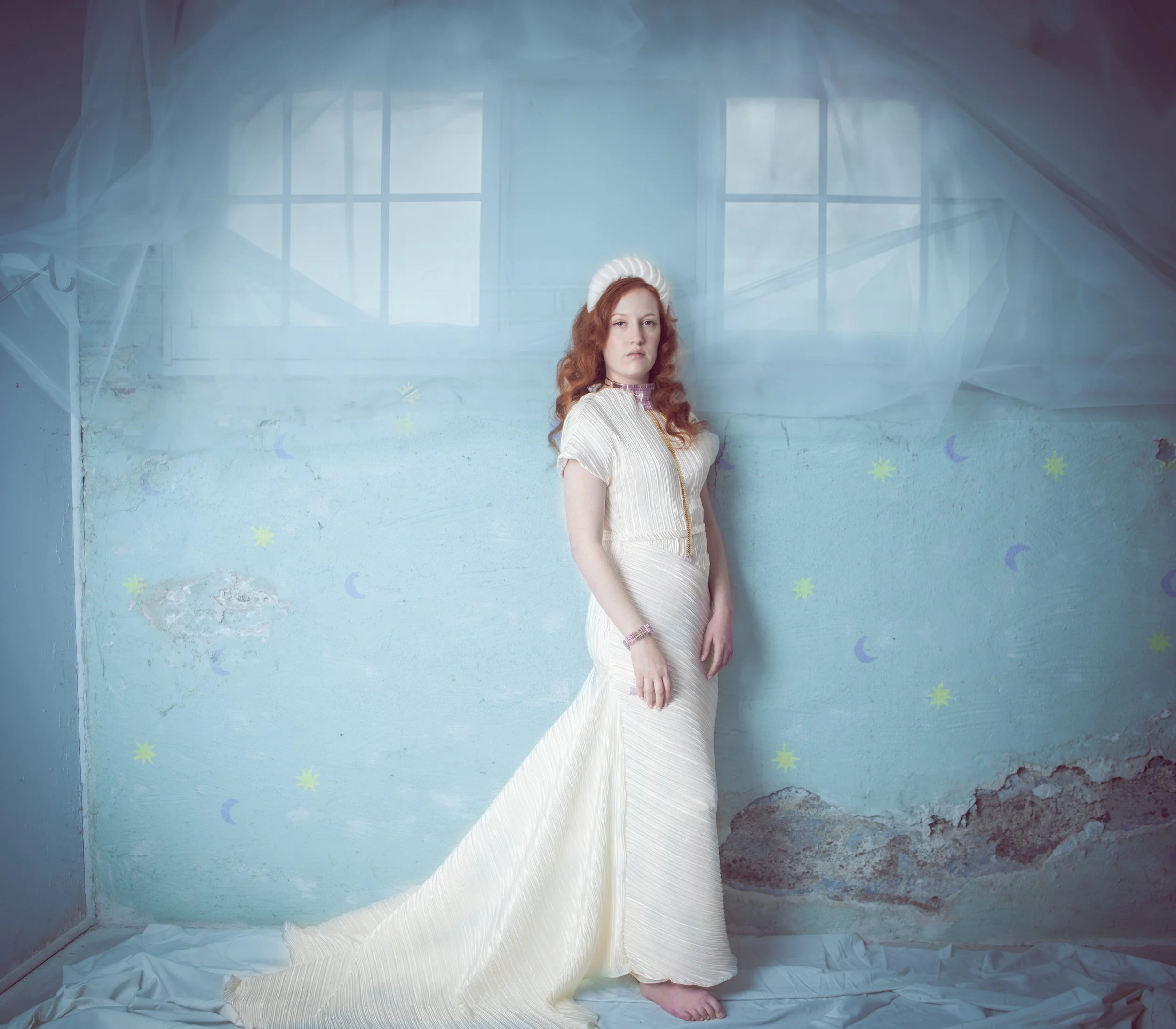
The shoot you see throughout this post became "My Star and Moon," a published editorial in Artells Magazine. What started as a creative conversation between Sara Mrad's Impressionist couture and my Tamar collection found its way into print, styled by Marie Margot Couture, photographed by E J Carr, and directed by Jani Duncan Smith, with Reilly Blake bringing it all to life against a hand-painted celestial backdrop.

Every artist on this team read the same brief and brought their own craft language to it. The pleated gown, the fur, the feathered headpieces, the celestial set, they all speak the same Impressionist softness the Tamar pieces were built to carry. That coherence is not an accident. It is what happens when every maker in the room understands the assignment at the level of material and light, not just mood board.

View "My Star and Moon" in Artells Magazine →
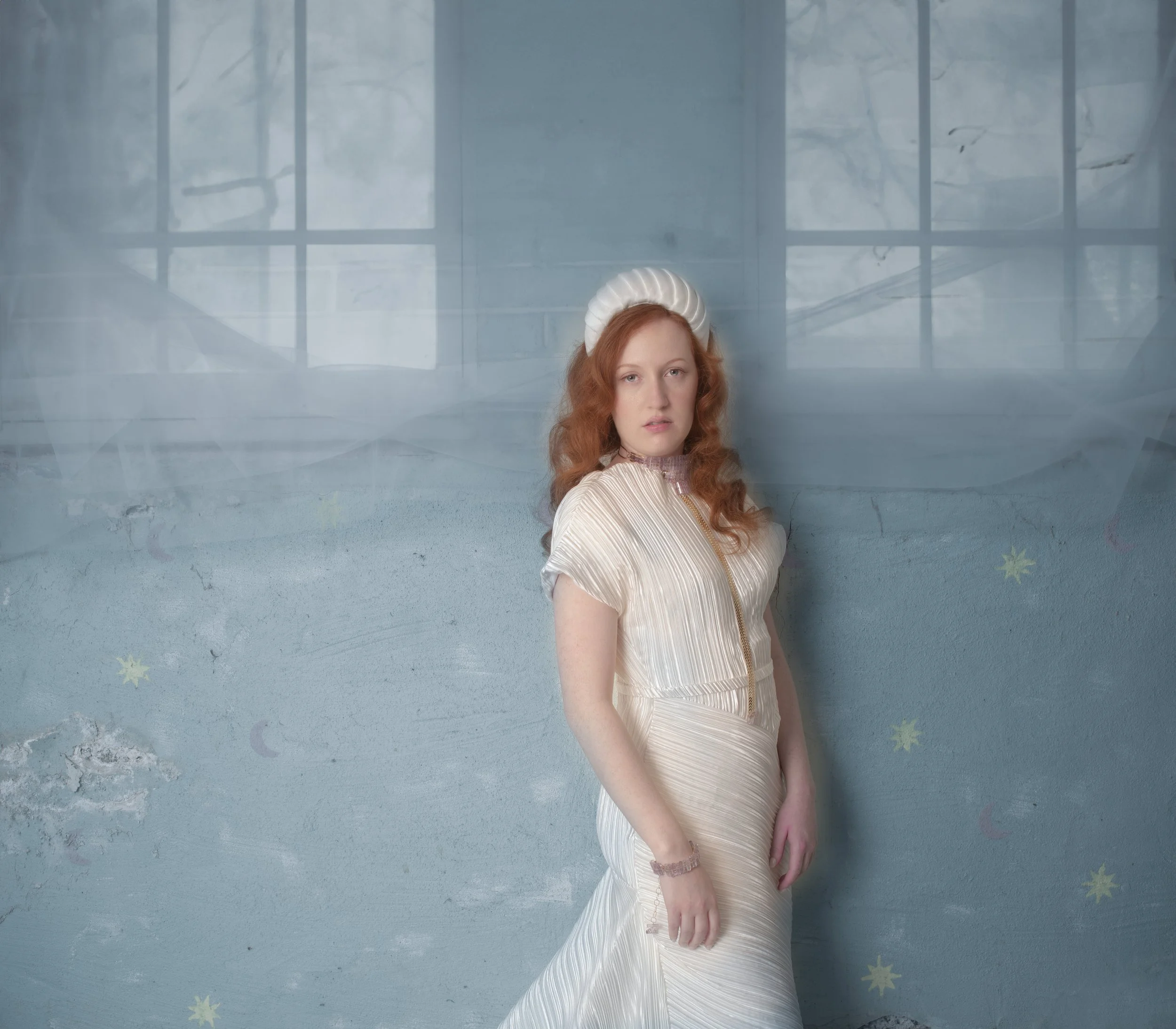
Portrait of a red-haired woman in a white pleated dress and fur stole, wearing delicate layered jewelry against a dreamy pale blue background.

What Fleur de Lumière is


Sara Mrad is a Lebanese designer whose Spring 2025 Couture collection takes Monet's gardens as its source material, the water lilies, the wisteria, the late-Giverny saturation when the painter was nearly blind, and color was doing the work memory couldn't.


What's striking about her interpretation is the discipline. Couture-trained beadwork is by nature additive, bead by bead, one stitch at a time, until the surface becomes the painting. Mrad's restraint, when called for or maximalism to convey aesthetic impact, is what makes it Impressionist rather than just floral. Intention is the point. The eye has to do some of the work.

What Tamar shares with it

When I designed the Tamar collection, I was not thinking about Sara Mrad; I'd never seen her work. But we were drinking from the same well.


Tamar started with a question: how do you capture the essence of the floral without it reading as jewelry pretending to be a flower? I wanted petals that suggested rather than depicted. Stones that weren't trying to be the bloom but to be the way the bloom looked at dawn — pearled, watercolored, soft at the edge. That meant choosing aquamarine over diamond, moonstone paired with softly colored sapphires, accented by freshwater and Akoya pearls. All three have the quality of being lit from within rather than reflecting light.


When I see Mrad's beading, I recognize that same choice. She isn't trying to make a beaded flower. She's trying to make the look of a flower at a particular hour, in a particular slant of garden light. The beadwork isn't decoration. It's the medium as the brushstroke.


That's the parallel I'd not have spotted from a distance. Up close, it's the same eye.

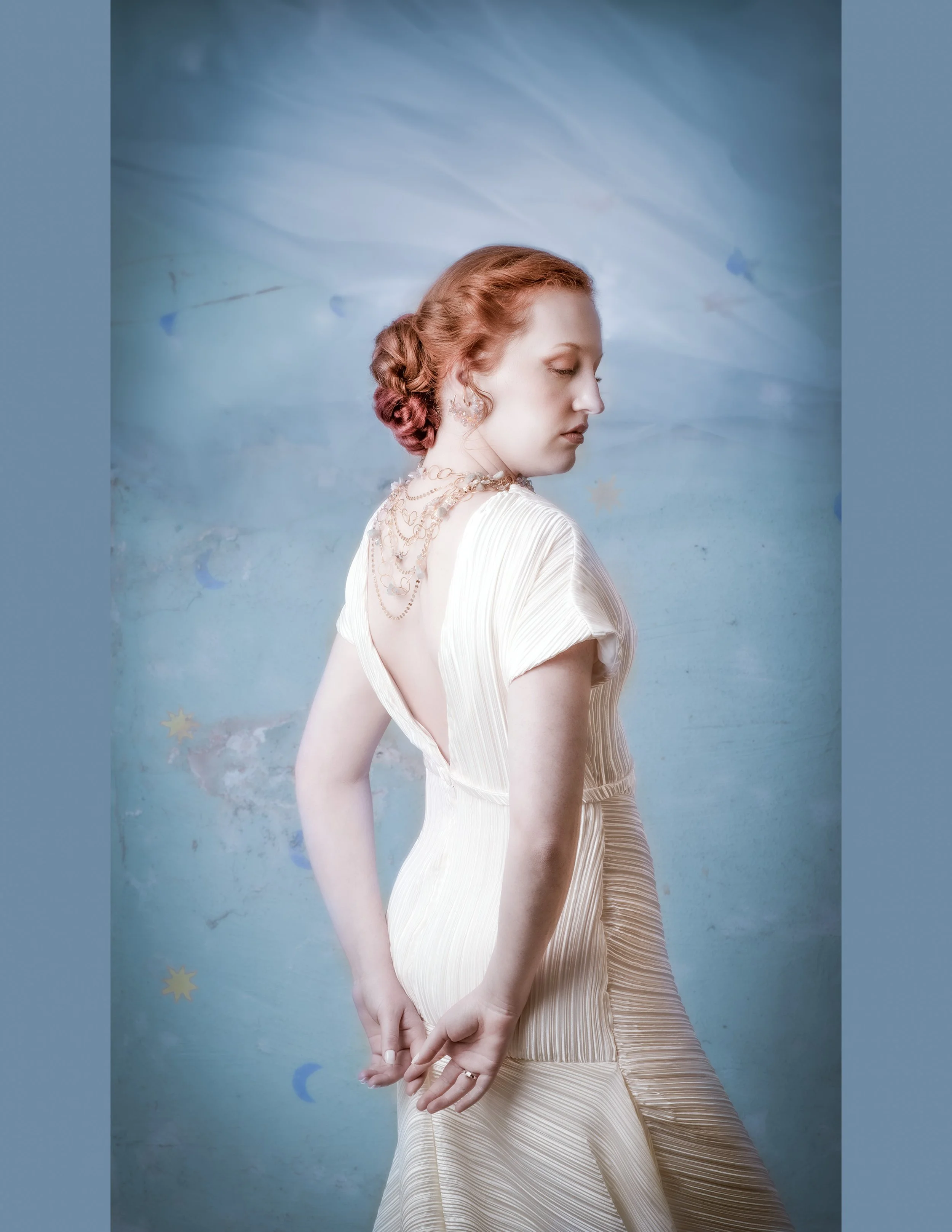
Portrait of a red-haired woman in a white pleated gown, viewed from behind, wearing delicate back-draped jewelry against a soft blue backdrop.

Where the work diverges: cold connection

Here's where the fabrication languages actually diverge and where my training shows.


Couture textile, the kind Mrad does, is inherently additive. You build a surface bead by bead, stitch by stitch, embellishment over embellishment. Heat is rarely the issue; needle and thread are. The craft accumulates.


My Tamar work uses what I call cold connection — not the entire fabrication process, just the gemstone-assembly portion. I build pieces using wire wrapping, hand-baling, and beading using crimps and crimp covers. No heat at any stage when I’m building these intricate gemstone clusters. Heat would damage the stones, and the rest of the construction follows the same logic: every connection is hand-built, mechanical, visible. This is where I employ soldering and bench fabrication. This builds a unique foundation for integrating my gemstone clusters and ensures the entire design is completely novel. When I integrate a commercial chain into a piece, I embed it so deeply through wire wrap and bail work that it becomes unrecognizable as a stock element.


The process: each stone arrives pre-drilled by the lapidary who cut and polished it. Sometimes I have to widen that hole with a diamond-bit drill so the wire I'm wrapping with can pass through cleanly. Then I wrap. One stone, one decision, one knot at a time, building outward into a cluster that has to flow as a piece of design even though it's been assembled bead by bead. Hand-bailing chain, wrapping individual rondelle beads onto a chain to form a gemstone-beaded chain, is the same technique applied to chain construction.


It demands planning many moves ahead. You're committing each stone's placement before you've placed the next twelve. There's no covering up your decisions afterward. Every wrap is visible. Every cluster shows the maker's hand.

Here's what didn't occur to me until I saw Mrad's work: she's doing the same thing. Single bead at a time. Pre-strung, pre-counted, planned ahead, no covering up the decisions. The unit is different (bead vs. gemstone), the medium is different (textile vs. metal+stone), but the fabrication philosophy is identical. Additive. Sequential. Hand-built. No casting, no molding, no shortcuts. The visible maker's hand is the point.


That's the parallel. Not just "Monet inspires both." The structural commitment to assembling a painterly surface one unit at a time, beadwork on couture, gemstone wire-wrap on Tamar, is the same craft language pointed at the same problem.

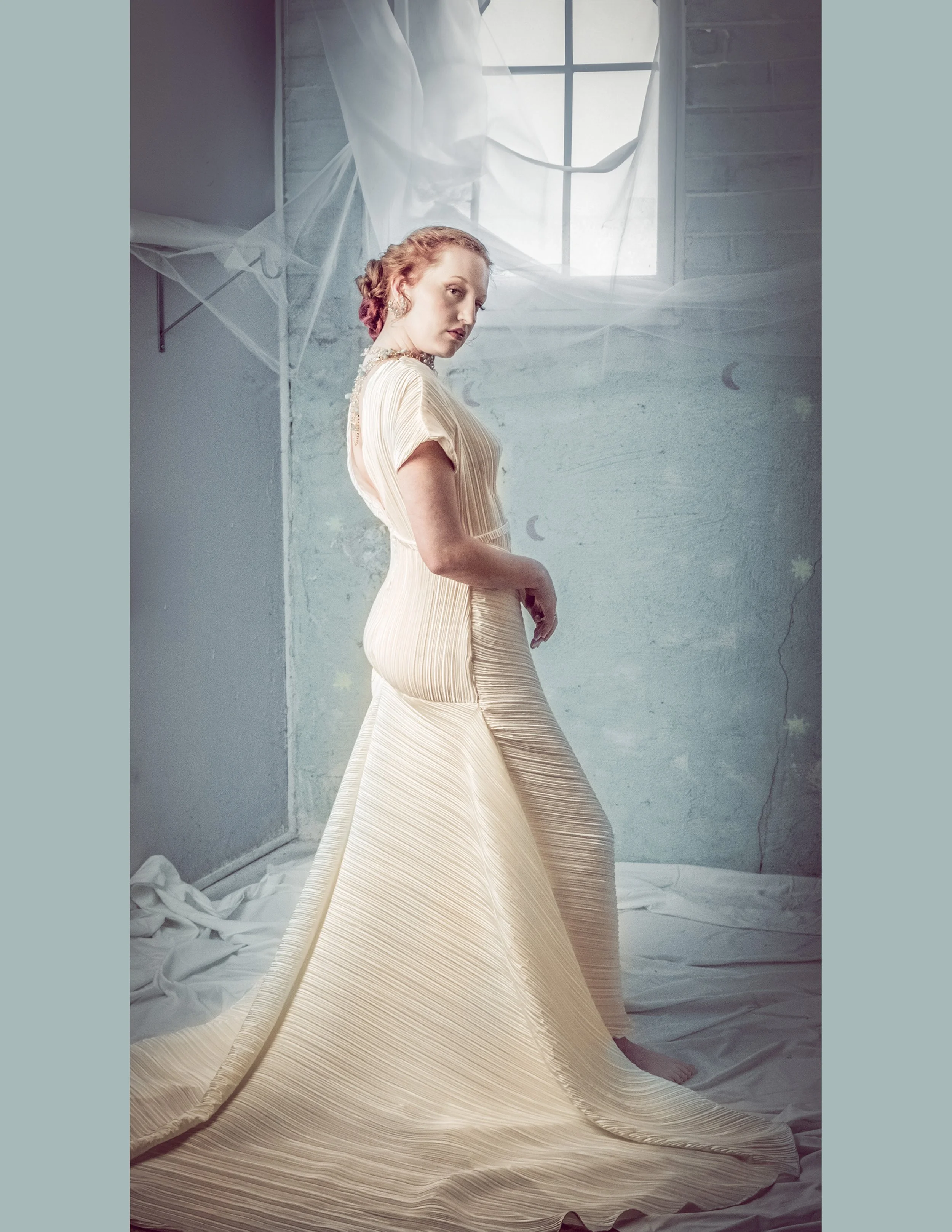
Full-length portrait of a red-haired woman in a flowing white gown, standing barefoot against a dreamy pale blue backdrop with sheer drapery.


What this means for how to wear it

If you're someone who tracks couture, who knows the difference between a Mrad and an Iris van Herpen, between a Schiaparelli embroidery and a Valli gradient, then your jewelry is part of that vocabulary too. It's reading from the same library.


The Tamar collection isn't trying to compete with couture. It's trying to live alongside it. A Tamar piece worn with a watercolor silk dress, an Impressionist-era pearl strand, and soft palette eyeshadow, it reads as one continuous design language. Worn against a sharper, more architectural piece (a Saint Laurent suit, a Mugler corset), it provides a counter-note: softness against structure, Monet against Mondrian.


The point isn't matching. It's literacy. Fine jewelry done well is a paragraph in a longer sentence about how you see the world.

Featured Tamar pieces


Six current Tamar pieces that carry the most of what I'm describing here, and what is featured in my recent shoot.

When you want a piece in this language


If you've read this far and what you actually want is a Tamar-spirited piece made for you, that's the custom shop. Cold-connection cluster work takes time, and one-of-a-kind means I'm not pulling something off a shelf. We start with the stones, what speaks to you, what suits your hand, what sits inside your wardrobe's color story, and build outward, one wire-wrap at a time.


This isn't a bigger or smaller version of an existing piece. It's a piece that's only yours. Different from couture, where Mrad makes one dress and another version is essentially impossible, but rhymes with it. Bench-built, hand-set, made once.


A note on cross-references


I'm going to write more of these. The fashion world has spent a hundred years thinking about how decoration creates meaning, and most of fine jewelry hasn't caught up yet. I want to bring some of that vocabulary back into how we talk about pieces. If you have a designer or a collection you'd like me to read through this lens, send it to me. I'll add it to the queue.

Frequently Asked Questions

Cold connection refers specifically to the gemstone-assembly portion of Andrea's process. Pre-drilled lapidary stones (sometimes widened with a diamond-bit drill) are wire-wrapped, hand-bailed, and secured with crimps and crimp covers into floral, pastel-textured clusters with no heat at the stone-assembly stage. Hand-bailing chain, wrapping individual rondelle beads onto a chain to form a gemstone-beaded chain, uses the same technique. The structural foundation of each piece is built separately using soldering and bench fabrication, creating a novel base for integrating the cold-connection gemstone clusters. When a commercial chain is incorporated, Andrea embeds it so deeply through wire wrap and bail work that it becomes unrecognizable as a stock element. Every connection in the cluster work is hand-built and visible; the maker's hand shows in every wrap.

Both designers draw on Monet's Impressionist palette and the technique of suggesting rather than depicting flowers. Both build painterly surfaces through additive single-unit assembly: Mrad bead by bead in textile and beadwork, Andrea stone by stone in wire-wrapped gemstone clusters. The aesthetic vocabulary, soft-edge color, watercolor light, restraint over depiction, is shared. The fabrication languages couldn't be more different on the surface, but the structural craft commitment is the same.

Yes, through the custom shop. Commissioned pieces are bench-built using cold-connection cluster work (no two are alike) and start with stone selection. Timeline depends on stone availability and design complexity; typical commissions take several weeks from first conversation to finished piece.

Stones lit from within rather than ones that reflect light outward. Aquamarine, moonstone, softly colored sapphires, and freshwater and Akoya pearls all carry that quality. These stones have a luminous, translucent character that reads as painterly rather than architectural. The Tamar lens favors translucence and softness over high-refraction brilliance.

Love What You See? Keep Finding Us.

Google now lets you choose your favorite sources so they show up labeled in AI search answers. If you enjoy discovering handcrafted gemstone jewelry here, add Andrea Li Designs and we'll be easier to find next time you search.

Add Andrea Li Designs as a Preferred Source

One click. Works across Google Search, AI Overviews, and AI Mode.
Credits

Studio Stories: The Pastel Gemstone Ear Cuffs

Tamar CollectionAndrea Li

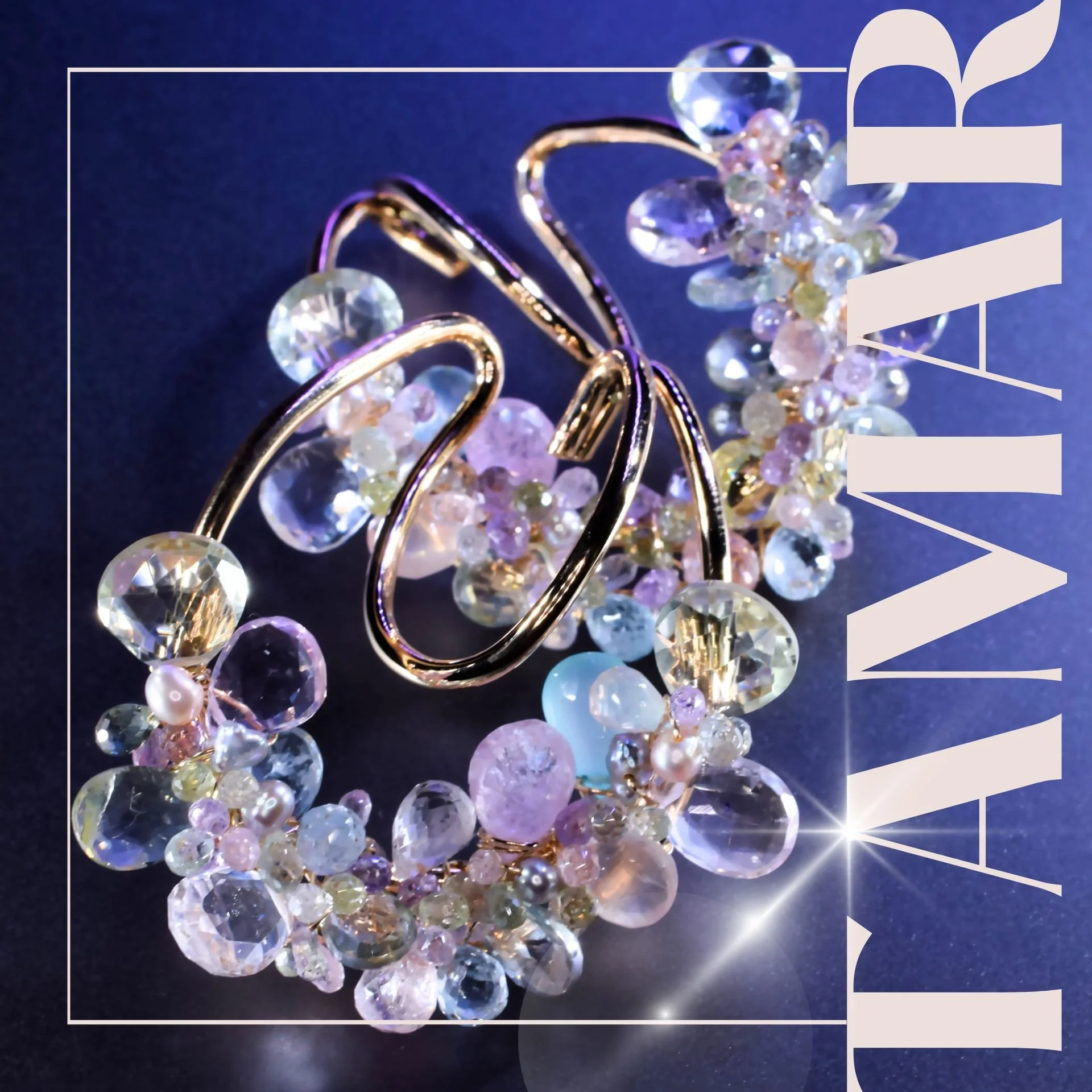
The Pastel Gemstone Ear Cuffs: The Mistake That Made It Better. One cuff came out shorter than the other. Instead of starting over, Andrea Li added wire layers to correct the mismatch, and those layers became the structural frame for a gemstone cluster that the original single-wire design could never have supported. No piercing required. No conformity required.
The Pink Kunzite Choker: A Wearable Rebellion

Tamar CollectionAndrea Li

The Pink Kunzite Choker: A Wearable Rebellion

This sculptural choker pushed me beyond my technical limits and wasn't designed to sell; it was created for the soul. Born from pure artistic instinct and advanced soldering techniques I had to master in real-time, this piece represents what's possible when you stop asking "will this sell?" and start creating without compromise.