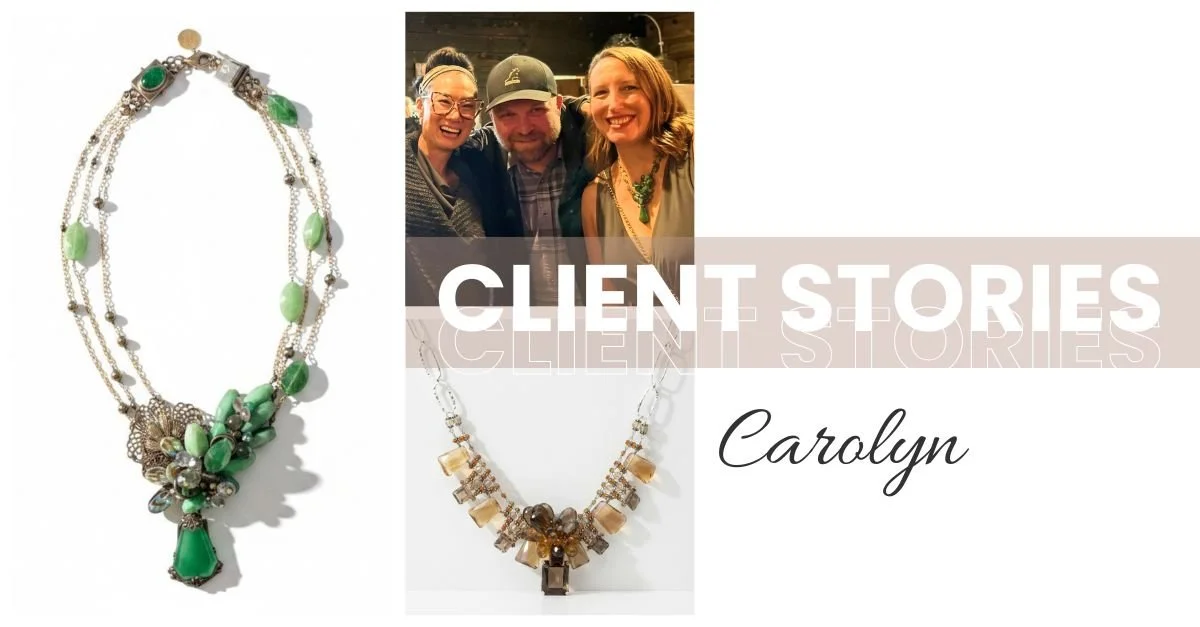
Carolyn's Three Necklaces: When Heirlooms Become Something New
Carolyn and I have been friends for a long time. The kind of friends where the work threads itself through the friendship, where the line between "a piece I want you to make for me" and "pieces we made together over years" becomes the relationship itself.
The first commission came up one evening during a conversation. I was telling Carolyn about a project I had been turning over: taking older pieces that did not quite suit their owner anymore and reimagining them into something new, something the owner would actually wear. Carolyn went still for a second, the way people do when a sentence lands somewhere it was already going. She had a green jade pendant from her aunt sitting in her jewelry box, she said. Unworn. Beautiful but not suited to her style. She loved it because it had belonged to her aunt. She did not wear it because it never felt like her.
That sentence is the whole reason for this piece you are reading. Most jewelry buyers know this exact grief. A piece you love without wearing. A piece you cannot give back, cannot give away, cannot melt down, cannot quite bring yourself to keep in stasis forever. The drawer is full of pieces like this in houses everywhere, and the inheritor carries a quiet weight about them that nobody really talks about.
Over the next five years, Carolyn and I worked together on three of them. This is the story of those three necklaces, told in the order they came to me.
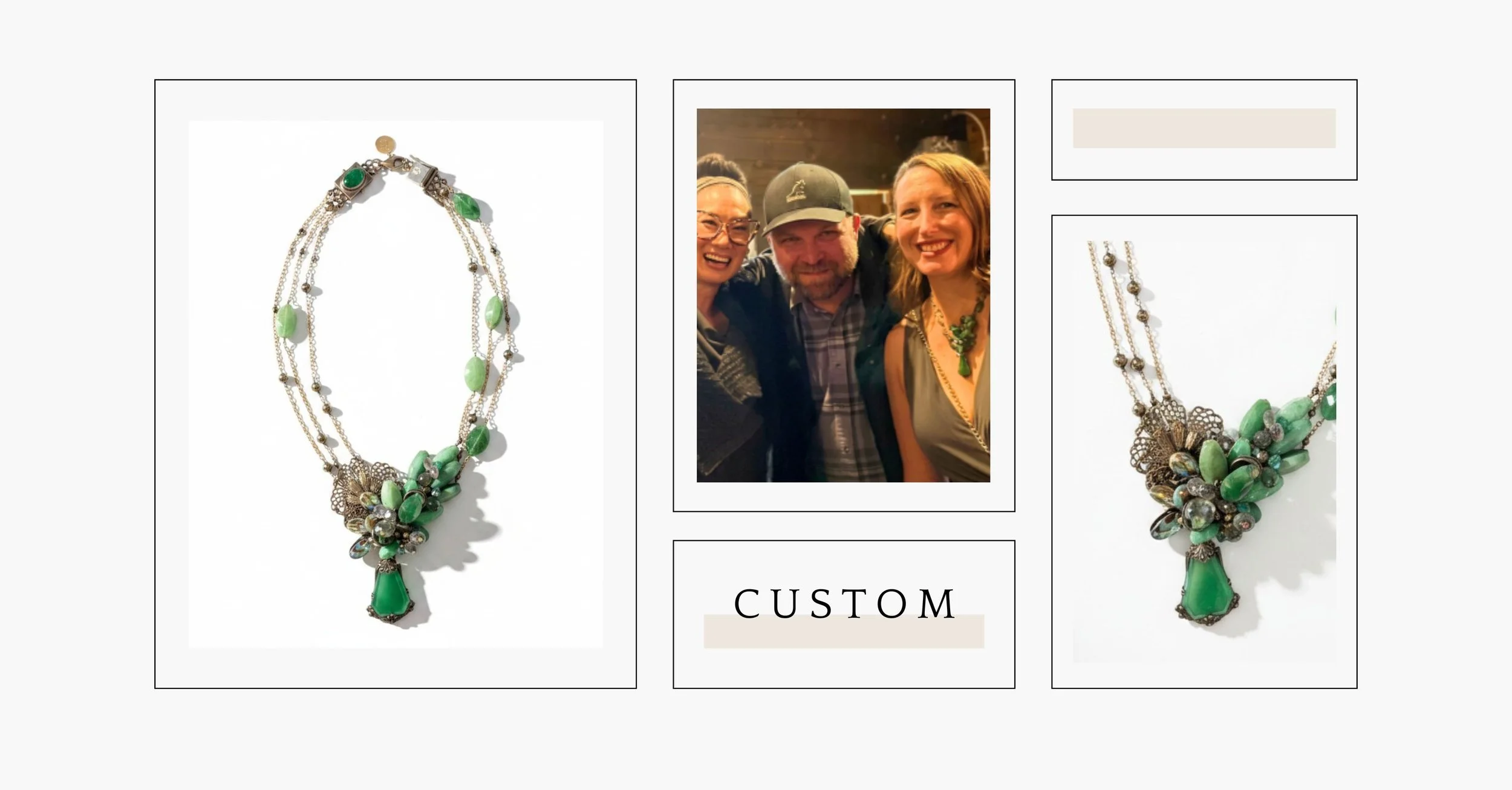
The Jade Pendant (2012–2013)
The first piece was the green jade. Carolyn's aunt had chosen it for her own taste, which was a different taste than Carolyn's, but the sentimental weight of it being from her aunt made simply not wearing it feel like a small ongoing betrayal. She wanted to know if we could bring it into her style without losing what made it her aunt's.
The first thing I want any reader who has a piece like this to know: I never melt the original. The jade pendant is still the jade pendant. It sits at the center of an asymmetrical multi-chain necklace I built around it. The work was in what surrounded the pendant, not in changing the pendant itself.
I sourced complementary green gemstone beads from my own inventory and mixed in antique filigree elements to give the piece ornate anchoring points where multiple gold chains could attach and the signature gemstone clustering I tend to build into asymmetrical work could settle in. The greens fanned across a wider palette than the pendant alone — emerald, mossy greens, the antique-gold flicker of pyrite — so that the pendant became the center of a chorus rather than a solitary note. The asymmetry let it breathe. The filigree gave it weight.
There is one detail I love about how this first piece reached Carolyn. The necklace was going to be a Christmas gift to herself. Mid-build, her husband Byron quietly intercepted the project, finished the conversation with me, and turned it into his Christmas gift to her instead. The necklace arrived in her hands with a different story than the one she had originally written for it, which is a small instance of the thing this work does: it makes pieces porous. The piece holds the aunt, the pendant, the wife, the husband, the gift, the redesign. None of those layers cancel each other out.
The aunt's piece is still the aunt's piece. Now Carolyn wears it.
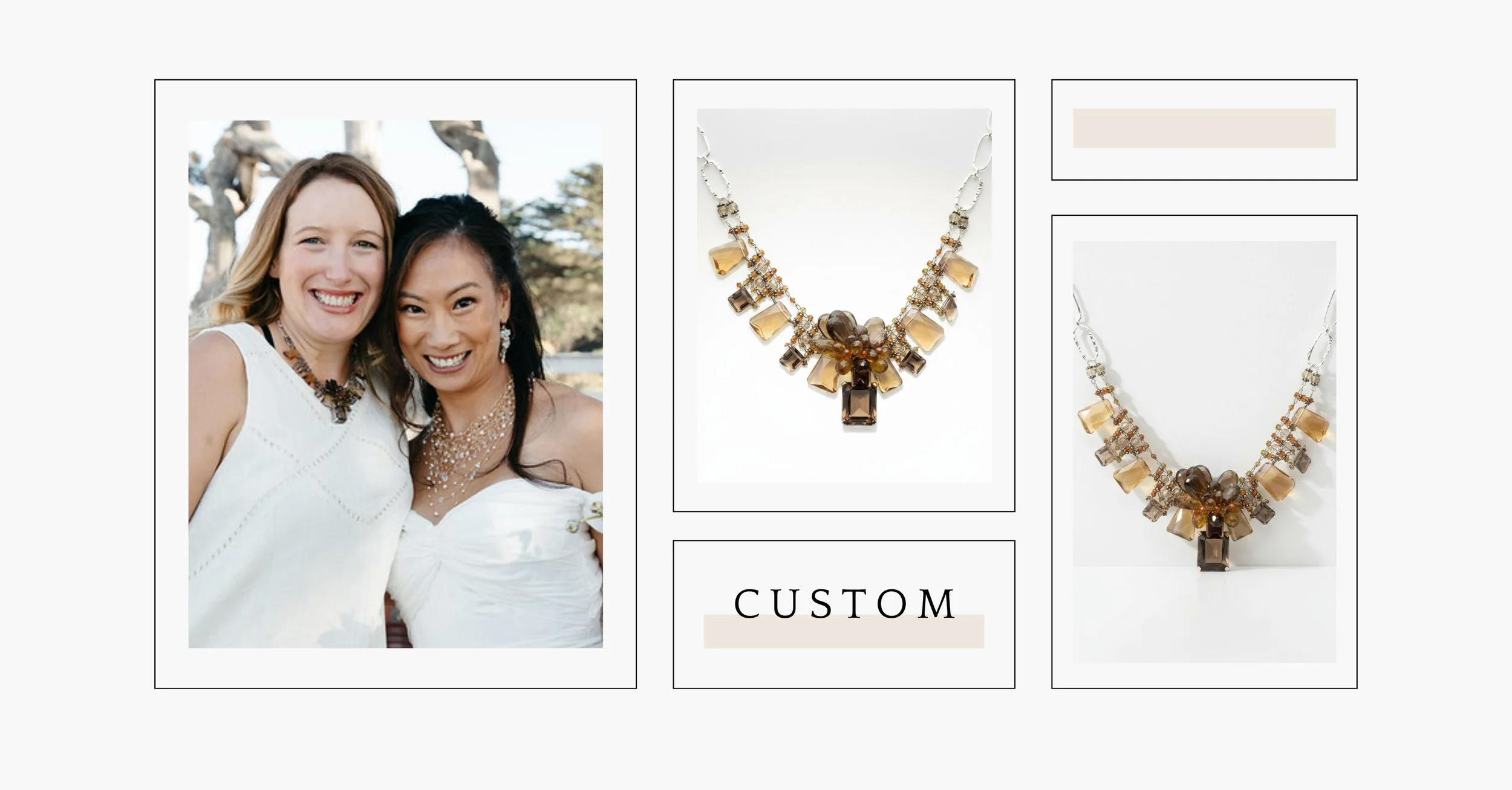
The Topaz Collar (2014–2015)
The second piece came a year or so later, on a different occasion. Carolyn had earned a milestone at work and decided to mark it. Not for an anniversary, not for a wedding, not for one of the special-occasion slots most jewelry sits waiting in. For an ordinary professional win she wanted to wear something for.
This time the heirloom was a brown topaz pendant, also from her aunt. Square. Set in sterling silver. The square shape was the structural cue I followed: a symmetrical collar design, with the original pendant as the centerpiece and smaller square gemstones echoing the shape outward along the collar. The metal palette stayed in silver throughout, because the original was sterling and gold would have fought it. I hand-wove layers of chain pattern with tiny gemstones threaded onto headpins of varying lengths to create a chain-mail effect that housed the larger square stones along the line of the collar. The whiskey-topaz pendant became the anchor at the throat. The piece pulled together as a single intricate structure: a collar that read first as architecture, second as ornament, third as the pendant her aunt had given her.
What I want to say about this piece is something the inheritor with the drawer often does not let herself say out loud: pieces like this are not only for grief, and not only for ceremony. Carolyn marked an ordinary professional win with her aunt's pendant, integrated into a necklace she could wear. The someday-occasion the original pendant had been waiting for turned out to be a Tuesday she could finally name as worth marking.
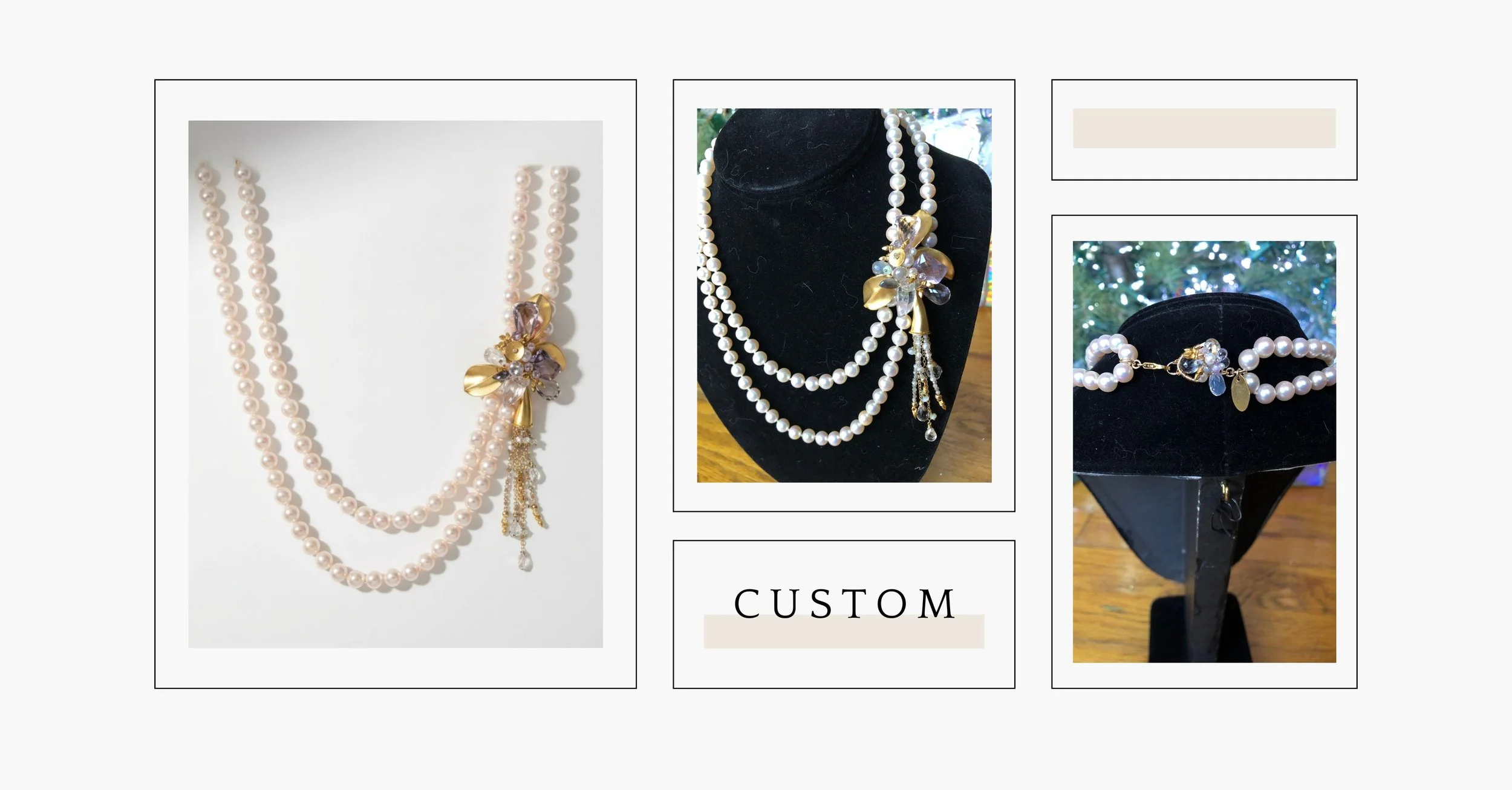
The Pearl Strand (2015–2017)
The third commission is the one that still moves me when I think about it.
When Carolyn's husband Byron's mother passed, Carolyn was given the chance to choose multiple pieces from her mother-in-law's jewelry collection. Except that she chose a strand of pearls. Just the strand.
I have been doing this work long enough that I know what extraordinary pearls look like, and when she first brought me the strand, I knew these were exactly that, extraordinary. Each pearl carried a brilliance and a rarity of size that matched all the others on the strand, and a luminescence that refracted light like each one held its own small rainbow. They were the kind of pearls a person chooses if they are choosing the one thing.
The only problem was the length. It was too long for Carolyn to wear functionally — somewhere between a long opera length and an awkward in-between. We played with the strand together and realized that if we doubled it back on itself into two layered strands, the length became right. The pearls became wearable.
The work I did was around that doubling. I designed a side flourish at the asymmetrical anchor point: 24k gold vermeil leaf-like shapes layered around a tight cluster of fiery opals that echoed the rainbow auralescence in the pearls themselves, along with other gemstones that gently called out the lavenders, greys, and blues sitting inside each pearl's surface. I anchored the flourish with a custom 24k gold vermeil cone-shaped component that gathered glittering strands of tiny gemstones, gold chains, vermeil spikes, Herkimer diamonds, ametrine, and zircon. The custom clasp held the two strands in a permanent two-layer configuration that is easy to put on and take off.
The pearls are still the pearls. The strand is still the strand Byron's mother chose for her own collection. Now they are around Carolyn's neck.
What Carolyn Wears Now
I would like to skip past the reveal part of this story by telling you the truth about how Carolyn reacted when I delivered each of the three necklaces, which is the way every commission client I have delivered to has reacted: with awe, wonder, the kind of excitement that overflows the room, and a particular kind of surprise that says she did not expect the finished piece to exceed what she had pictured. That is what happens at the bench-side of this work. The reveal is real and it is consistent. I have built my practice around making sure it happens.
What matters more than any single reveal moment is what came after. Carolyn wore the green jade necklace, then the topaz collar, then the pearl strand into the years between then and now. She wore the topaz collar at my wedding. She has worn the jade necklace to her husband's concerts. The pearl necklace turns up at occasions like our friend's annual Derby party and ordinary days alike. None of these pieces are special-occasion necklaces in the strict drawer-forever sense. They are life pieces.
She told me once, after the third piece, the line I think about when I am at the bench making something for someone whose grandmother or aunt or mother-in-law has given them something they cannot bring themselves to wear: I get to wear a piece of them each time I wear the necklaces. The memory is not erased by the redesign. The memory is amplified by being present. The aunt is at her throat at the work milestone. Byron's mother is at her throat at special moments shared by her community of friends in gatherings. The pieces hold more lineage than they did when they were sitting in the drawer.
The arc has kept moving. Carolyn's mother — Carolyn's own mother, who is still with us — has recently started encouraging Carolyn to buy a safe to keep the necklaces in when they are not on her. Not to put them away from use, but to safeguard them so they can pass to Carolyn's daughter when she is old enough to receive them. The pieces will travel forward, not just backward. The three necklaces will become what Carolyn's daughter inherits, layered over what Carolyn's aunt and Byron's mother already gave.
The aunts, the mothers, the husbands, the daughters. The pieces hold all of it. And they are, finally, being worn.
That is what I want any reader to take from these three commissions if she has her own pendant or strand sitting in a jewelry box. Drawer-forever is not the only ending. The pieces can become part of how you live now, and they can become what the next generation inherits from you instead of just from the maker before. The integration is the way to do that without losing what made the piece worth keeping in the first place.
If you have one of these pieces — and most of us do — I would love to hear about it.
Read More
Where to go from here
If Carolyn's story resonated, here is where to follow the threads.
- Tamar's heirloom redesign The sibling commission that opened this thread in the studio
- The Aglow collection Pearl pieces and their commission origins
- Pearl jewelry pillar The science, the sourcing, and the design language behind pearl-anchored pieces
The full Studio Stories archive lives at Studio Stories: Commissions and Studio Stories: Wedding.
If you have an heirloom piece you love without wearing, the commission inquiry page is where most of these conversations begin. A piece, a stone, an idea. The email after the inquiry is how I get to know what you are actually trying to say.
Discover
Jewelry that feels like you.
Two minutes. The quiz tells me how you want jewelry to feel in your life, and the messages that follow walk you through pieces I think you'll love.
Take the Style QuizTwo minutes. I take it from there.
Stay Close
Love what you see? Keep finding us.
Google now lets you choose your favorite sources so they show up labeled in AI search answers. If you enjoy discovering handcrafted gemstone jewelry here, add Andrea Li Designs and we'll be easier to find next time you search.
Add Andrea Li Designs as a Preferred SourceOne click. Works across Google Search, AI Overviews, and AI Mode.