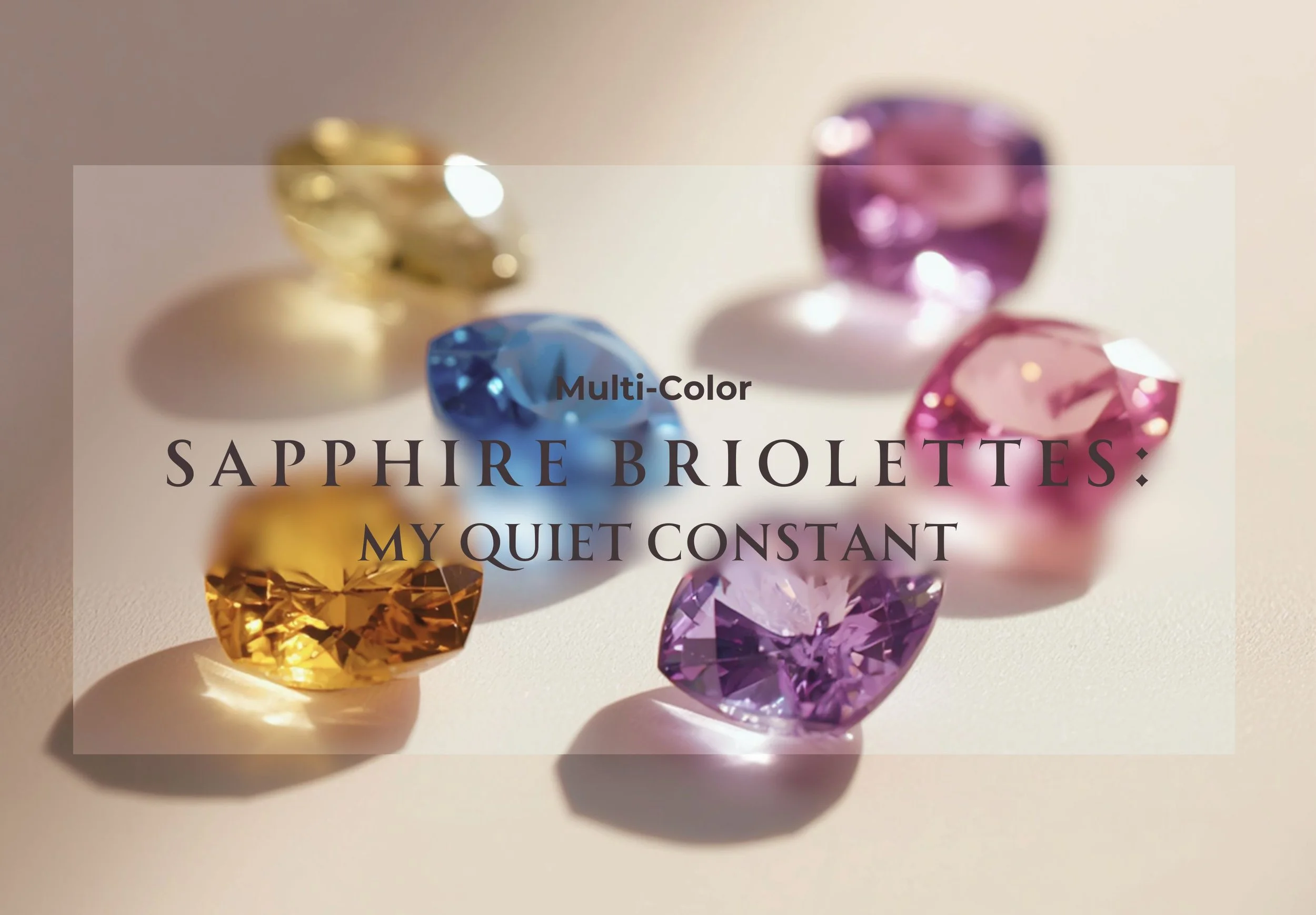
There are two stones I reach for in almost everything I make. One is the pearl, and most people expect that. The other surprises them: a tiny multi-color sapphire, often no bigger than three millimeters, tucked so far inside a cluster that you might never know it is there. But I know. Aside from pearls, a sapphire briolette is the one material that runs through nearly every piece that leaves my Denver studio.
I did not set out to make sapphires my signature. I went looking for something small. I wanted a faceted stone tiny enough to nest between the larger center gems in my clusters, in enough colors that I could always find one to echo the heart of a design. For a long time, that stone did not exist in the form I needed. Then I found it, and I have not stopped buying them since.
The Materials
The stones come from Gem House USA, a vendor based in New York with mines in India, which means the precise origin of any given briolette is honestly a little ambiguous, somewhere in the long history of Indian corundum. What matters to me is what arrives: faceted sapphire briolettes around three millimeters across, in what feels like every color a sapphire can be. Blue, of course, but also pink, yellow, green, violet, peach, and the soft in-between shades that do not have tidy names. They are one of the more precious stones I work with, and having them in nearly every piece quietly raises the whole register of the work.
A Little Sapphire Science
Sapphire is gem-quality corundum, a crystal of aluminum and oxygen, and it comes in every color except red. Red corundum has its own name: ruby. The color is written by trace elements caught in the crystal as it grows, with iron and titanium turning it blue and chromium pushing it toward pink. That range is exactly why sapphire suits the way I design. Whatever color sits at the center of a piece, there is a sapphire to coordinate or complement it.
The other reason is durability. Sapphire is a 9 on the Mohs hardness scale, second only to diamond, and just as important, it is tough rather than brittle. It resists chipping and cleaving in a way softer stones do not. At three millimeters, in a cluster that gets worn and bumped, that toughness is not academic. It is the difference between a stone that survives and one that does not.
The Colors, and Where They Come From
Sapphire takes its color from whatever trace elements were caught in the crystal as it grew, which is why the range runs so wide. Here is how I think about the ones I reach for most.
| Color | What gives it the color | How I use it |
|---|---|---|
| Blue | Iron and titanium | The classic. Cools and anchors a warmer center stone. |
| Pink | A trace of chromium, where more would make a ruby | Softens or warms a palette without going loud. |
| Yellow | Iron and color centers | Adds light, sits beautifully beside golden and honey stones. |
| Green | Iron, often color-zoned | Earthy, pairs with mossy, olive, and aquatic centers. |
| Violet | Vanadium, sometimes with iron and titanium | Bridges cool and warm in a single hue. |
| Padparadscha | A trace of chromium with iron | The rare pink-orange glow, used sparingly as a highlight. |
| Colorless | Pure corundum, with no coloring elements | A neutral sparkle to bridge two stronger colors. |
| Parti | Zones of different trace elements in one crystal | A single stone that does two color jobs at once. |
At the Bench
Here is the small, specific thing that made me fall for these stones: the holes. Each briolette is top-drilled, with the hole running through the narrowest part of the stone, right up at the point. On these, that hole is sized almost exactly to my 26-gauge wire. That sounds like a trivial detail. It is not, and it is exactly why the hardness matters so much. Drilling through the slender top of a briolette would crack a brittle stone, but sapphire takes it without complaint. When the wire passes cleanly through, without forcing and without play, the connection sits true, the stone hangs the way I intend, and the cold connection holds. A briolette whose hole fights my wire is a briolette I fight all day. These do not fight me.
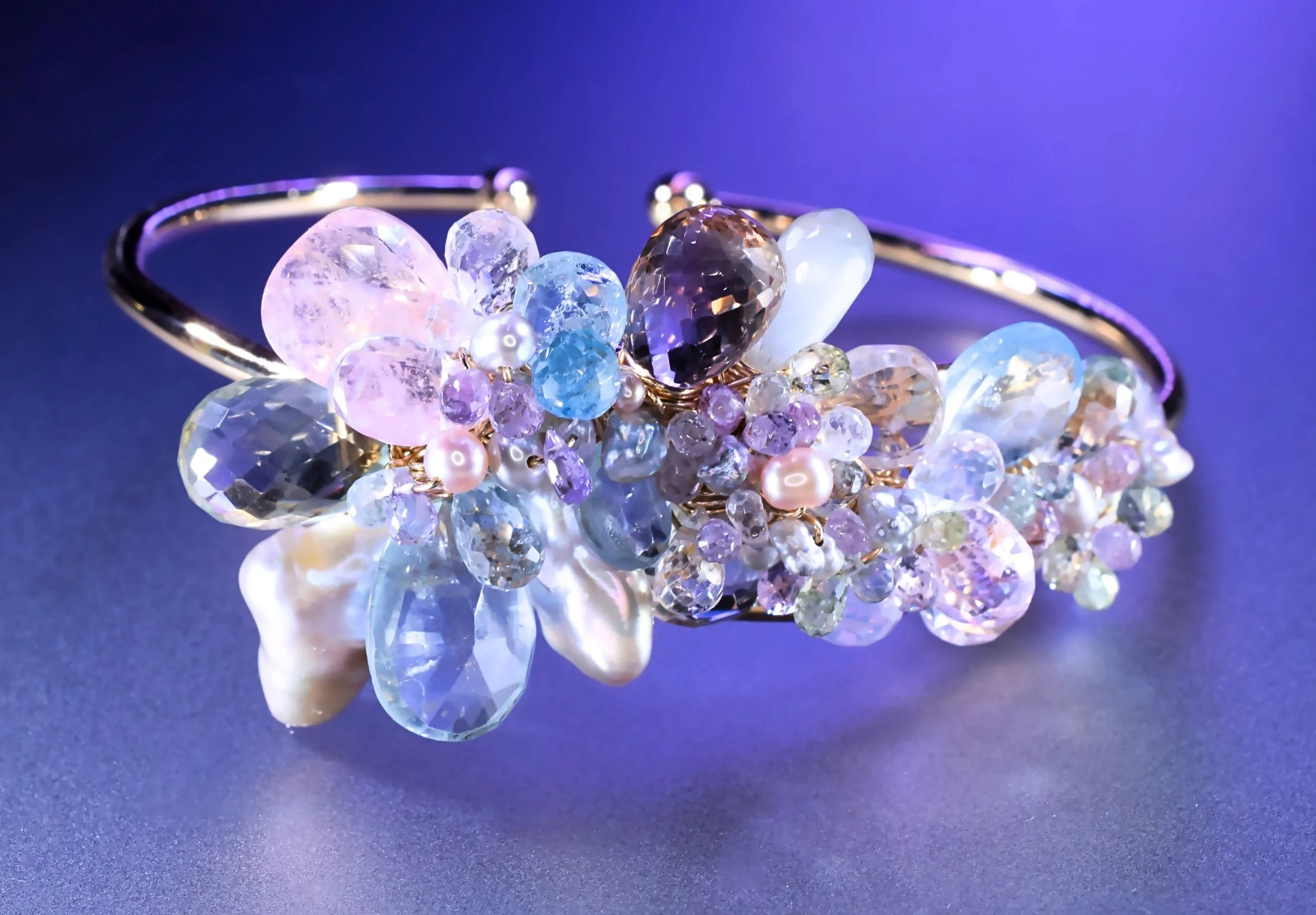
So they have become the connective tissue of my clusters. I build a piece around a larger center stone, then I nest these tiny sapphires in around it, choosing colors that pull from the center or set up a quiet contrast. Because color leads my design more than any single stone does, the sapphires give me an enormous palette to reach into. I can warm a cool center, cool a warm one, or build a whole gradient out of stones I could lose in my palm.

They are always on my shopping list when I go to the gem show. Not as the star of anything, but as the supply I cannot work without, the way another maker might restock solder or wire. I buy them by color, by the handful, because I know every one of them will eventually find a home between two larger stones.
Why They Earned the Staple Spot
Pearls earned their place in my work for their lustre and their softness against metal. Sapphires earned theirs for the opposite reasons: they are hard, exact, and endlessly variable in color. Together, those two stones are the only true constants across collections that otherwise share very little.
What I did not expect when I started using them is how much they would do invisibly. A piece reads as more considered, more luxurious, when there is a real sapphire nested in it, even a small one, even one the wearer has to go looking for. The value is not loud. It is just there, the way good materials are. If you are curious about the other stones I build around, the gemstone guides walk through each one, and the most famous sapphire of all, the Star of India, is a star sapphire with a story worth knowing.
In Almost Everything
Because every cluster I build is one of a kind, no two arrangements of these sapphires are ever the same. The stones are a constant; what I do with them never is. So if you have worn one of my pieces, you have very likely worn a multi-color sapphire without knowing it, a tiny, hard, brilliantly colored thing doing quiet work between the stones you noticed first. Aside from a pearl, it is the closest thing I have to a signature.
Questions
What colors of sapphire does Andrea Li use?
Why does Andrea use sapphire briolettes in her clusters?
Are sapphires durable enough for everyday wear?
Is a sapphire the same as a ruby?
What is a sapphire briolette?
Discover
Jewelry that feels like you.
Two minutes. The quiz tells me how you want jewelry to feel in your life, and the messages that follow walk you through pieces I think you'll love.
Take the Style QuizTwo minutes. I take it from there.
Stay Close
Love what you see? Keep finding us.
Google now lets you choose your favorite sources so they show up labeled in AI search answers. If you enjoy discovering handcrafted gemstone jewelry here, add Andrea Li Designs and we'll be easier to find next time you search.
Add Andrea Li Designs as a Preferred SourceOne click. Works across Google Search, AI Overviews, and AI Mode.