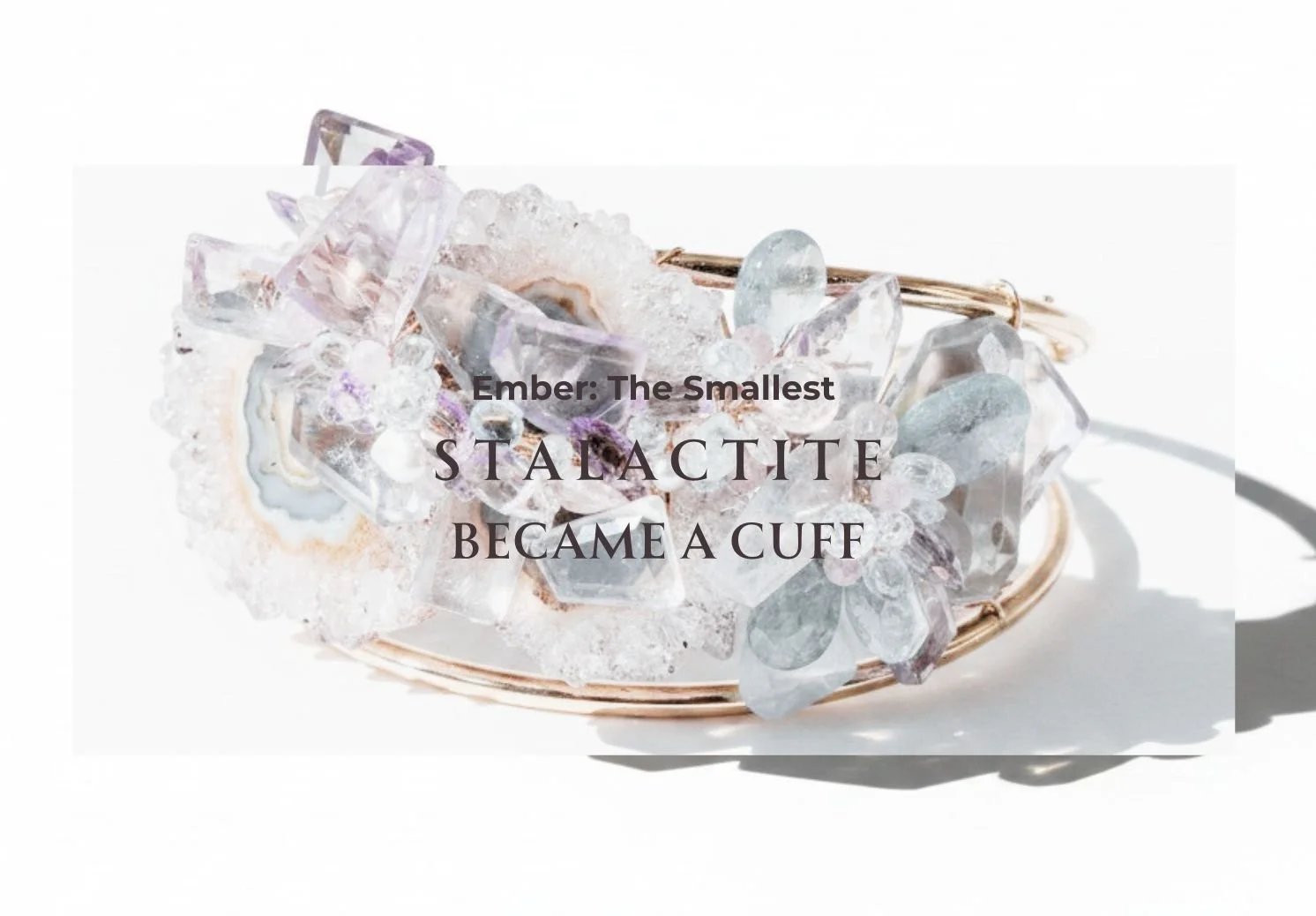
By the time I got to the last amethyst stalactite slice, it was clearly the smallest of the three. It could have become a modest third necklace. Instead I decided to wrap it around a wrist.
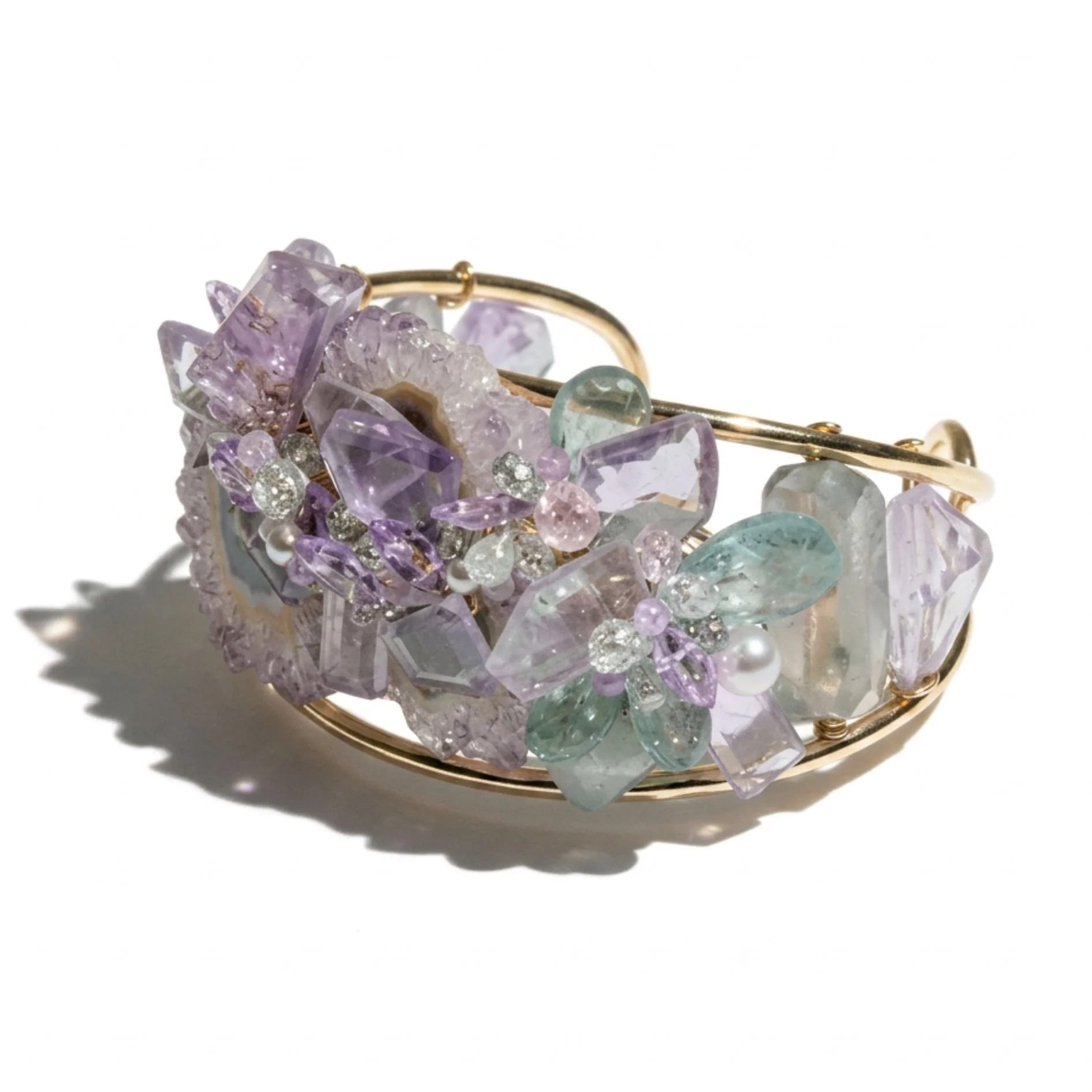
This collection already had two stalactite necklaces, the horizontal Awakening and the vertical Cascade. A third one on a chain would have started to feel like a repetition. The smaller slice gave me a way out. It was the right scale to sit on a cuff, close to the skin, where you catch it in glimpses instead of seeing it head on. So I set out to build something the other two could be worn with, or that could hold its own alone as a piece of arm candy. I named it Ember because that is what it is: the smallest, warmest coal of the three, still glowing.
The materials
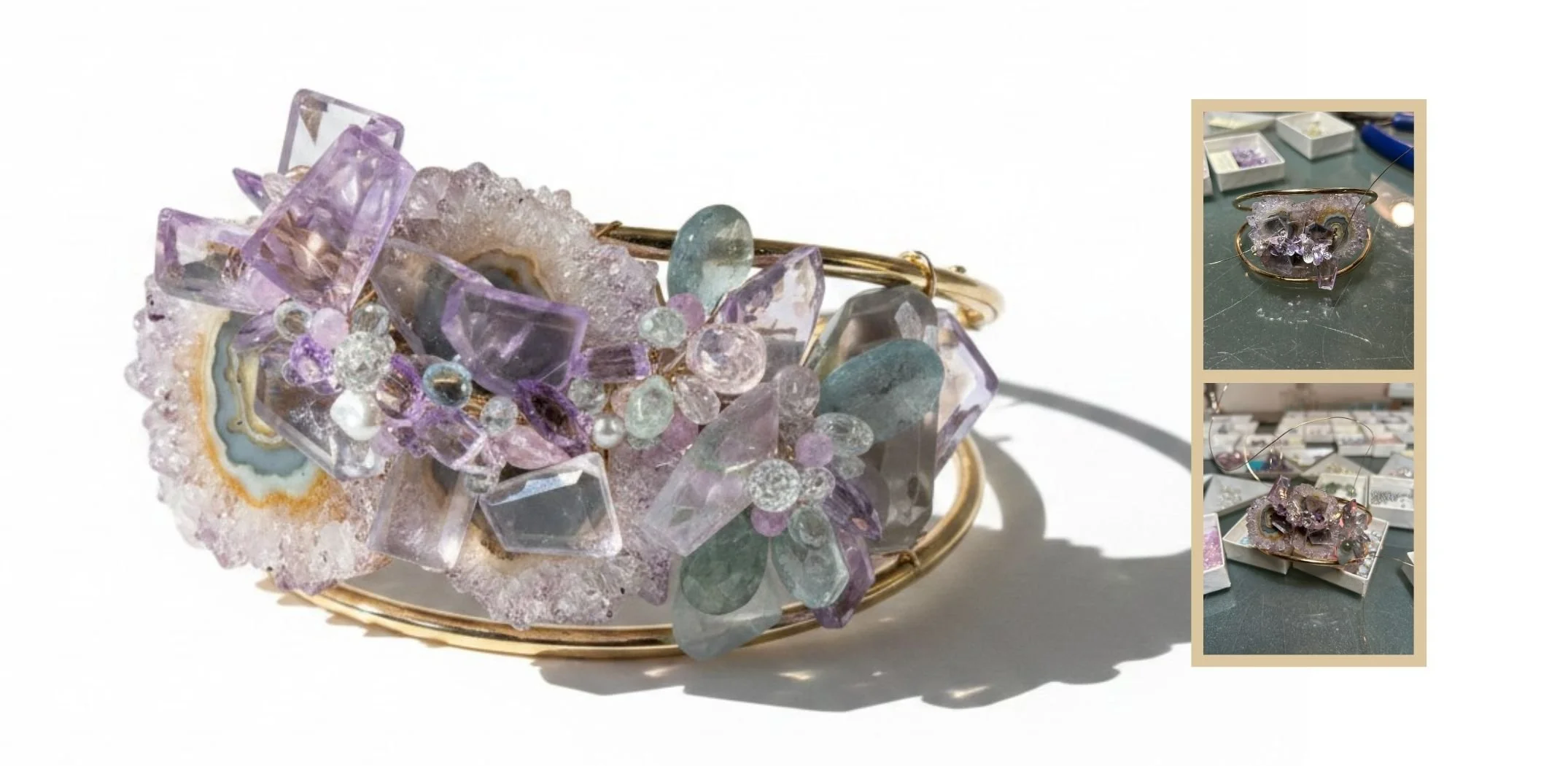
Ember is built on a custom cuff frame I fabricated from heavy 10-gauge 14k gold-filled wire, with the same small folded 24k gold vermeil circle I use to cradle the stalactite. The centerpiece is that last, smallest amethyst geode slice.
The cluster leads with light purple amethyst in asymmetric shield cuts, chosen because their jutting, uneven shapes mirror the raw edges of the stalactite itself. Around them I set fancy-cut amethyst, softer "Scorolite" amethyst, aquamarine in irregular shapes and flat briolettes, tiny sapphires in every color, and akoya keshi pearls. Framing the whole thing are four larger flanking stones, two grey moonstone rectangles and two light amethysts, threaded straight through the cuff.
Gemstone science: one geode, three slices
All three stalactite slices in this collection were cut from the same kind of formation: an amethyst stalactite grown drop by drop inside an ancient volcanic geode, almost always from Uruguay or southern Brazil. Silica-rich water seeps into a pocket in cooling basalt and builds a hanging spike, filling first with a banded agate eye, then ringed by a halo of pale purple amethyst crystal. Amethyst is purple quartz, colored by traces of iron and natural irradiation, and it sits at a 7 on the Mohs hardness scale. What matters for a cuff is that each slice is cut to a different size from the same rare material, so the smallest one carries the exact same geology as its larger siblings, just scaled to the wrist. You can read more in my amethyst stalactite guide.
Andrea Li
andreali.com
Gemstone Science: Amethyst Stalactite Geode
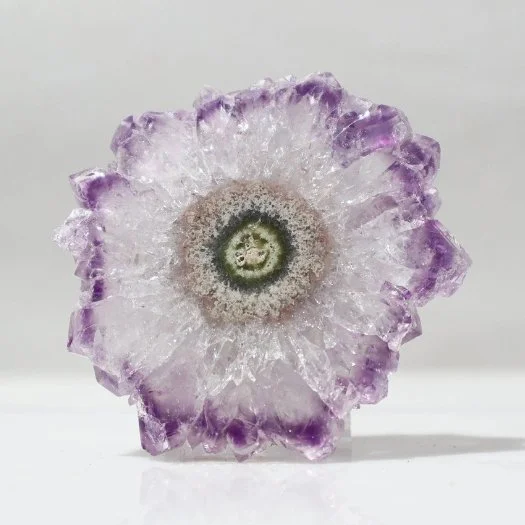
One geode, sliced · a sealed landscape no two of which are alike
How It Forms
01
A pocket opens inside cooling volcanic basalt, and silica-rich water seeps in.
02
Drop by drop, a stalactite grows hanging downward, exactly the way one grows in a cave.
03
The center fills first with banded agate, then amethyst crystals grow outward, finished by a raw druzy rim.
Ancient volcanic pocket in cooling basalt · drop-by-drop stalactite formation
Anatomy of a Slice
Microcrystalline Agate Center
The banded eye at the heart of the slice, the first mineral to fill the pocket.
Amethyst Crystals Halo
Larger purple crystals growing outward into the open space, forming the ring of color.
Raw Druzy Rim
The sparkling crystal-tipped edge that finishes the formation, left exposed as the feature.
The Facts
Origin
Uruguay and southern Brazil, from ancient volcanic geodes.
Mineral
Purple quartz, the violet variety of crystalline quartz.
Color Cause
Traces of iron plus natural irradiation deep in the earth.
Hardness
7 on the Mohs scale, durable enough for regular wear.
Unique Patterns
The pattern forms entirely by chance. No two slices are ever the same.
Truly One of a Kind
Drawn once by the earth over millions of years, it can never recur.
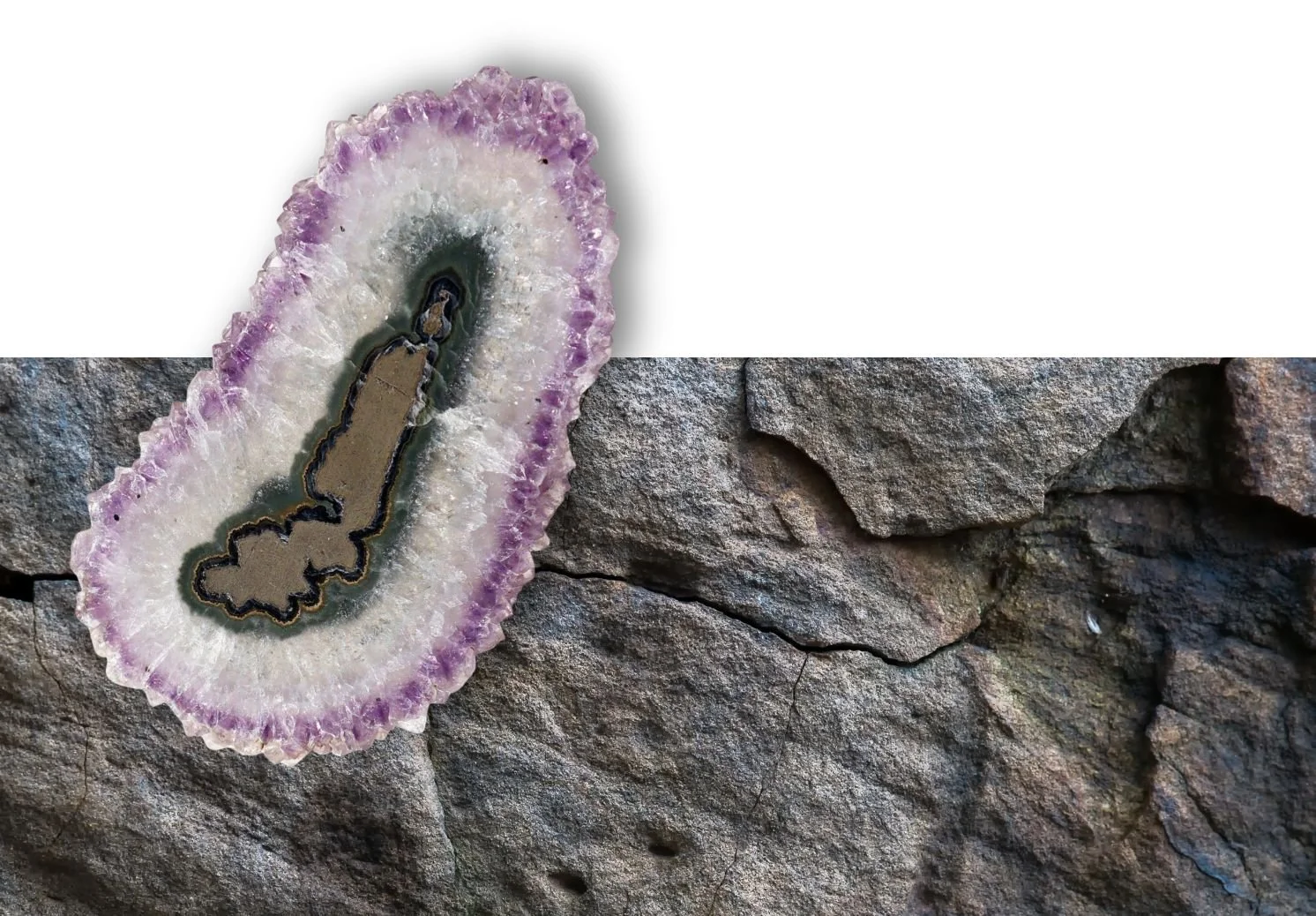
Setting Point-Down
Lets it hang the way it first formed, millions of years ago, in the dark.
Learn more at andreali.com
Andrea Li
The creative process
A cuff has a demand a necklace does not: it has to open and close comfortably around a wrist, over and over, without fighting you. So I fabricated the frame from heavy 10-gauge wire and soldered the ends at an angle to leave a wide opening, then rounded and high-polished those ends so the cuff slips on and off easily and never catches. Only after the frame was sound did I set the stone.
The stalactite went in the same way its sisters did, and this shared technique is the signature that ties the trio together. I fold a single 24k vermeil circle over a wooden dowel, widen its one anchor hole with a diamond-tipped reamer, and thread gold-filled wire through it again and again to weave a web that locks the frame to the slice. Then I set the cluster over the top so the stones appear to grow out of the stone. I let the asymmetric amethyst shield cuts jut out first, echoing the stalactite's raw edges, and then vine into a fuller cluster that reads as if it is creeping across the surface of the geode.
The moment it tested me
The hardest part of Ember was the four flanking stones, and specifically the holes I had to drill for them.
I wanted two large grey moonstone rectangles and two light amethysts to sit outside the main cluster, threaded through the body of the cuff itself so the whole bracelet reads as one continuous story rather than a centerpiece with empty metal on either side. To thread a heavy-gauge head pin through each of those large stones and anchor it to the cuff, the holes on both sides had to align almost perfectly. There is very little forgiveness in that. Drill one a hair off and the head pin binds, or the stone sits crooked. It took patience and a steady hand to get all four to line up and pull the cuff together into a single, integrated piece.
Why this one is truly one of a kind
Like its two sisters, Ember is built around a slice that was unrepeatable before it reached my bench, and the cluster and cuff are matched to that one stone alone. But Ember carries something the necklaces do not: it is the smallest of a set of three cut from the same material, the last of its kind in this collection. When these three stalactites are gone, there will be no fourth. That is the whole idea behind Second Light, the pastel work I continue here from Tamar: I buy the stones I fall for, and I keep designing until each one has found the single piece it was always meant for.
Questions
What is an amethyst stalactite slice?
Is a gemstone cuff comfortable to wear every day?
Is this cuff one of a kind, and can I commission something similar?
Discover
Jewelry that feels like you.
Two minutes. The quiz tells me how you want jewelry to feel in your life, and the messages that follow walk you through pieces I think you'll love.
Take the Style QuizTwo minutes. I take it from there.
Stay Close
Love what you see? Keep finding us.
Google now lets you choose your favorite sources so they show up labeled in AI search answers. If you enjoy discovering handcrafted gemstone jewelry here, add Andrea Li Designs and we'll be easier to find next time you search.
Add Andrea Li Designs as a Preferred SourceOne click. Works across Google Search, AI Overviews, and AI Mode.