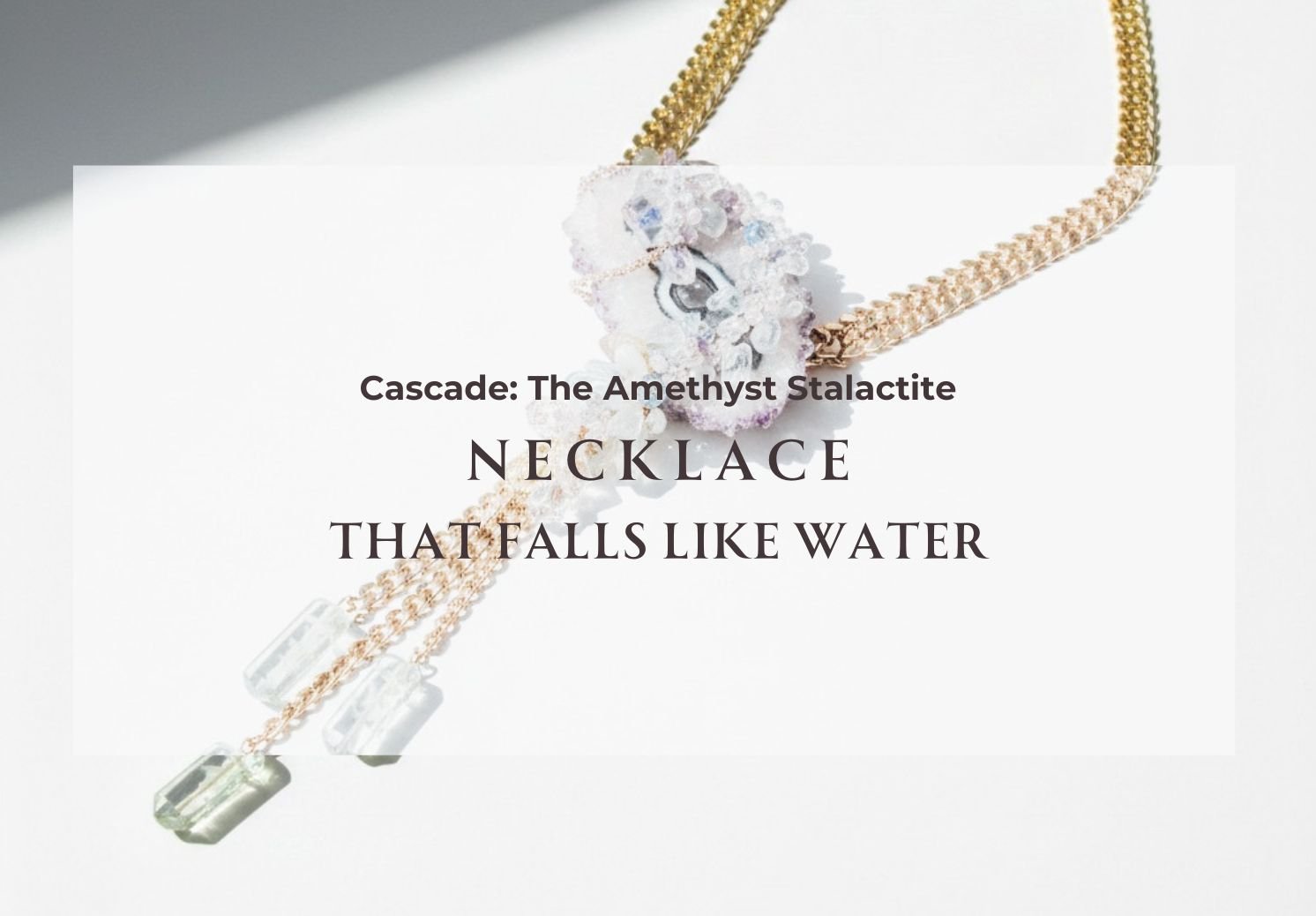
When I finished the first amethyst stalactite necklace in this collection, I knew there had to be a second one. Not a copy. A counterpart.
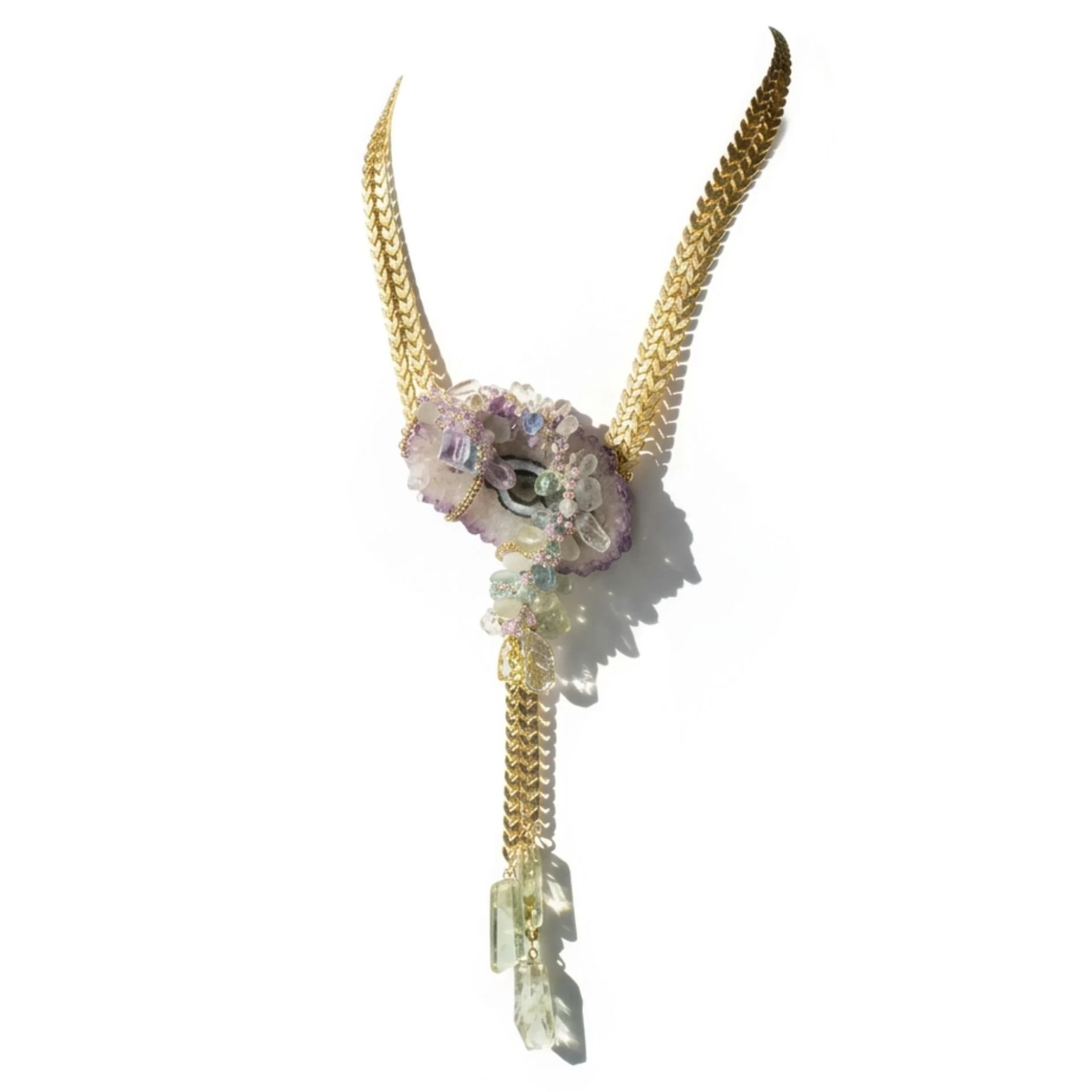
The first piece, the one I called Awakening, lies on its side like a small landscape, calm and horizontal, with the gemstone cluster gathered tight at one end. I had another slice from the same rare group of stones, and it wanted to do the opposite. It wanted to fall. So instead of turning this one on its side, I hung it the way a stalactite actually grows in the dark: pointing down, reaching toward the ground, drop by drop. Everything about this necklace came from that single decision to let the stone descend.
The materials
The heart of the piece is an amethyst geode stalactite slice, set downward into large 24k gold vermeil circles I fold by hand. Because the stone is substantial, it needed a chain with equal presence, so I built the body from a chevron-patterned 14k gold-filled chain, layered in three rows so it reads as one thick, unified band.
Around the slice I grew a cluster of coordinating pastel stones: fancy-cut amethyst, mixed beryl in aquamarine, morganite and heliodor, aquamarine briolettes, tiny sapphires in every color from opaque pink to green, a touch of green topaz, grey moonstone, kunzite, and akoya keshi pearls. The chain drops are anchored with green amethyst, and the lighter edge of the setting is finished in tiny sparkling mystic labradorite. Every stone was chosen to echo the soft purples and smoky greys held inside the slice itself.
Gemstone science: a stalactite, set the way it grew
An amethyst stalactite slice is a cross-section cut from a formation that grew hanging inside an ancient volcanic geode, almost always from Uruguay or southern Brazil. Silica-rich water seeps into a pocket in cooling basalt and, drop by drop, builds a hanging spike exactly the way a stalactite grows in a cave. The center fills first with microcrystalline agate, the banded eye you see, and larger amethyst crystals grow outward around it into the open space, forming the pale purple halo, often finished with a rim of raw druzy. Amethyst is simply purple quartz, colored by traces of iron and natural irradiation, and it sits at a 7 on the Mohs hardness scale. Because the pattern forms entirely by chance, no two slices are ever the same. Setting this one point-down lets it hang the way it first formed, millions of years ago, in the dark.
Andrea Li
andreali.com
Gemstone Science: Amethyst Stalactite Geode
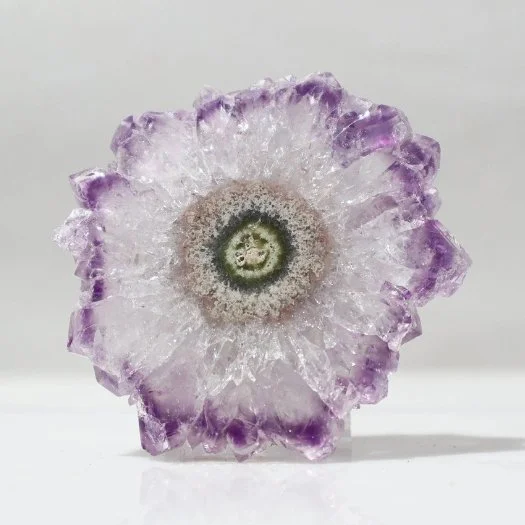
One geode, sliced · a sealed landscape no two of which are alike
How It Forms
01
A pocket opens inside cooling volcanic basalt, and silica-rich water seeps in.
02
Drop by drop, a stalactite grows hanging downward, exactly the way one grows in a cave.
03
The center fills first with banded agate, then amethyst crystals grow outward, finished by a raw druzy rim.
Ancient volcanic pocket in cooling basalt · drop-by-drop stalactite formation
Anatomy of a Slice
Microcrystalline Agate Center
The banded eye at the heart of the slice, the first mineral to fill the pocket.
Amethyst Crystals Halo
Larger purple crystals growing outward into the open space, forming the ring of color.
Raw Druzy Rim
The sparkling crystal-tipped edge that finishes the formation, left exposed as the feature.
The Facts
Origin
Uruguay and southern Brazil, from ancient volcanic geodes.
Mineral
Purple quartz, the violet variety of crystalline quartz.
Color Cause
Traces of iron plus natural irradiation deep in the earth.
Hardness
7 on the Mohs scale, durable enough for regular wear.
Unique Patterns
The pattern forms entirely by chance. No two slices are ever the same.
Truly One of a Kind
Drawn once by the earth over millions of years, it can never recur.
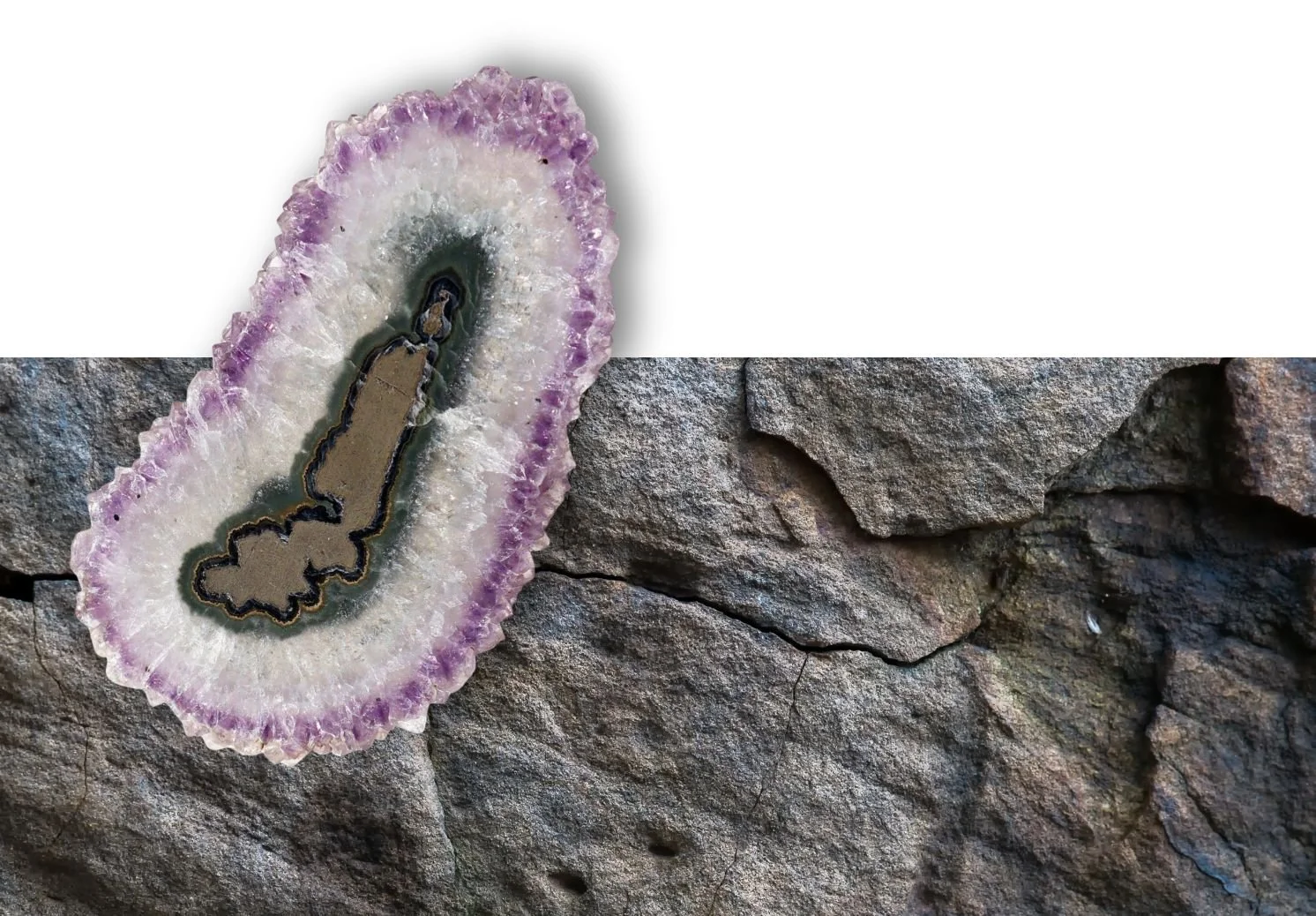
Setting Point-Down
Lets it hang the way it first formed, millions of years ago, in the dark.
Learn more at andreali.com
Andrea Li
The creative process
Always, with these stalactites, the hardest part is invisible in the finished piece: building the structure everything else attaches to. I use large 24k vermeil circles that I gently fold in half over a wooden dowel to get a clean crease, and I cradle the slice inside that fold. There is only one hole to anchor the whole frame, so I widen it as much as I dare with a diamond-tipped reamer, then thread layer after layer of gold-filled wire through it to weave a web that locks the vermeil circles in place. Only then can the gemstone setting begin, covering the surface of the circles so completely that the stones look like they are growing straight out of the stone.
Here I made a choice about restraint. I clustered gemstones along only half of the vermeil circle and edged the rest of the lighter left side in nothing but tiny mystic labradorite, keeping it deliberately minimal so the fully clustered right side could sing. Then I cascaded that cluster downward, letting it spill past the edge of the stalactite to exactly where the three chains reappear at the bottom right, so the pendant and the waterfall drop read as one seamless line rather than two separate ideas.
The chains were their own puzzle. I wanted them to waterfall off the bottom of the pendant into a dramatic triple drop, extending the line of the stone and giving it room to breathe. To make three chains lay correctly around a neck, I used a two-strand bar clasp and drilled an extra hole in the middle to carry the third chain, then cut the chains to slightly varied lengths, shorter on the inside and longer on the outside, so they would curve cleanly instead of tangling.
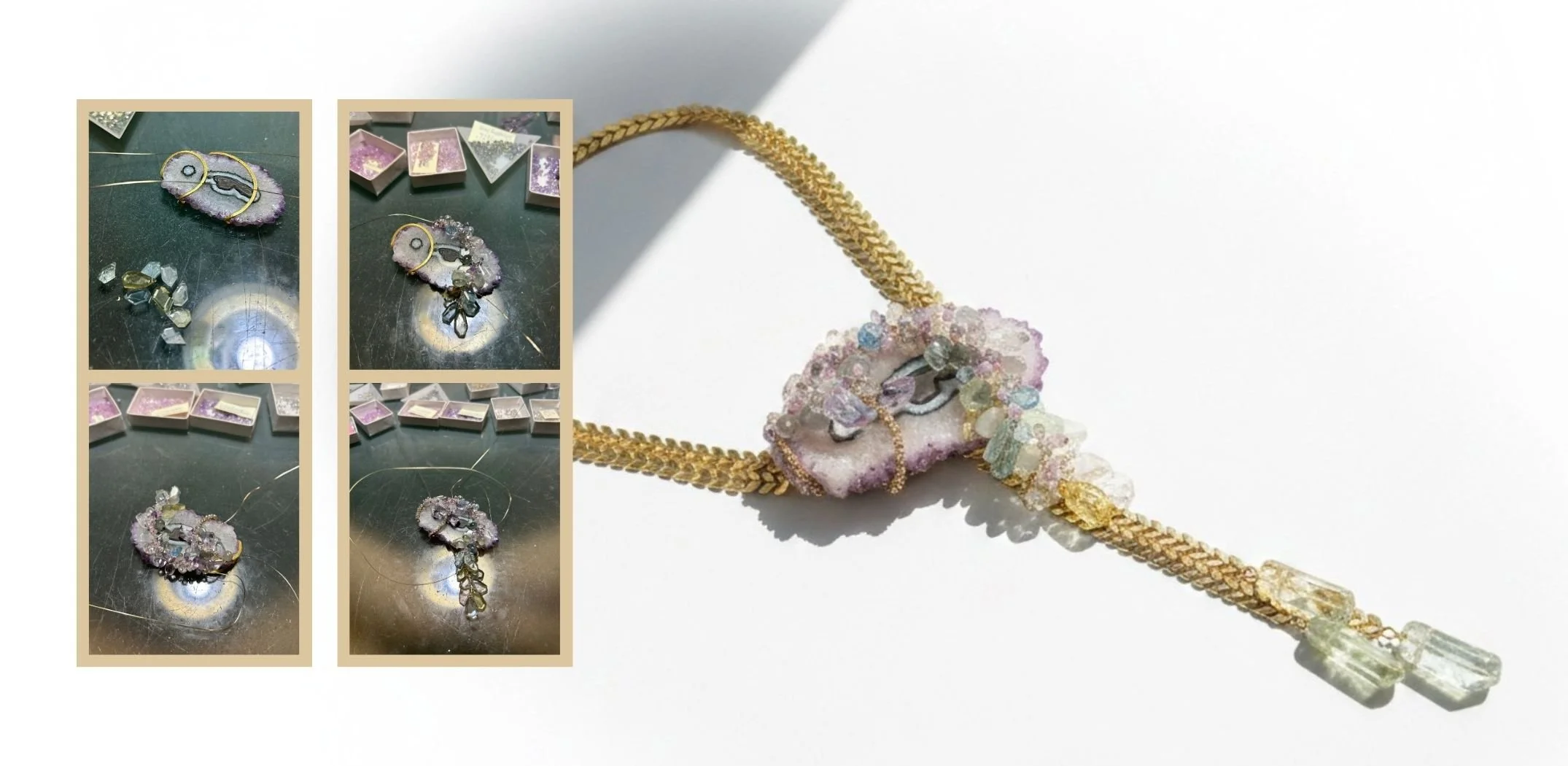
The moment it changed
The first version of the chain drops was wrong, and I knew it the moment I held it up.
I had originally anchored each of the three drops with a green rutilated quartz teardrop, clear quartz shot through with fine green needles. On paper it made sense. In the hand it was too much: the green was oppressive, and it clashed with the soft, muted palette of the rest of the stones. So I took them off and switched to simple-cut green amethyst rectangles instead. Their color was quieter, their rawness echoed the stalactite and the other stones, and suddenly they belonged to the chorus rather than shouting over it. That one swap is the difference between a piece that fights itself and a piece that resolves.
Why this one is truly one of a kind
The slice was unrepeatable before it ever reached my bench. Its banded eye, its purple halo, the exact way the crystals grew, all of it was drawn once by the earth and will never be drawn the same way again. When I build a cluster and a cascade of chain to match one stone, I am matching a composition that cannot recur. Cascade is the vertical, dramatic sister to Awakening, and together with the Ember cuff they complete a three-piece story I could only tell with these three particular slices.
Questions
What is an amethyst stalactite slice?
Is amethyst durable enough for everyday wear?
Is this necklace one of a kind, and can I commission something similar?
Discover
Jewelry that feels like you.
Two minutes. The quiz tells me how you want jewelry to feel in your life, and the messages that follow walk you through pieces I think you'll love.
Take the Style QuizTwo minutes. I take it from there.
Stay Close
Love what you see? Keep finding us.
Google now lets you choose your favorite sources so they show up labeled in AI search answers. If you enjoy discovering handcrafted gemstone jewelry here, add Andrea Li Designs and we'll be easier to find next time you search.
Add Andrea Li Designs as a Preferred SourceOne click. Works across Google Search, AI Overviews, and AI Mode.