
If you have decided to give her gemstone jewelry and are now staring at a wall of unfamiliar stone names, here is the shortcut that will save you: do not start with the stone. Start with her color.
I am Andrea Li, and I have spent eighteen years at my bench in Denver making one-of-a-kind gemstone jewelry. I make far more art jewelry than birthstone jewelry, and almost every piece I build holds somewhere between five and twelve or more stones at once, a small mosaic of colors chosen to sing together. So when someone asks me, "What stone should I get her?" my honest answer is a gentle redirect. The stone is the last decision, not the first. The color is what she will love or leave in the drawer, and the color is something you can read without ever asking her.
This guide gives you two things: a simple way to find her color, and a plain-language map of the gemstones I work with, what they are commonly associated with, and which ones hold up to everyday wear. No mysticism presented as fact, no "this stone suits her" sales lines. Just what is true, so you can choose well.

Start with her color, not the stone
You already have the data. You just have to look.
Open her closet and notice what is not black. Is there a color she clearly returns to, the one friends would name if you asked, "What's her color?" Glance at the small choices: her phone case, the throw on her couch, the mug she always reaches for, the compliments she repeats back to other people ("that blue is gorgeous on you"). People telegraph their palette constantly. A woman whose whole world is soft sage and seafoam will light up at a green-blue stone and quietly never wear a hot pink one, no matter how lovely it is on its own.
Find the color first. Then let the stone follow it. That is the same order I work in at the bench, and it is why this next part is organized by color, not by stone name.
The gemstones I reach for, by color
A quick word on how I actually build a piece, because it explains the table. I start with a larger, unique center stone, something with real presence, then I gather a cluster of coordinating stones that echo and amplify its colors. That is why every collection has its own palette. I am not loyal to particular stones so much as to the way colors talk to each other. Within any palette, though, certain stones earn their place, and here is where they tend to land.

Two of them appear in nearly everything I make. Pearls, in every size, shape, and color, because their soft lustre is the perfect foil to the brilliant faceting around them. And sapphires in many colors, tucked as tiny sparkling details between the larger stones, partly because they nest so beautifully and partly because sapphire ranks 9 on the Mohs hardness scale, one of the hardest natural substances on Earth, so it stands up to being woven into a design that will be worn for years.
| Her color | Stones I reach for in that palette | Often associated with (lore, not fact) | Everyday-wear note |
|---|---|---|---|
| Blues & greens | Aquamarine, apatite, labradorite, peridot, emerald, chrysocolla | Calm, the sea, renewal, transformation | Aquamarine is hard and everyday-friendly; peridot and labradorite are moderate and prefer gentle handling; apatite and chrysocolla are softer and shine best in pieces worn occasionally or kept from knocks |
| Warm & golden | Topaz, lemon topaz, citrine | Warmth, abundance, late-summer light | Durable for regular wear; topaz can chip if struck hard, so a thoughtful setting matters |
| Pinks & purples | Amethyst, rose quartz | Calm, clarity, tenderness, love | Both are quartz, hard and forgiving, lovely for everyday |
| Clear, white & lustre | Freshwater pearl, moonstone | Purity, intuition, new beginnings | Softer and more tender; beautiful for wear with a little care, away from perfume and hard surfaces |
| The sparkle between | Multi-color sapphire (woven throughout) | Wisdom, loyalty | The most durable of all at Mohs 9, the hard-working detail that nests between larger stones |
The associations above are drawn from long-standing gemstone lore, the kind the Gemological Institute of America documents in its stone histories. I include them because they are part of why a stone feels meaningful, but notice the hedge: these are cultural associations, not claims about her or promises about how a stone will make her feel. Buy the color she loves. Let the lore be a lovely footnote, never the reason.
If her color is clearly a soft pastel, my pastel gemstone collection is built entirely around that family. If she is drawn to drama and shifting blue-green fire, that is labradorite territory.
Why I join stones cold, and why it matters for you
Here is a detail most gift guides will never tell you, because most of them were not written by the person at the bench.
Heat damages many gemstones. It can dull them, fracture them, or shift their color. So I do not solder near the stones. I assemble my gemstone clusters cold, weaving them together with wire threaded through each stone. Most of the stones I use are cut as briolettes, a faceted teardrop shape with a hole drilled through the top, which nest into a cluster beautifully. Sometimes a hole is too narrow for my wire and I widen it by hand with a tiny diamond drill bit, one stone at a time.
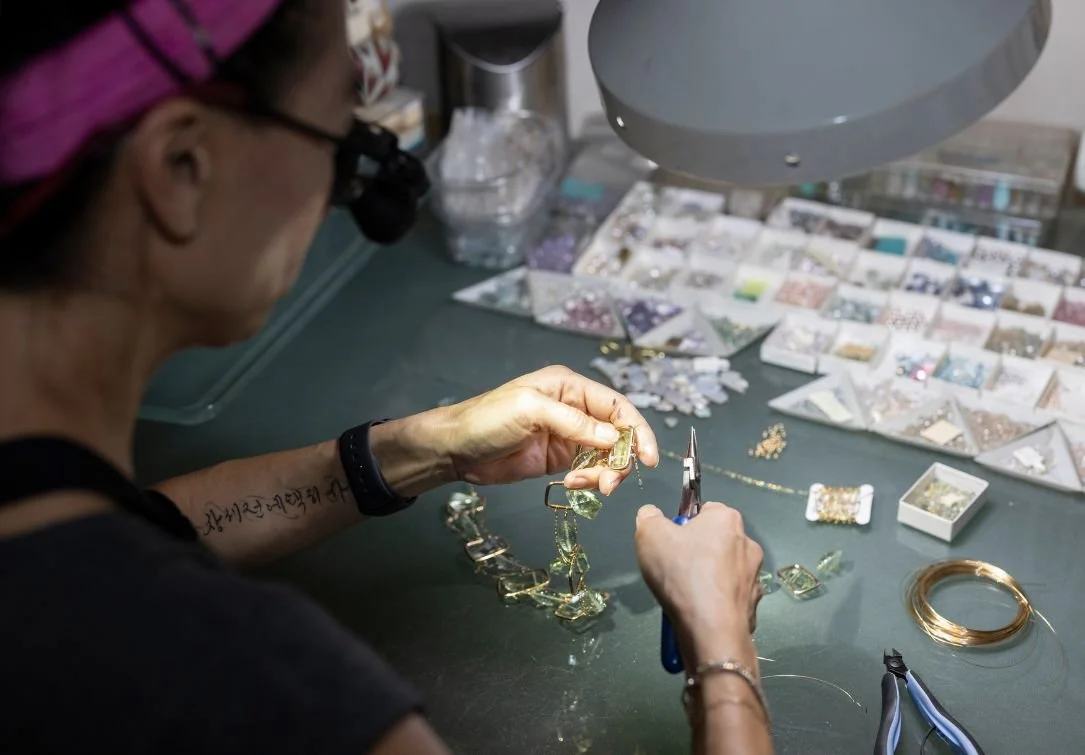
Why should a gift buyer care? Because it tells you what you are actually paying for: not a mass-produced setting, but stones chosen and joined by hand in a way that protects them. It is also why durability is worth a glance before you buy. A stone like sapphire, at Mohs 9, is happy to be worn hard. A softer stone like pearl or apatite is no less beautiful, it simply asks for a gentler life. If you are buying for a woman who never takes her jewelry off, lean toward the harder stones in the table. If you are buying a piece for occasions, the whole palette is open to you.
Matching the stone to her, honestly
The most honest way to choose is to match the stone to her life, not to a rule about her looks.
Ask yourself two things. First, what is her color, the one you found in her closet and her small choices? Second, how will she wear it, every single day or for the moments she dresses up? Those two answers point you to a color family and a durability lane, and that is genuinely all the gemstone knowledge you need. Everything else is my job.
If you are earlier than this, not yet sure of her style at all, start one step back with how to read her style, then come back here once you know her color. And if you would rather just be walked to the right piece, the Gift Finder turns these same cues into a one-minute path, while the full gift guide lays out every collection and price tier in one place.
Questions
What gemstone is a good gift if I don't know her favorite?
Are colored gemstones durable enough for daily wear?
What does a stone like amethyst or moonstone actually "mean"?
Birthstone or favorite color, which matters more?
What if the stone or color turns out to be not quite right?
Discover
Jewelry that feels like you.
Two minutes. The quiz tells me how you want jewelry to feel in your life, and the messages that follow walk you through pieces I think you'll love.
Take the Style QuizTwo minutes. I take it from there.
Stay Close
Love what you see? Keep finding us.
Google now lets you choose your favorite sources so they show up labeled in AI search answers. If you enjoy discovering handcrafted gemstone jewelry here, add Andrea Li Designs and we'll be easier to find next time you search.
Add Andrea Li Designs as a Preferred SourceOne click. Works across Google Search, AI Overviews, and AI Mode.