
Sometimes you design in service of the collection itself.
I had two bracelets in Second Light. I wanted three.
Two cuffs, and a gap where a third bracelet should be
Both of the others are cuffs. Ember is a heavy fabricated frame built around a stalactite slice, and the Alpenglow Bracelet is seven linked shapes with a stone set into every one. Both are dense.
So the third one had a job. It needed to be more minimal than either, and it needed to not be a third cuff.
A bangle answered both at once. It brought a form the collection did not have, and it gave someone a way into this work that does not require wearing a statement.
I should say that this is not how I usually start. Most of the time a stone arrives and I follow it. This time I was looking at a list of what the collection had and did not have, and I designed toward the gap.
One wave, and nothing else
I knew the design element before I knew anything else. A single wave.
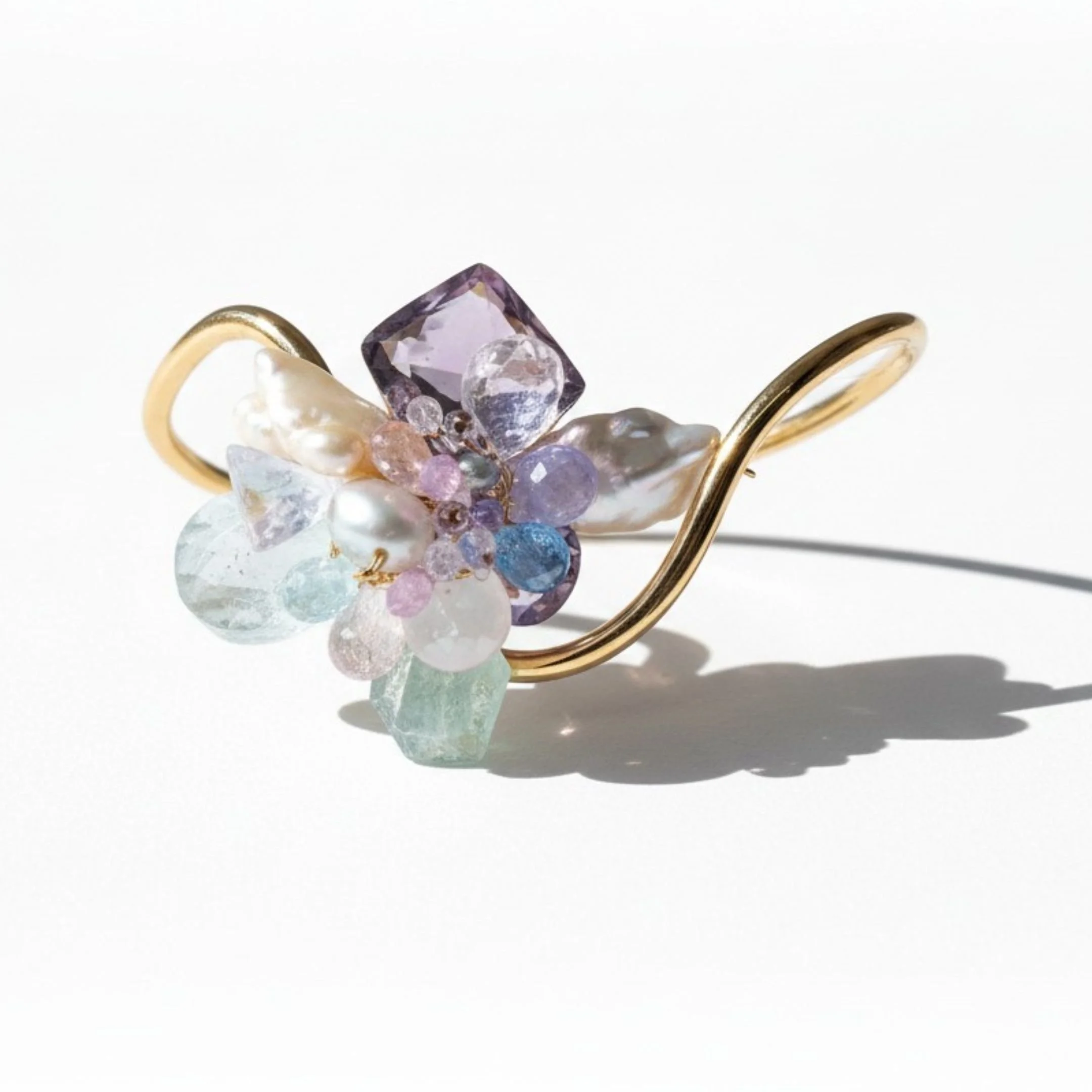
I formed it on a wire jig from 10-gauge 14k gold-filled wire, letting one side resolve slightly higher than the other so the curve came out asymmetric rather than even. That unevenness is the whole design. It opens a place along the bend where a gemstone cluster can sit down into the curve instead of perching on top of it.
Then I shaped it on an anvil until it held. Wire this heavy does not hold a curve because you formed it there once. It holds because it has been worked until the metal agrees, and 10-gauge is thick enough to argue.
The whole form took seven hours at the bench. The Alpenglow Bracelet took eighteen, across three days. That gap is the piece.
The two ends took a few passes
Each end finishes in a small 14k gold-filled ball, and the ball does not sit on the end of the wire. It sits down inside it.
That means drilling a burred-out divot into the cut end of 10-gauge wire, then soldering a ball into that divot so it sits level and centered. On a curve, with two ends, and the two of them visible side by side whenever the bangle is on a wrist.
It took a few passes. This was the tricky part of the piece, and it is the part you would never guess was difficult, because when it works it looks like nothing happened at all.

The cluster was built for a different necklace
While I was forming the bangle I was also working on Blue Hour, my moonstone marquis pendant. I had hand-formed its oval frame and I was building a gemstone cluster to fill it.
That cluster did not fit. It was too big to sit properly inside the oval, and at that size it threw the proportions of the necklace off.
It was exactly right for the curve of the bangle.
I set it into the bend and marked the metal with a sharpie where I needed to drill, so the cluster could be wired down into the frame rather than resting against it. Shield-cut and pear aquamarine, a fancy-cut amethyst, lavender quartz, morganite, kunzite, pale amethyst, and clear pink, opaque pink and purple sapphires, with a Japanese Akoya pearl and a freshwater pearl among them. Twelve kinds of stone in a cluster you could cover with a thumb.
Nothing was wasted, and nothing was compromised to make it fit. The cluster simply belonged somewhere other than where I built it.
A pearl that reaches across
One lavender keshi freshwater pearl runs across the curve and anchors into the other side.
It does two things at once, which is why it is there. It holds the cluster more securely than the drilled anchor points alone, and it carries the eye across the open span of the wave instead of letting everything pile at one end.
There is a second keshi pearl in the cluster itself. Together they are the largest single material cost in the piece, more than the wire.


Opulent and minimal
That is the result, and I am going to use both words because the piece earns both.
The form is one line. One curve of gold-filled wire, two finished ends, nothing else structural. Set against that, the cluster is as dense and as layered as anything in Second Light, with a dozen stones packed into a space the size of a thumbprint.
Crest was made once. The wave was formed by hand and will not come off the jig the same way twice, and the cluster that sits in it was built for a different piece entirely, so it exists in this configuration and no other.
Questions
What is a bangle, compared to a cuff?
What does 14k gold-filled mean?
Is Crest one of a kind, and can I commission something similar?
Discover
Jewelry that feels like you.
Two minutes. The quiz tells me how you want jewelry to feel in your life, and the messages that follow walk you through pieces I think you'll love.
Take the Style QuizTwo minutes. I take it from there.
Stay Close
Love what you see? Keep finding us.
Google now lets you choose your favorite sources so they show up labeled in AI search answers. If you enjoy discovering handcrafted gemstone jewelry here, add Andrea Li Designs and we'll be easier to find next time you search.
Add Andrea Li Designs as a Preferred SourceOne click. Works across Google Search, AI Overviews, and AI Mode.