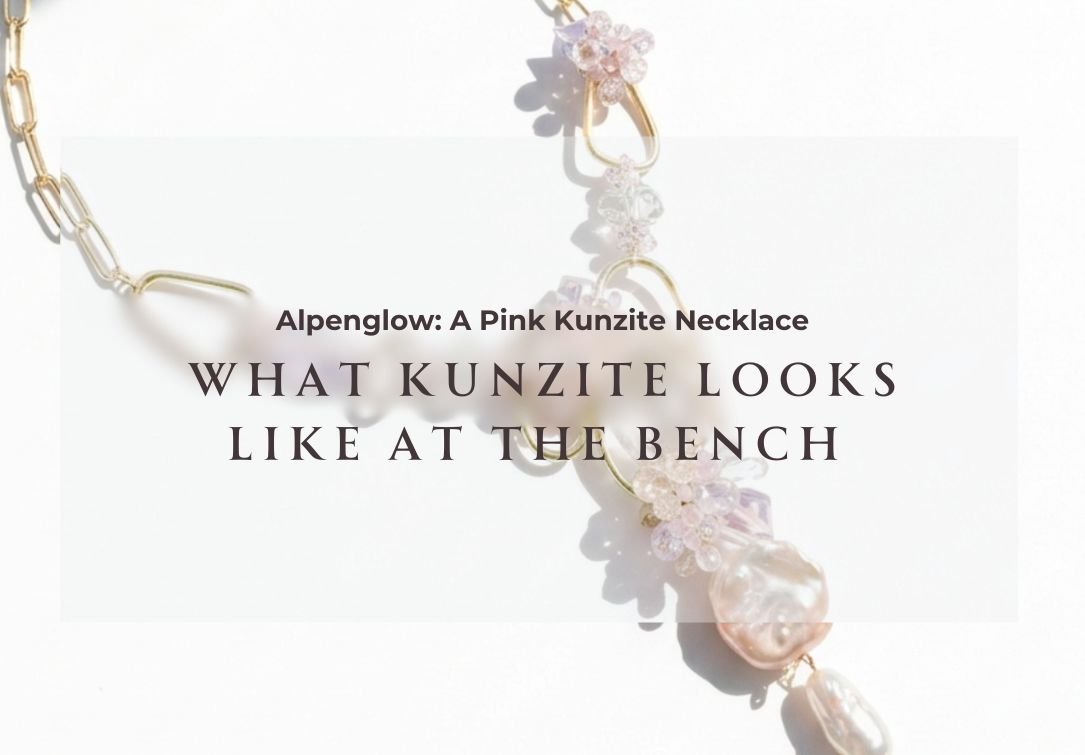
I usually start with a stone. I find the one I cannot stop looking at, I carry it around for a while, and eventually it tells me what it wants to be.
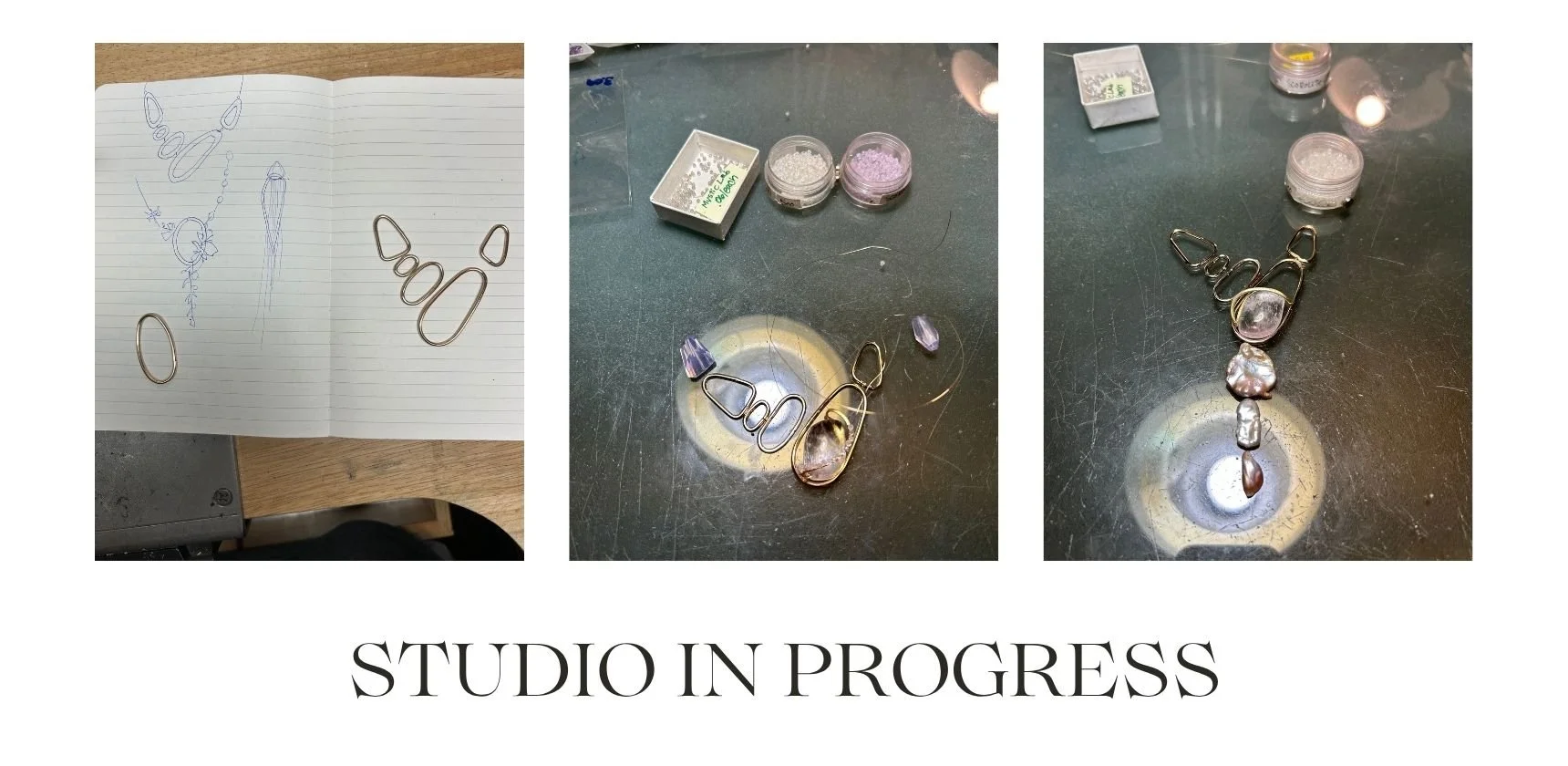
Alpenglow started in a notebook, with shapes drawn out and placed in an appealing configuration.
Five shapes, formed one at a time
I wanted large fabricated links, which meant I had to make them. I used a metal wire-bending jig with adjustable dies so the curves would come out smooth and uniform rather than approximately round, and I formed each shape from 12-gauge 14k gold-filled wire.
A large teardrop for the center. An elongated oval next to it, then a smaller oval. Then two more triangular shapes for the outer ends, because I knew I wanted the top point of each triangle to be where the chain attached.
Each one got soldered closed at its two end points, polished to a high shine, and drilled with tiny holes at every place another piece would eventually attach. That is hours of work that produce five plain gold shapes and nothing you would yet call jewelry. It is also the part that decides whether any of the rest of it holds together.
Andrea Li Fine Jewelry
Why Kunzite Is Finished Smooth
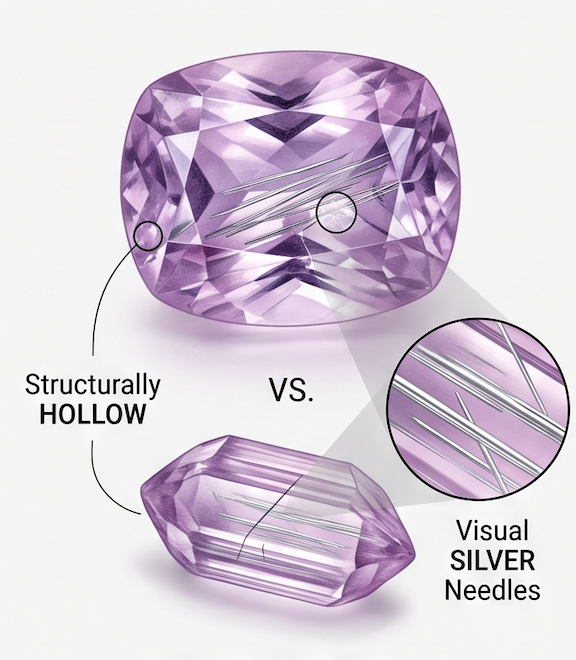
The silvery threads inside a kunzite are hollow. That one fact decides how the stone has to be cut, and it is the reason you will not see this stone faceted on my bench.
Step One
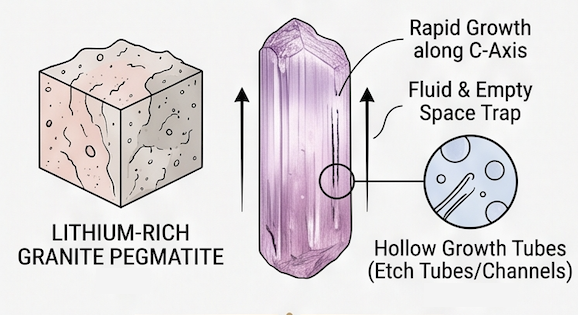
The tubes are empty space
Kunzite grows in lithium-rich granite pegmatite, and it grows fast along one axis. That speed traps pockets of fluid and empty space as the crystal lengthens, leaving hollow growth tubes, also called etch tubes or channels, running the length of the stone.
In the pendant I used for Last Light I could see both kinds: growth and etch tubes, fine parallel needle-like tubular channels, and healing cracks or feathers, partial internal fractures that look like faint veils.
Step Two
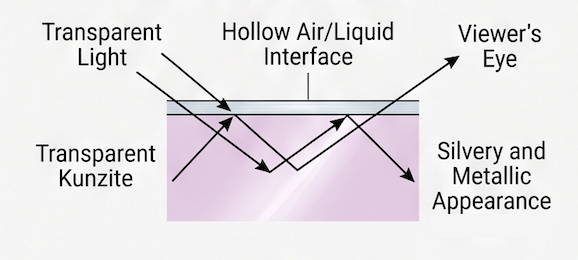
Which is why they look like silver
Nothing metallic is in there. Light moving through the transparent stone hits the boundary between crystal and the air or liquid inside a tube, and at a shallow enough angle it reflects instead of passing through.
That is total internal reflection, the same effect that makes a fiber-optic strand glow. The eye reads those bright reflections as fine silver needles.
Step Three, the bench decision
So the stone gets a dome, not facets
Those same hollow channels are structural weakness. Four reasons I finish kunzite smooth:
- Kunzite has two directions of perfect cleavage, so faceting pressure can split it.
- The stone resists abrasion, so faceting friction stresses the weak internal structures rather than cutting cleanly past them.
- A cabochon distributes pressure evenly instead of concentrating it at an edge.
- Kunzite is pleochroic. A dome blends the shifting pink and violet, where facets lock them into fixed reflections.
"Kunzite looks almost like a light pale pink hard piece of candy with fine, parallel grooves or lines called striations along their length. These lines reflect light and give the stone a shimmering, fibrous look from within. As you move the stone under light these striations shimmer at different angles."
Andrea Li, at the bench
Kunzite is the pink to lilac variety of spodumene, colored by traces of manganese, 6.5 to 7 on the Mohs scale, named for the gemologist George Frederick Kunz who described it in 1902. Gemology per GIA and the International Gem Society. The bench observations are my own.
See the Second Light CollectionThe moment it dropped into the shape
The centerpiece was a large smooth pink kunzite I already had. There is often a bit of kismet and destiny whenever a stone finds its home.
Kunzite looks almost like a pale pink piece of hard candy. It carries fine parallel grooves running the length of it, called striations, and they catch the light from inside so the stone reads as fibrous rather than glassy. Move it under a lamp, and they shimmer at different angles, one after another.
I held it up against the large fabricated teardrop, and it nestled straight into the shape. That was the moment. Once I wired it onto the vermeil oval to set it, the necklace had a direction, and everything after that followed.
There was one problem. It had a single drill hole, and the hole sat at the slimmest point of the stone. Meaning it had only one anchor point, which is insufficient, especially when pointing downward to defy gravity rather than hanging right side up as a regular pendant on a chain.
This is not my first kunzite. I made a pink kunzite choker some time ago, and it has since found its person.
Kunzite, by the way, is the pink to lilac variety of spodumene, colored by traces of manganese, and it sits at 6.5 to 7 on the Mohs scale. I selected this stone for its pure aesthetic beauty.
So I could not hang it. It had to be seated into something that would allow multiple anchor points and to secure it well enough that positioning it inversely would not matter.
So I took a 24k gold vermeil oval. Vermeil is a thick layer of gold over sterling silver, not over base metal. I folded it in half over a wooden dowel, working it until it cradled the kunzite, then wired the stone in.
That gave me three anchor points into the fabricated teardrop instead of one. The stone is held by the structure now, not hanging off it.
The vermeil was showing, so I drew a line across it
Setting the stone left a curve of bare vermeil exposed along one edge. Not that this is a problem; the gold vermeil is still beautiful to look at, but I wanted the bare metal elements to be exclusive to the fabricated shapes.
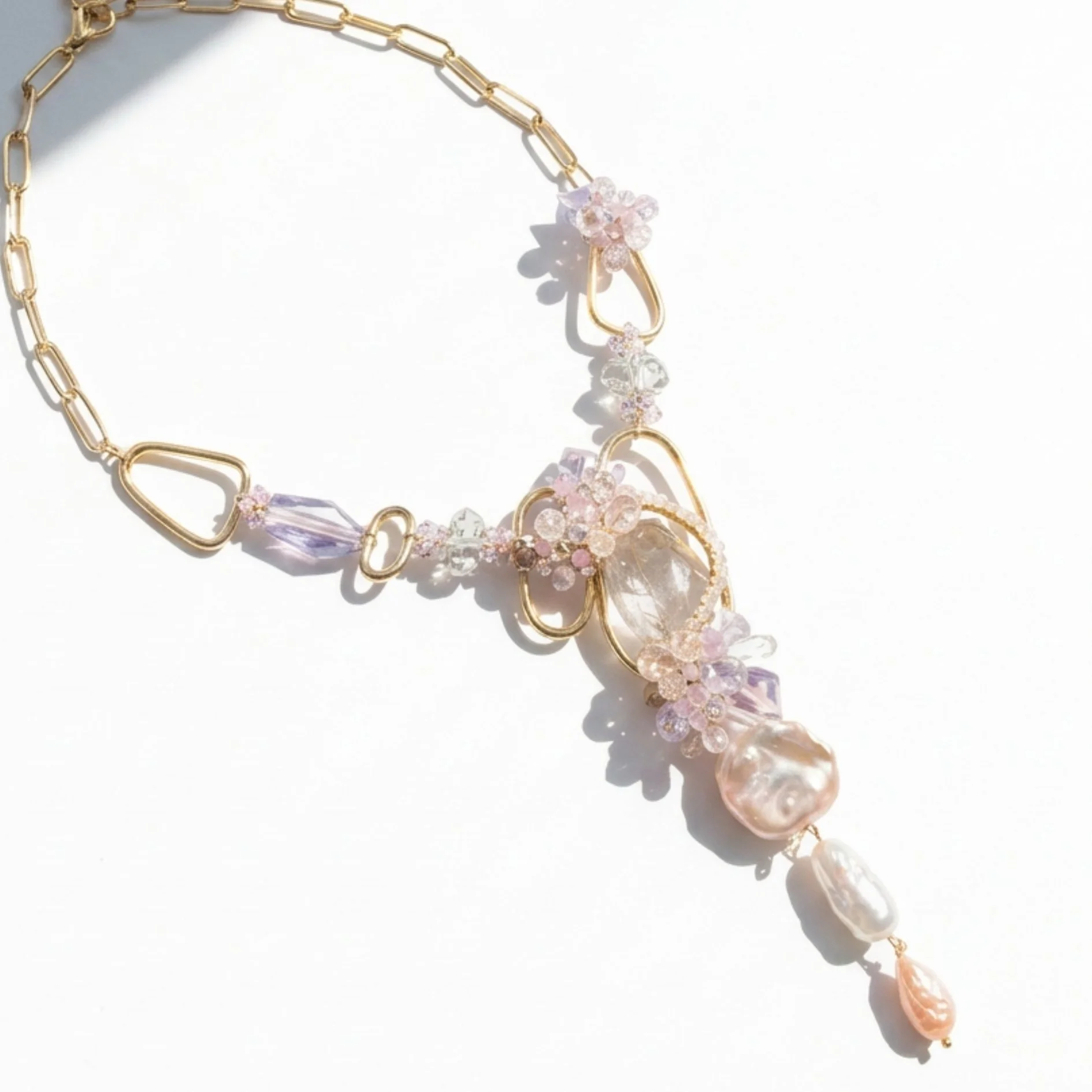
I edged it with mystic labradorite. The stones are so small they read as a line before they read as stones, sweeping across the kunzite in an arch that comes back down on the far side from where it is wired.
It is the smallest material in the necklace. It is the first thing your eye follows.
Everything else grows out from there
Above and below the kunzite I built the clusters: kunzite pear briolettes, clear and opaque pink sapphires, purple sapphires, lavender quartz, morganite briolettes, moonstone rondelles, and Japanese Akoya keshi pearls. One large baroque pearl hangs below the lower cluster, with two lavender keshi freshwater pearls dropping beneath it.
Between each pair of shapes sits a simple-cut aquamarine on a 14k gold-filled head pin. Each one carries its own small cluster of pink and purple sapphires, above and below.
That is more than mere decoration. A stone threaded on a wire will rotate, and a rotating stone shows you its back half the time. The clusters hold it where I put it.
Both aquamarine and morganite appear in this piece. I have written up the difference separately. Go check out the link if you’re curious.
The side I changed my mind about
The two ends are not symmetrical, and that was not the plan.
One triangle takes a small gemstone cluster and runs into 14k gold-filled paperclip chain. The other was going to take a pearl with sapphire clustering above and below it, the same as its opposite number. I built it, looked at it, and swapped the pearl out for a single large pale amethyst simple cut with a small cluster of sapphires at its top.
I am glad I did, and not only because the necklace is better for it. That one pale amethyst is the reason there is now a bracelet. It sat there looking like the beginning of something, and I went back to the bench and made the piece it was asking for.
Why it is called Alpenglow
Alpenglow is the pink light that stays on the mountains after the sun has already dropped behind them. If you live where I live you see it most evenings, and it is the exact color of this stone.
It is also the whole idea of this collection stated in one word. Second Light is about the light that arrives after the light you were counting on has gone. I did not have to reach for the name.
The necklace was made once. The kunzite had one hole and one shape, the five links were formed by hand and will never come off the jig the same way twice, and the cluster was built to this stone and no other. It will not be made again, which is the point.
Questions
What is kunzite?
Does kunzite fade, and how should I care for it?
Is Alpenglow one of a kind, and can I commission something similar?
Discover
Jewelry that feels like you.
Two minutes. The quiz tells me how you want jewelry to feel in your life, and the messages that follow walk you through pieces I think you'll love.
Take the Style QuizTwo minutes. I take it from there.
Stay Close
Love what you see? Keep finding us.
Google now lets you choose your favorite sources so they show up labeled in AI search answers. If you enjoy discovering handcrafted gemstone jewelry here, add Andrea Li Designs and we'll be easier to find next time you search.
Add Andrea Li Designs as a Preferred SourceOne click. Works across Google Search, AI Overviews, and AI Mode.