I finished the kunzite necklace, and part of the ritual of completing a piece is to sit with it. In a way, it’s to soak in the newness of what I created (this is why buying something new is so satisfying, right?). Part of it, admittedly, is to admire what I had just made. But in this process, I begin to see elements of the design that can be improved and parts I can borrow for my next design.
In this case, I noticed where I had placed a pearl with sapphire clusters towards the end of the necklace. While there was nothing inherently wrong with this initial design choice, I decided I wanted something more substantial. I replaced it with one large pale amethyst.
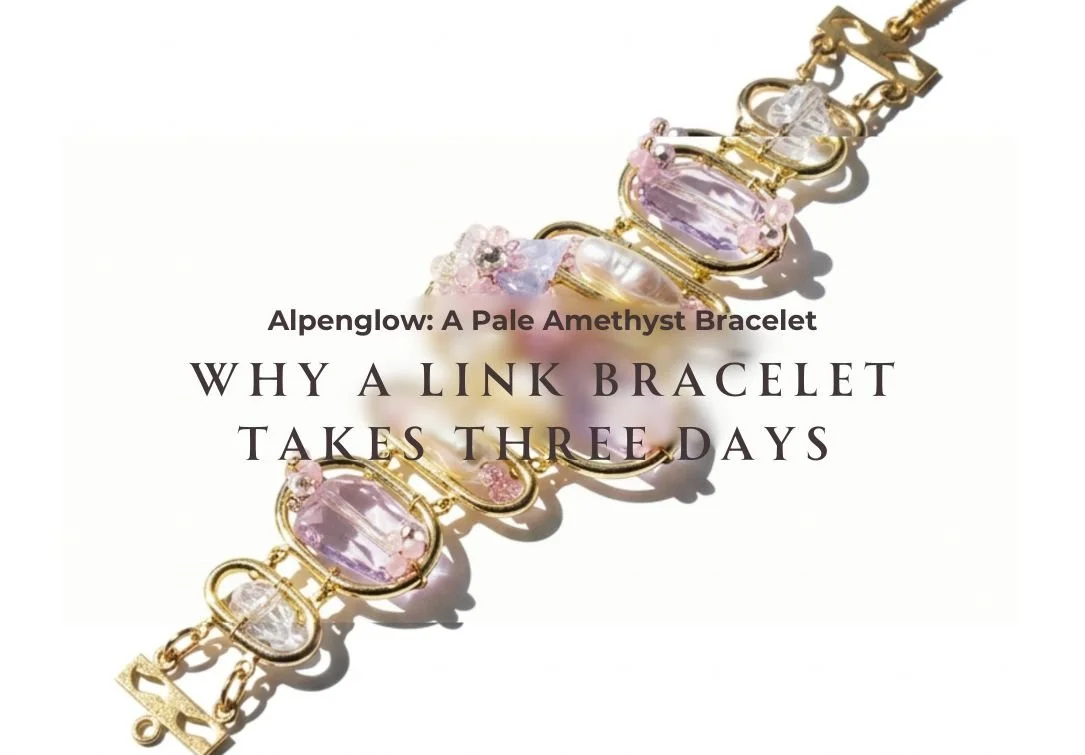
I knew my current selection of pieces was thin on bracelets, and as I continued auditing the necklace, I began thinking about the fabricated shapes and how they could serve as a borrowed design concept to create a large link bracelet that would carry a similar spirit to the necklace. So I went back to the same jig and made the bracelet it was asking for.
Seven shapes in a line
Most bracelets I create are cuffs or bangles, but this one was an entirely new concept: creating large links interconnected to form a daisy chain, designed flat but that would wrap around the wrist.
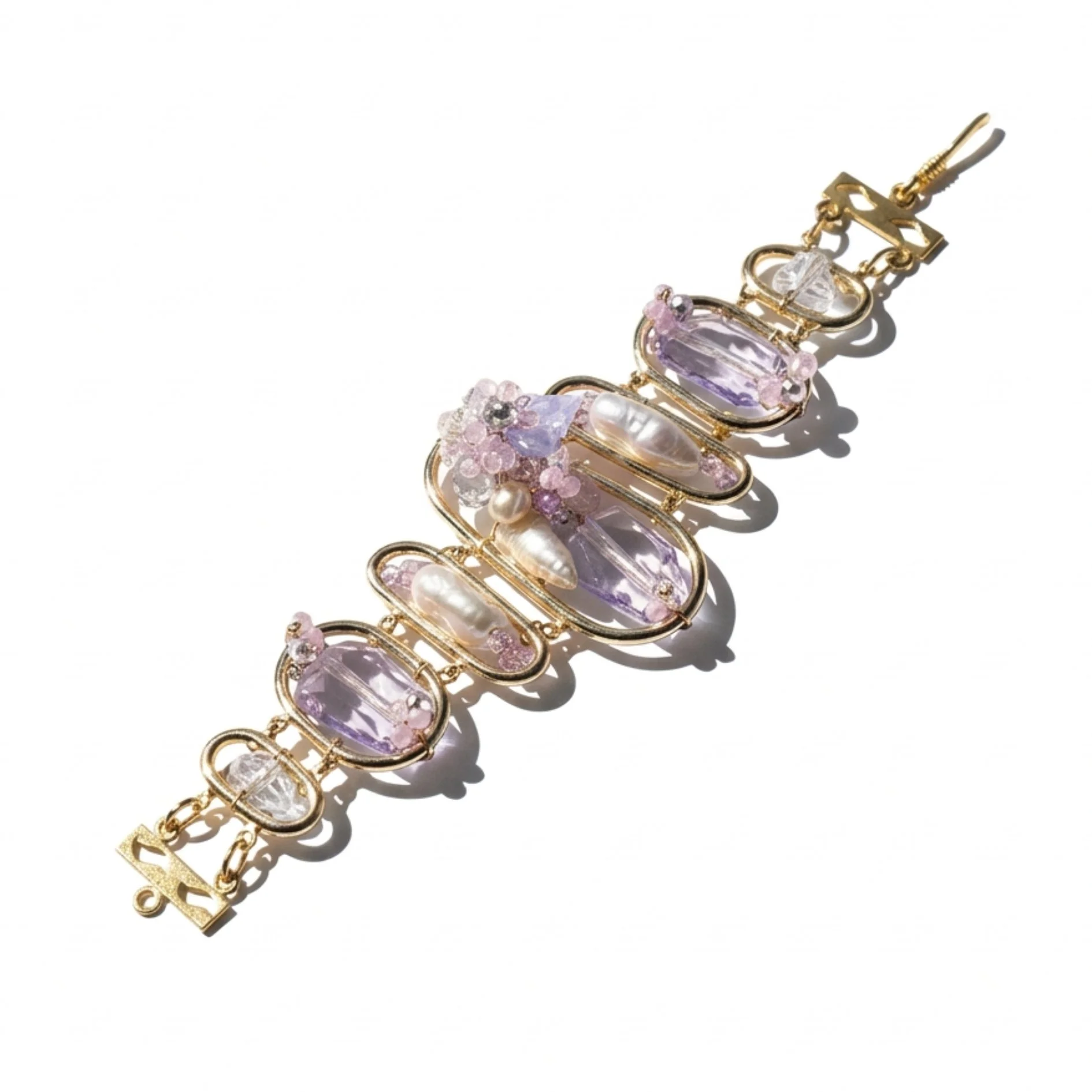
That changes what the shapes have to do. I laid out seven of them to run linearly: a large teardrop at the center, an elongated oval on either side of it, then two rounder and larger ovals, and a smaller elongated oval at each end. Hand-formed on the same jig, from the same 12-gauge 14k gold-filled wire as the necklace, so the two pieces would obviously come from the same aesthetic family.
Seven fabricated links soldered closed. Polished to a high shine. Seven finished shapes on the bench, and the hard part still ahead of me.
Twenty-eight holes, and every one had to agree
Each shape needed four holes. Two on one side, two on the other, so it could hold hands with the shape on its left and the shape on its right.
Seven shapes. Twenty-eight holes. And every single one had to line up with the hole in its neighbor closely enough to pass a head pin straight through.
There is very little forgiveness in that. Drill one a hair off, and the pin binds, or the link sits crooked, and it pulls everything downstream of it out of true. You do not always notice at the time. You notice four shapes later, when the run has started to curve away from you, and you have to work out which hole is the liar.
Keeping track of twenty-eight of them, in the right order, on the right sides, was the whole job. This is why designing is akin to playing chess. You have to think about how one move on the board can affect several moves downstream once a piece is in play. One mistake and it can cost you the whole game.
Three days before a single stone went in
I joined the shapes with 10-gauge 14k gold-filled head pins so every connection point would be genuinely strong, and threaded 14k gold-filled jump rings through the drilled holes and then through the hole in each head pin, locking each link to the next. The minutiae of engineering is always the tedious and unsexy part.
The other thing I was solving the whole time was length. I wanted 7 inches, which is standard. I also knew I wanted a 24k gold vermeil double-strand clasp, so it would go on and come off with one hand. Vermeil is a thick layer of gold over sterling silver, not over base metal.
But the finished length is the sum of every gap between every component. I did not know most of those gaps until I was already committed to them. So I kept going back, adjusting, re-measuring.
Fabrication and assembly took three days of separate bench sessions. Not one stone had gone in yet. That is where the time in this piece actually lives, and it is the part nobody can see. Nothing about the process can be automated or shortcut.
Three vendors, three names, one stone
Then the stones, and I want to be straight about one thing first, because it is a real buying question and nobody answers it plainly. I know this because it has bitten me in the past. I used to take the names of the stones I purchased as the source of truth. What I didn’t realize until later is that many gemstone manufacturers invent names for their stones.
The pale amethyst here, a stone one of my vendors sells as Scorolite, and the lavender quartz I buy from a different vendor are almost identical, except one is technically amethyst and the other a type of quartz. The two stones sit side by side, and one wouldn’t be able to distinguish one from the other.
Amethyst is the purple variety of quartz, colored by traces of iron and natural irradiation, sitting at 7 on the Mohs scale. Pale amethyst is amethyst at the light end of its range.
What it actually looks like is a muted, cool violet, closer to lilac, with a soft greyish undertone sitting under it. Put it next to a crisp purple amethyst, and it reads hazy. Diffused. Milky, almost, and translucent rather than clear.
Scorolite is a name somebody made up. Lavender quartz comes from a different supplier and is, for every practical purpose, indistinguishable.
I use all three in this bracelet and in the necklace. They are one stone with three price tags and three stories attached, and knowing that is worth more to you than any of the three names.
I had planned six little clusters. I did not need them.
I started at the center teardrop and built the full cluster there: kunzite, pale amethyst, morganite, pink and purple sapphires, with Japanese Akoya keshi pearl accents. I ran a lavender keshi pearl vining up one side, which gave the shape a second anchor point as well as a line to follow, and filled the top with a large pale amethyst simple-cut gemstone.
The plan for the other six shapes was six smaller versions of that.
Then I went through what I had. I already owned exactly the right stones. I’ll be honest, this bracelet has already demanded three days of production, and creating seven unique gemstone clusters was a hill I wasn’t certain I was ready to climb. Filling the space with a singular stone was much more appealing and, as it turns out, the correct aesthetic choice. The design needed something bolder to fill the void. It didn’t need the fine detail of a gemstone cluster.
Two lavender keshi pearls sat perfectly into the flanking elongated ovals. Their luminescence mirrored the milky undertone in the pale amethysts, and they were the right length and width for the shape almost to the millimeter.
Two large pale amethysts dropped into the rounder ovals as though the shapes had been formed around them. Two simple-cut aquamarines fit the end shapes exactly.
Nothing needed building up to fill space. Nothing was empty. The design was balanced with the perfect mix of delicate and bold.
The pale amethyst stones are simple cut, and that cut does something particular with light. Each facet throws it back from inside the stone like a small mirror. Pass light through, and it goes kaleidoscopic, refracting internally in a kind of parallel dance.
I added sapphire clusters above and below each of those stones, partly for detail and partly for a practical reason: a stone threaded on a wire will rotate, and a stone that rotates shows you its back half the time. The clusters set it where I put it so it will not spin.
Made once
What I like about how it came out is that the metal frames the stones instead of merely carrying them. Every link is a window with one thing in it. That only works because the shapes were made first and the stones were chosen to fit them, which is the opposite of how most jewelry gets built, mine included.
Seven shapes that will never come off the jig the same way twice, twenty-eight holes drilled by hand, and a set of stones that happened to already be the right sizes. It was made once, and it will not be made again.
It wears beautifully next to the kunzite necklace it came from, and just as well on its own. Both pieces belong to Second Light, the pastel collection I continue here from Tamar.
Questions
Is lavender quartz the same as pale amethyst?
What length is the bracelet, and how does it fasten?
Is it one of a kind, and can I commission something similar?
Discover
Jewelry that feels like you.
Two minutes. The quiz tells me how you want jewelry to feel in your life, and the messages that follow walk you through pieces I think you'll love.
Take the Style QuizTwo minutes. I take it from there.
Stay Close
Love what you see? Keep finding us.
Google now lets you choose your favorite sources so they show up labeled in AI search answers. If you enjoy discovering handcrafted gemstone jewelry here, add Andrea Li Designs and we'll be easier to find next time you search.
Add Andrea Li Designs as a Preferred SourceOne click. Works across Google Search, AI Overviews, and AI Mode.