
You almost never see a faceted moonstone, and there are three reasons for that. All of them are the same reason, really. The stone only works if you leave it alone.
I could not get enough of these stones
Eight AAAA rainbow moonstone marquis, cut as smooth polished domes rather than faceted. The flash in them is almost neon. An electric blue that moves when the stone moves.
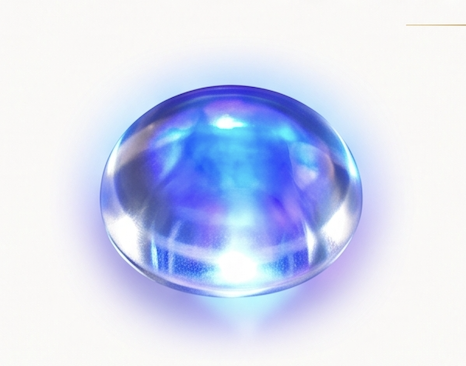
That flash has a name. Adularescence, and it is not a color in the stone at all. It is light scattering between microscopic alternating layers of two feldspar minerals, orthoclase and albite, stacked inside the crystal like sheets.
Which is exactly why the cut matters.
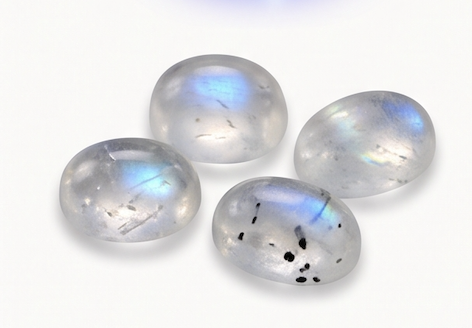
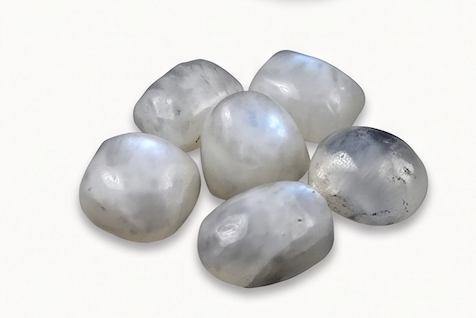
Three reasons the dome is correct
A rounded, polished surface works like a lens. Light enters, scatters across those internal layers, and glides smoothly through the stone. Facets do the opposite: flat faces break light into sharp, sparkling reflections that sit on the surface, and that masks the glow underneath. You trade the moonlight for sparkle, and moonstone is not a sparkle stone.
The second reason is the stone's own fragility. Moonstone belongs to the feldspar family and has two directions of perfect cleavage, which means it splits easily along flat planes if struck. Grinding it into a dome removes the sharp edges that would chip in daily wear. Cutting sharp angles into it does the reverse, and raises the risk of fracture both on the lap and on a wrist.
The third is inclusions. Most moonstone carries fine internal fractures that look like tiny centipedes, and that is the actual term for them. A cabochon blends those into the overall glow. Faceting turns each flat face into a window and puts every flaw on display.
So the smooth finish is not a style choice. It is the only cut that lets the stone be what it is. You can read more in my moonstone guide, and if you have ever confused the two, pearl versus moonstone sorts them out.
I built the frame, then edged only one side of it
I hand-formed an oval from 12-gauge 14k gold-filled wire and drilled tiny holes around it as anchor points, so every stone could be wired down into the frame rather than sitting against it.
Then I edged that oval with the marquis moonstones, running them up the right side only.
Not all the way around. Up one side, in an asymmetric line, and then filled in with the rest of the cluster. That decision is what made the rest of the piece harder, and better.

The topaz already matched
While I was choosing the cluster I found some sky blue topaz left over from another collection.
They reflected the same blue as the flash in the moonstones. Not close to it. The same. That settled the whole palette, and everything else got chosen to sit beside those two blues: morganite, aquamarine, gray and pink sapphires, and Japanese Akoya keshi pearls.
There is a lot of luck in a sentence like that. There is also the fact that I keep what I do not use.
The drop is holding the necklace straight
I knew I wanted a gemstone drop from the beginning, so I wired 14k gold-filled chain into the base of the cluster and worked down it. Larger stones at the top, graduating smaller the further down they go, with more space between them as they descend.
I have used this same aesthetic many times, clustering stones down a chain, because it works. The look is recognizable by now, and I am fine with that.
But the drop is doing a structural job too. The pendant is deliberately asymmetric, with the moonstones weighted up one side, and an asymmetric pendant will hang crooked if you let it. The drop puts weight at the bottom and pulls the whole thing straight.
The second cluster, on the other side
Then I built a smaller cluster on the opposite side of the oval.
It balances the design and gives the eye something on the other side, and it fills the empty part of the frame. What it does not do is fill it completely. There is still plenty of negative space inside that oval, and there is meant to be.
I finished it on paperclip chain, which was the right weight twice over. Substantial enough to carry a pendant this heavy, delicate enough to belong with stones this fine.
Made once
Blue Hour is named for the light after the sun goes down, when everything reads blue. That is the color living inside these eight stones, and it gives Golden Hour a sibling at the other end of the day.
The same moonstone strand runs through Halo and through its matching earrings, so the three pieces share a stone as well as a collection. This one was made once, and the cluster inside its oval is the second cluster I built for that frame. The first one did not fit, and went on to become a bangle.
Questions
Why is moonstone cut smooth instead of faceted?
What causes the blue flash in moonstone?
Is Blue Hour one of a kind, and can I commission something similar?
Discover
Jewelry that feels like you.
Two minutes. The quiz tells me how you want jewelry to feel in your life, and the messages that follow walk you through pieces I think you'll love.
Take the Style QuizTwo minutes. I take it from there.
Stay Close
Love what you see? Keep finding us.
Google now lets you choose your favorite sources so they show up labeled in AI search answers. If you enjoy discovering handcrafted gemstone jewelry here, add Andrea Li Designs and we'll be easier to find next time you search.
Add Andrea Li Designs as a Preferred SourceOne click. Works across Google Search, AI Overviews, and AI Mode.