ANDREA LI

LIMITED COLLECTIONS

moonstone

Moontide: The Moonstone Necklace I Was Not Sure Would Work

Tamar: Second LightAndrea Li
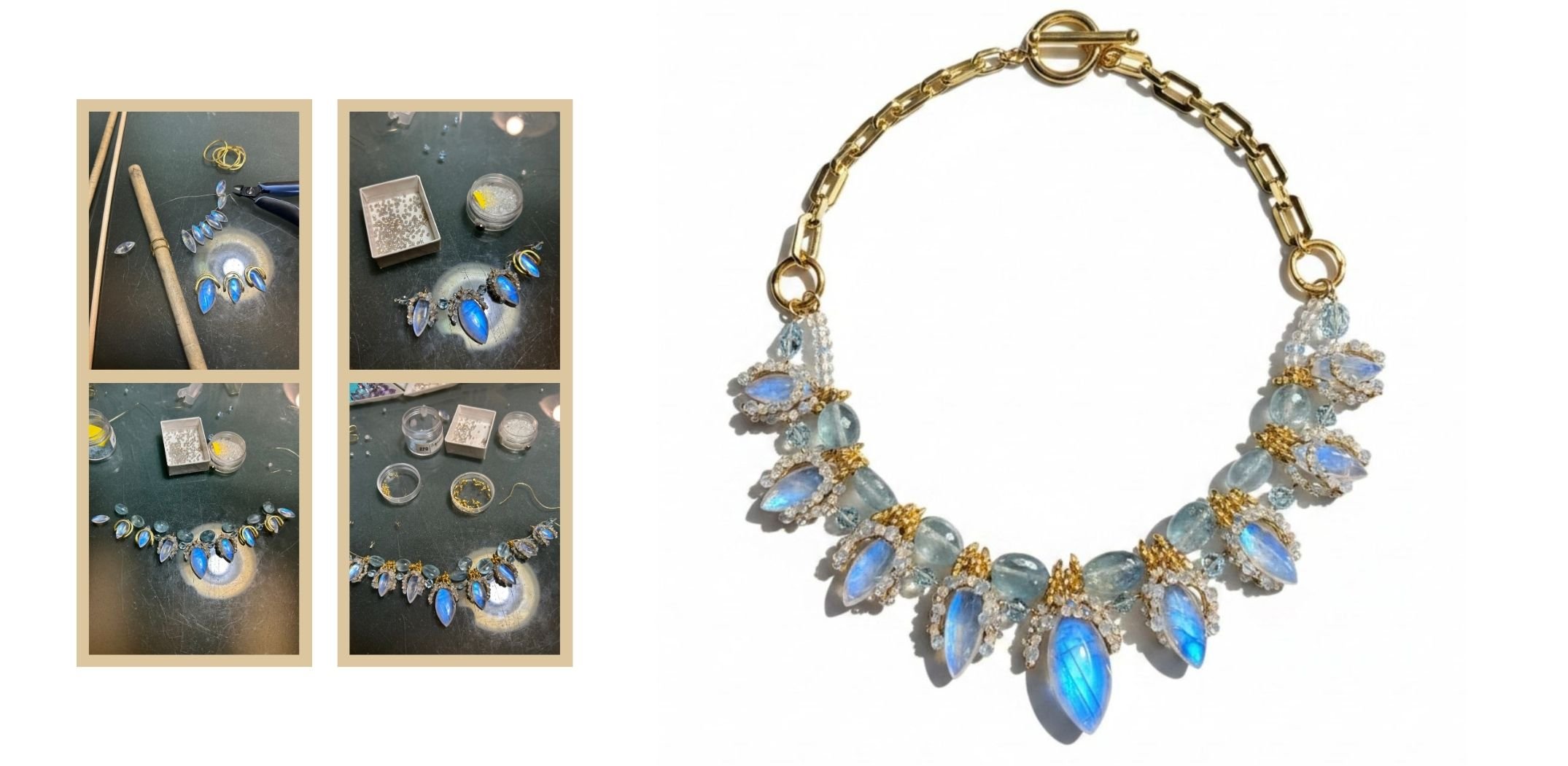
Close-up of a gold and moonstone statement necklace with luminous blue gems, overlaid with the title “Moontide: The Moonstone Necklace.”

I build most pieces knowing, more or less, where they are going. This one I built the way you play chess against someone better than you: looking a hundred moves ahead, hoping the plan you cannot fully see will hold.

It took me close to twenty hours over three days. For almost all of that time I was confident, in the way thousands of hours at the bench make you confident, and still not certain. Those are two different feelings. I did not actually know Moontide would work until I was setting the finishing touches and the whole thing finally stood up and held its shape. That was the moment. Everything before it was faith.

The stones I chose, and the ones I gave up

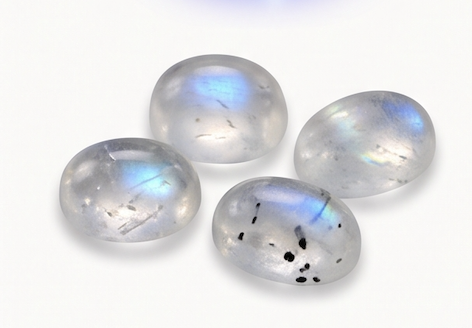
The heart of Moontide is a run of rainbow moonstone marquis, cut into that pointed-oval shape jewelers call a navette. They are the finest moonstones I have ever worked with, AAAA grade, nearly clear, with a blue flash that seems to float up from somewhere inside the stone rather than sit on its surface. I graduated them by size, largest at the center front, tapering as the design climbs toward the neck.

Around each moonstone I wrapped mystic labradorite, aquamarine, and tiny moonstone rondelles, and set small blue topaz between the frames. But that was not the original plan. I had meant to edge each frame in pastel Herkimer diamonds. When I started working at the scale this piece demanded, the Herkimer proved too brittle to survive the construction. The design was already ambitious enough without fighting my own materials, so I let the Herkimer go and let moonstone, aquamarine, and labradorite carry the cool, watery palette instead.

Gemstone science: where the flash comes from

Moonstone's glow has a name: adularescence. It happens because moonstone is built from microscopic alternating layers of two feldspar minerals, and when light enters, those layers scatter it and send it back as that soft, rolling sheen. In the best rainbow moonstones, like these, the effect reads as an electric blue floating over near-colorless stone. Labradorite carries a cousin of the same magic, called labradorescence, which is where its own metallic blues and greens come from. Moonstone sits around 6 to 6.5 on the Mohs hardness scale, so it is a stone to wear with a little care. Because each stone's flash depends on its own internal structure, no two are alike, and no two ever catch the light the same way.

Andrea Li

☾ ✦ ✧

Gemstone Profile:

Moonstone
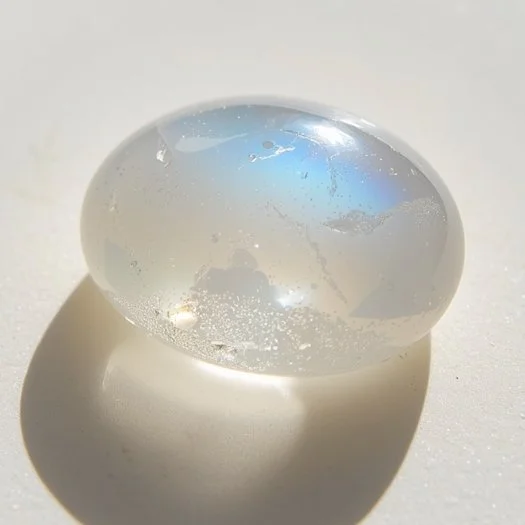
Moonstone showing its blue adularescent glow

The glow · Adularescence

Identification & Type

Moonstone (orthoclase feldspar). A captivating variety of feldspar known for its ethereal, floating luster.

Physical Properties

Mohs hardness: 6 to 6.5

Colors: translucent to opaque. Classic white with a blue sheen, plus rainbow, peach, and grey.

Luster: pearly to vitreous.

Chemical formula: (K,Na)AlSi3O8

Key Phenomenon: Adularescence

Scattered light. The sheen comes from light diffracting through thin, alternating mineral layers inside the crystal, which scatters it back as that soft floating glow. Rainbow moonstone, a variety of labradorite, spreads it into a full spectrum.

Major Origins

Sri Lanka (Ceylon) India Madagascar United States

Symbolism & Metaphysical

Intuition & Clarity

New Beginnings

Calm & Balance

Feminine Energy & Fertility

Care & Handling

Gentle cleaning. Use warm, soapy water and a soft brush. Never an ultrasonic or steam cleaner.

Avoid chemicals. Protect it from harsh agents, perfume, and cosmetics.

Store separately. Keep it in a soft pouch so harder stones cannot scratch it.

The beauty of moonstone. Elegance in nature's glow.

Andrea Li

andreali.com

Building the cages

I do not bezel stones like these. Instead I made a frame for each marquis by taking a 24k gold vermeil oval and folding it, gently, over a wooden dowel, almost in half, into an open horseshoe shape. I left one side sitting a little higher at the back, which gave each frame dimension and something to anchor its moonstone into. Then I hand-wrapped the perimeter of every frame with mystic labradorite, aquamarine, and tiny moonstone rondelles, and went back and wrapped again, rewiring and securing the whole thing a second time so nothing would ever wiggle loose. Some frames I went through three times. When I broke a stone, I replaced it and started that frame's discipline over. When I missed a single rondelle, the pattern fell out of step and the moonstone would not sit centered, so I took it apart and did it again.

The frames themselves are two sizes. The front three are larger, one for the biggest moonstone and one on each side to flank it with the next size down. The rest are smaller, so the necklace reads as a graduated fan that narrows as it wraps the neck. That graduation was a decision I made at the very beginning, long before most of the piece existed.
The problem I solved at four in the morning

Here is the part that kept me up. Each frame needed to connect to its neighbors, and it needed a second layer above to hold everything up as the necklace climbs and, honestly, defies gravity a little. I set tiny blue topaz between the frames to join them, and they had to land at the exact same point on every arch or the whole necklace would hang crooked. I marked the pattern with a sharpie so I could repeat it precisely.

The top join was the real puzzle. Plain chain would not work, because chain has fixed spacing and the distance between the frames has to change continuously as the piece curves toward the neck. A bare beading chain would let the design collapse on itself. It needed something substantial between the frames to prop it open. I hunted for the right bead. Pearls were easy to drill but felt too precious. Then I remembered a stock of smooth aquamarine cabochons left over from my Glacier collection, exactly the right size, and I only had to ream a wide hole in that one kind of stone rather than dozens. The trouble with a smooth cabochon is that it can rotate. It was at four in the morning that I realized I had tiny 24k gold vermeil spikes I could place between the stones, a variable number in each gap. Their points radiate in every direction, almost like a burr, so they catch against the smooth cabochons where a plain rondelle never could. They do not stop the spin completely, but they slow it and give each stone structure on either side, and they became the thread running through the entire piece. Once I saw it, the design finally came together.

One last detail I love: on the final moonstone rondelle at each end, right before the chain, I drilled the hole extra wide so the end cap sinks down inside the stone and disappears. No visible hardware. Just stone into chain.
Why Moontide is one of a kind

Every one of these moonstones was unrepeatable before it reached my bench, and the way I graduated, framed, and joined them cannot be drawn the same way twice. Moontide is the first piece of Second Light, the next chapter of the pastel work I began with Tamar. Second Light is about light returning after dark, and a necklace built almost entirely of captured moonlight felt like the right place to begin. This one asked more of me than almost anything I have made. It was worth every one of those hundred moves.

The matching earrings
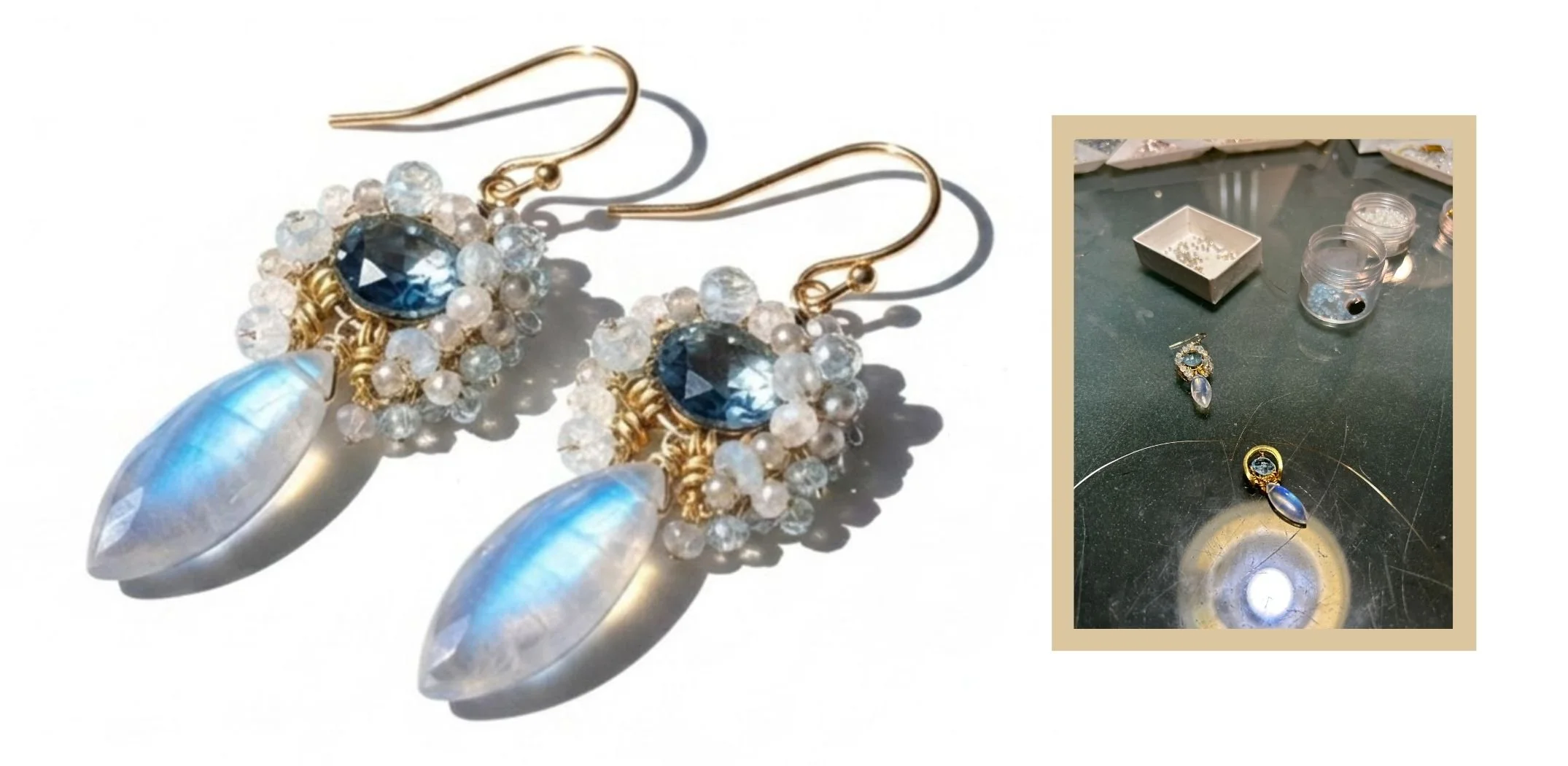
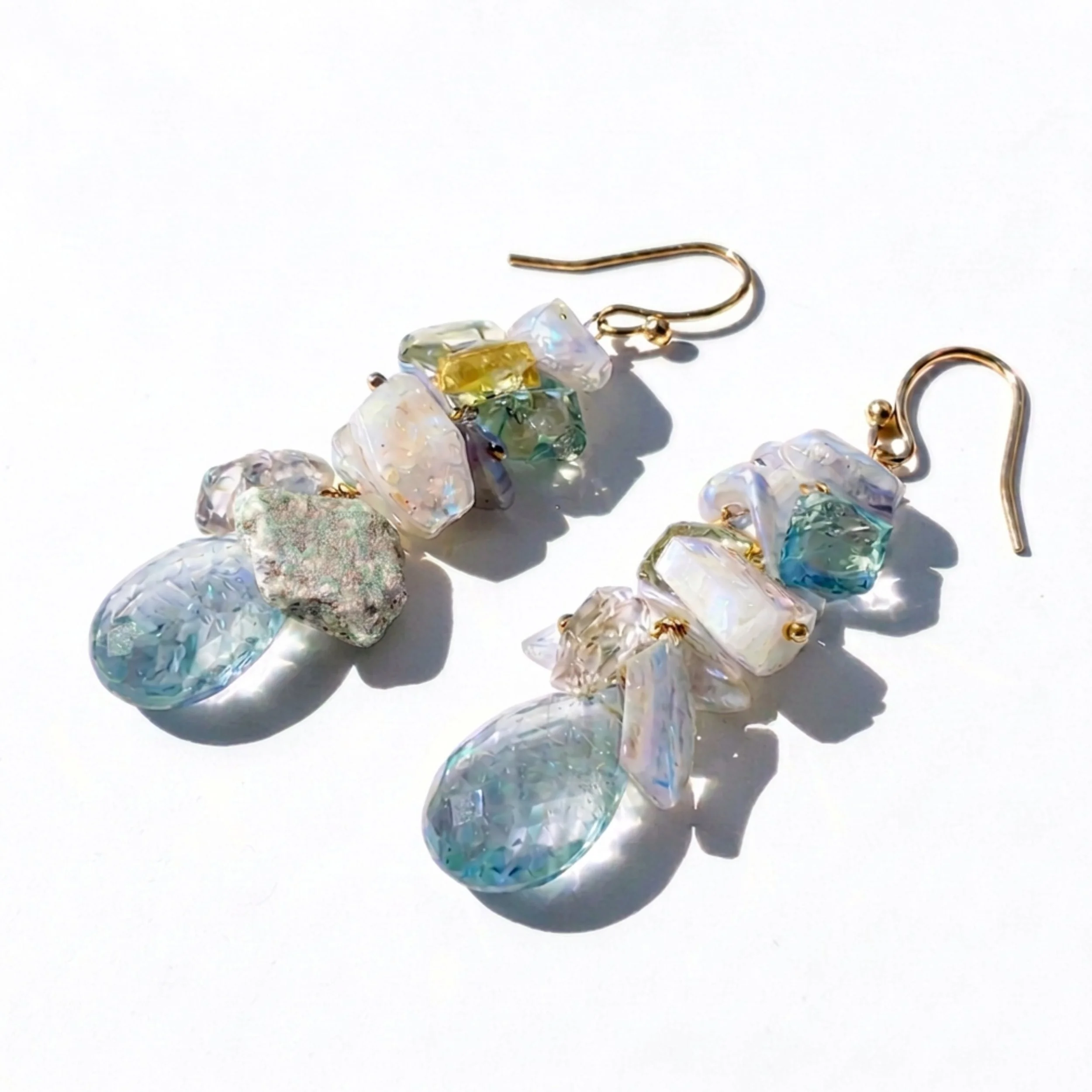
I made a pair of earrings to wear with Moontide, changed just enough to stand on their own. Each one centers a faceted Swiss blue topaz, a slightly deeper blue than the necklace's accents, framed with the same hand-wrapped halo and finished with a moonstone marquis drop. Tiny 24k gold vermeil spikes echo the spacer beads that run through the necklace, so the pair reads as clearly part of Moontide without simply repeating it.

Shop the Moontide necklace and its matching earrings, the first pieces of the Second Light collection.

Questions

What gives rainbow moonstone its blue flash?
The effect is called adularescence. Moonstone is made of microscopic alternating layers of two feldspar minerals, and when light enters the stone those layers scatter it and send it back as a soft, floating sheen. In fine rainbow moonstone like the marquis in this necklace, that sheen reads as an electric blue over near-colorless stone. Because it depends on each stone's internal structure, no two flash exactly alike.
Is moonstone durable enough to wear often?
Moonstone sits around 6 to 6.5 on the Mohs hardness scale, which is softer than quartz, so it rewards a little care. It is a wonderful stone for a statement piece worn for an occasion or an evening, kept away from hard knocks and stored on its own so nothing harder scratches it.
Is Moontide one of a kind, and can I commission something similar?
Yes. Each moonstone was unrepeatable before it reached the bench, and the whole piece is engineered around this exact set of stones. If you would like something made in the same spirit, you can begin a commission through the custom shop.

Discover

Jewelry that feels like you.

Two minutes. The quiz tells me how you want jewelry to feel in your life, and the messages that follow walk you through pieces I think you'll love.

Take the Style Quiz

Two minutes. I take it from there.

Stay Close

Love what you see? Keep finding us.

Google now lets you choose your favorite sources so they show up labeled in AI search answers. If you enjoy discovering handcrafted gemstone jewelry here, add Andrea Li Designs and we'll be easier to find next time you search.

Add Andrea Li Designs as a Preferred Source

One click. Works across Google Search, AI Overviews, and AI Mode.
Halo: A Beautiful Contradiction

Tamar: Second LightAndrea Li
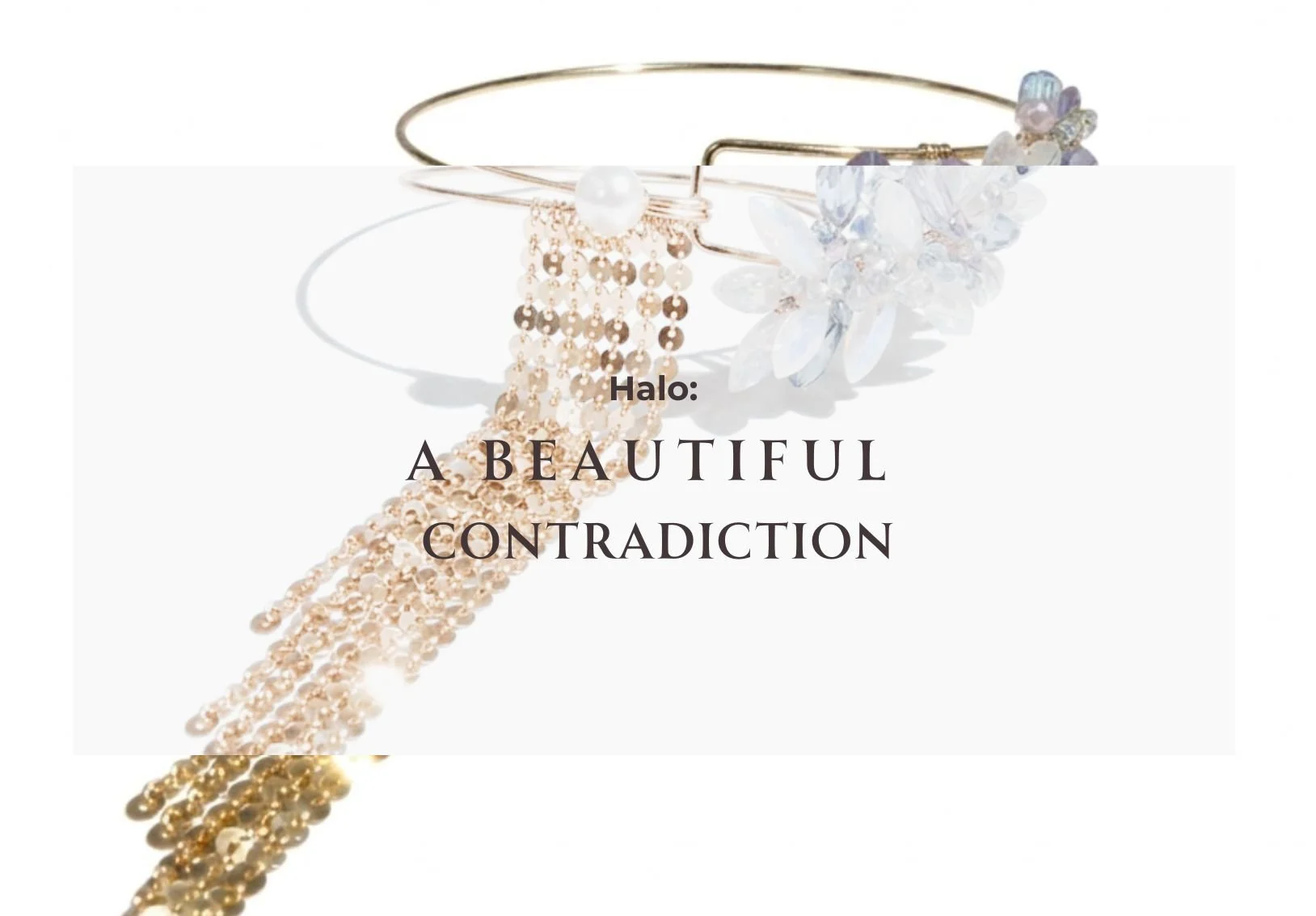
Editorial graphic with a gold halo-style bracelet and text overlay reading “Halo: A Beautiful Contradiction.”

I wanted to make a choker that looked like it was floating. That was the whole idea before I even walked into the studio, and it is a good example of how a piece rarely arrives the way you picture it.

Life gets busy, and keeping the studio perfectly stocked is not always high on the list. So this began the way real work often does: I trusted my inventory, got to the bench ready to build my floating choker, and discovered I had only enough wire in 12 gauge. Not what I would have chosen. But I went to work anyway, because sometimes the constraint is the assignment.

The materials

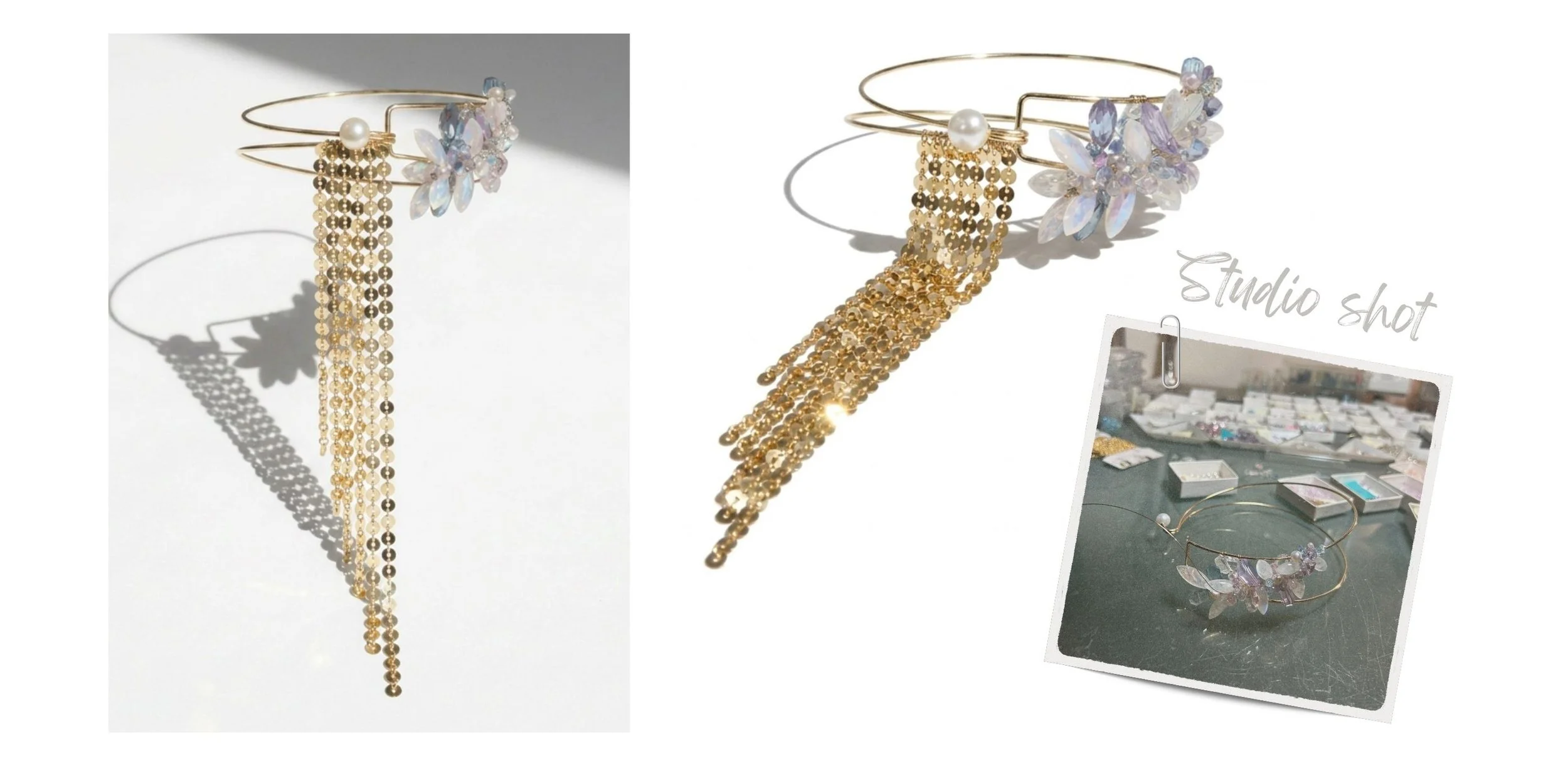
This is a Second Light piece, built in 12-gauge 14k gold-filled wire with a soft, watery pastel palette. The stones are a whole family of pale color: purple, pink, and grey sapphires, pale amethyst, morganite, aquamarine, a crown-cut mixed beryl, AAA-quality marquise moonstone, freshwater pearls, mystic quartz, and tiny moonstone rondelles, all finished with a cascade of 14k gold-filled sequin chain. Left to its own, it is a lot of gravitas hanging in the air. Held together the way I built it, it is barely there on the neck. That contradiction is the piece.

Gemstone science: why moonstone reads like captured light

Moonstone was the right stone for something meant to float. That drifting glow, called adularescence, is not a color in the stone at all. It is light scattering between microscopic, alternating layers of feldspar inside the crystal, so the shimmer seems to hover just under the surface and move as you do. Rainbow moonstone is actually a variety of labradorite, which is why it can throw a whole soft spectrum rather than a single flash. It is also a brittle stone with cleavage, so it asks to be set gently and cool, never near heat. All of which made it the perfect companion to a choker built around the idea of weightlessness.

Andrea Li

☾ ✦ ✧

Gemstone Profile:

Moonstone

Moonstone showing its blue adularescent glow

The glow · Adularescence

Identification & Type

Moonstone (orthoclase feldspar). A captivating variety of feldspar known for its ethereal, floating luster.

Physical Properties

Mohs hardness: 6 to 6.5

Colors: translucent to opaque. Classic white with a blue sheen, plus rainbow, peach, and grey.

Luster: pearly to vitreous.

Chemical formula: (K,Na)AlSi3O8

Key Phenomenon: Adularescence

Scattered light. The sheen comes from light diffracting through thin, alternating mineral layers inside the crystal, which scatters it back as that soft floating glow. Rainbow moonstone, a variety of labradorite, spreads it into a full spectrum.

Major Origins

Sri Lanka (Ceylon) India Madagascar United States

Symbolism & Metaphysical

Intuition & Clarity

New Beginnings

Calm & Balance

Feminine Energy & Fertility

Care & Handling

Gentle cleaning. Use warm, soapy water and a soft brush. Never an ultrasonic or steam cleaner.

Avoid chemicals. Protect it from harsh agents, perfume, and cosmetics.

Store separately. Keep it in a soft pouch so harder stones cannot scratch it.

The beauty of moonstone. Elegance in nature's glow.

Andrea Li

andreali.com

The build, and the clasp that saved it

Shaping heavy 12-gauge wire into a floating collar was the first fight. The hardest part was doubling the wire back and squaring off the ends so the two ends met cleanly on the opposite side. I fiddled with it until the wire would rest flush, then set my solder neatly between the two ends.

And then I had two problems at once. Once it was soldered, the circumference was far too large, and I could feel that 12-gauge, as heavy as it is, was actually too thin to hold my floating concept rigid on its own.

Here is the moment the piece turned. Because the circumference was too big, I had extra length to work with, so I used it to build a hook clasp at the front. That one decision solved everything. The clasp took in the excess size, and the act of anchoring the collar closed at the front gave the whole structure the rigidity the thin wire could not provide by itself. The floating concept came back to life because I had, almost by accident, given it a spine. The shortage of wire, the very thing I had cursed an hour earlier, was what handed me the answer. To make the clasp a feature rather than just hardware, I soldered a pearl peg on the end and set a large freshwater pearl there, so the closure became the most decorative point on the piece.

Building the cluster in mid-air

Then came the gemstone cluster, and it fought me too. My first plan was two separate clusters running along the edges, because the front clasp needed clearance and I did not want a cluster blocking the hook. But when I held it up in the mirror, I could see the truth immediately: the cluster had to sit in the center of that empty floating space, or the whole design fell apart. So I started over with that intention.

I began with my usual vine cluster, assuming it would happily suspend between the two wires. It would not. As I built between them, it became clear the vine needed anchoring all the way along, or it would shift. So I diamond-bit drilled two large pale amethysts and one substantial aquamarine, opening them enough to thread multiple wires through, and spaced those stones down the cluster as structural anchors that hold the entire vine in place.

A few smaller choices made it cohere. I used round pearls throughout the cluster, which I rarely do in this collection, specifically to echo the large pearl on the clasp so the two ends of the piece would speak to each other. I filled and finished the front with moonstone marquise stones. And on the opposite side of the cluster I added a cascade of 14k gold-filled sequin chain, anchored with tiny moonstone rondelles, for drama and movement, the falling counterweight to the cluster's density.

Collage of a gold halo choker with pastel crystal detail, paired with a pinned studio process photo on a light background.

What sitting with a piece teaches you

I always live with a finished piece for a while, setting it in places where I will keep catching sight of it, because that is when the last improvements reveal themselves. This time I could see one empty spot near the start of the cluster asking for a stone. I chose a beautifully faceted amethyst. My first instinct was to go large and really fill the gap, but a larger stone crowded the pearl hook clasp and would have kept it from clearing when you fasten it, so I sized down. The smaller amethyst rounded out the cluster and gave the whole design more cohesion, which is often how it goes: the right answer is the one that respects how the piece is actually worn.

Last, I went back and secured a few stones that had not passed my own durability test. I built gold-filled wire bezels around the ones that needed it and deepened their security within the cluster with a barrier of smaller stones that "set" them more firmly. It is quieter work than the drama up front, but it is the difference between a piece that photographs well and a piece that lasts.

The finished choker is minimal and not minimal at once, light to wear despite the gravitas of all that clustering. I named it Halo, for the ring of light it makes around the neck, and because a halo is exactly that kind of contradiction: weightless, and yet the most serious thing in the room. A beautiful contradiction, which feels honest to me, because so many true things are.

I would not have found any of it with a full drawer of the perfect wire. Constraints force us to be more creative. They take the obvious path away and leave you standing in front of the more interesting one. This piece is the proof I keep on my bench.

Questions

How does a floating choker stay closed without a visible clasp?
This one closes with a hook clasp at the front rather than a hidden catch at the back. The hook is anchored by a pearl peg set with a large freshwater pearl, so the closure doubles as the most decorative point on the piece. Fastening at the front also gives a fine-gauge collar the rigidity it needs to hold its shape.
How is the gemstone cluster kept from shifting?
The vine cluster is anchored, not just suspended. I diamond-bit drilled two large pale amethysts and one substantial aquamarine so I could thread multiple wires through them, then spaced those stones along the cluster as structural anchors. Any softer stones are further secured with hand-formed gold-filled wire bezels and a surrounding barrier of smaller stones.
Is a statement choker like this heavy to wear?
No, and that is the contradiction I love about it. It carries real visual weight from the pastel gemstone cluster and the cascade of chains, but built in 14k gold-filled wire and balanced by the front closure, it sits light on the neck. [CONTINUE READING — PRE-LAUNCH TEASE: Halo is part of Second Light, arriving November 4. Link to the Second Light collection / pre-launch page. Primary next step is the Style Quiz / join-the-list so readers are first to know when Halo and the collection go live. Do NOT link a shop/product page yet (Halo's product page is being built and the piece is not yet purchasable). Swap in the Halo product link + a shop CTA at launch.]

Discover

Jewelry that feels like you.

Two minutes. The quiz tells me how you want jewelry to feel in your life, and the messages that follow walk you through pieces I think you'll love.

Take the Style Quiz

Two minutes. I take it from there.

Stay Close

Love what you see? Keep finding us.

Google now lets you choose your favorite sources so they show up labeled in AI search answers. If you enjoy discovering handcrafted gemstone jewelry here, add Andrea Li Designs and we'll be easier to find next time you search.

Add Andrea Li Designs as a Preferred Source

One click. Works across Google Search, AI Overviews, and AI Mode.
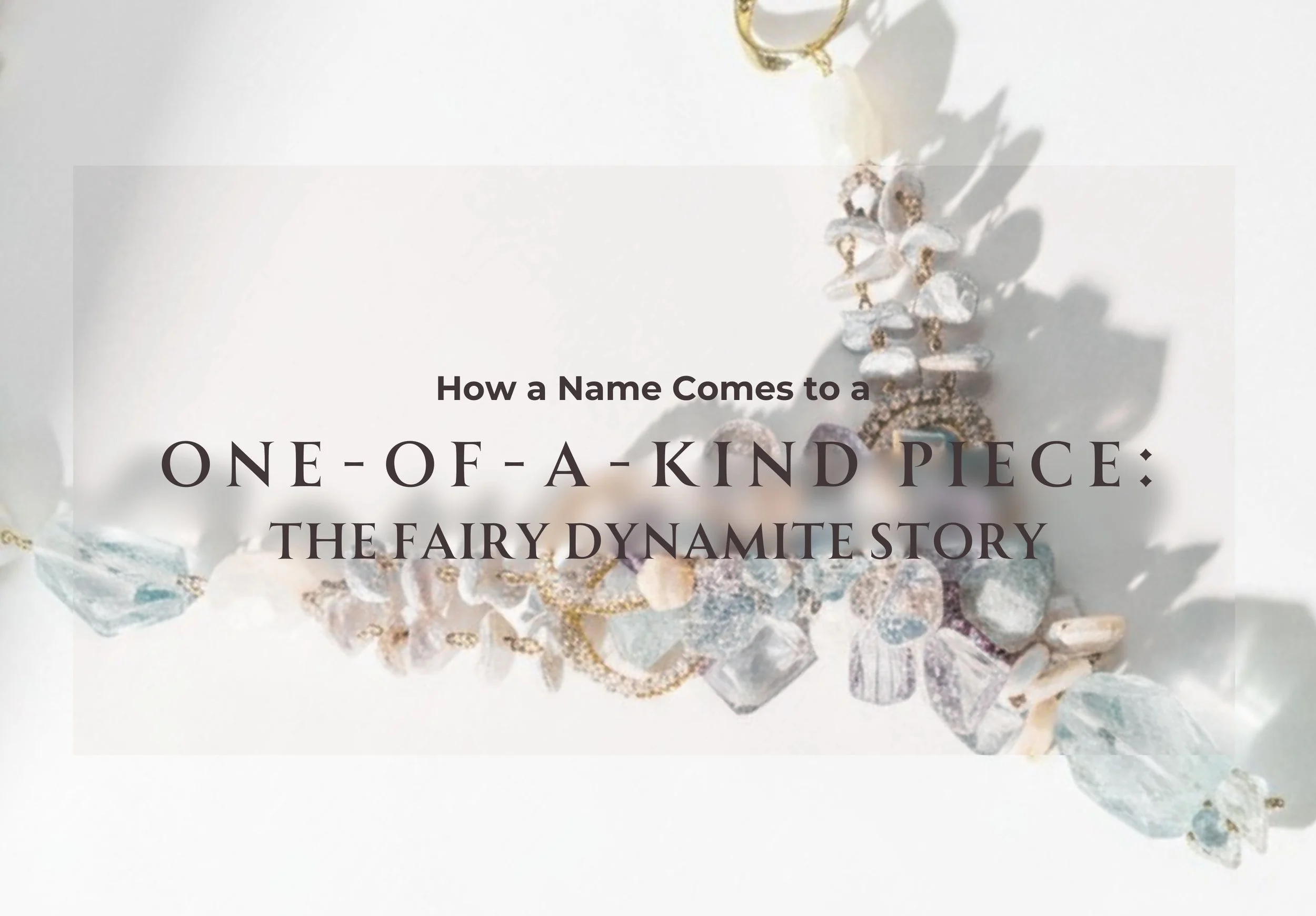
How a Name Comes to a One-of-a-Kind Piece: The Fairy Dynamite Story

Tamar: Second LightAndrea Li

I have named hundreds of pieces over the years. This one refused to let me.

So I did something I had never done before. I showed it to the people on my email list before it was fully finished, and I asked them to name it for me. That is a vulnerable thing to do. The name is usually mine to give, the last quiet decision I make at the bench. Handing it over meant trusting that the people who follow my work would see in the piece what I saw in it. They did, and then some.

This is the story of how that necklace came to be, and how it earned the name it carries now: Fairy Dynamite.

A piece that picked up where the last release left off

The investment I make in my art is more precious than paint and canvases. Gemstones are sold in strands. Creating a lush palette for a new collections requires multiple strands. I work hard to honor the full use of each tiny treasure that ends up on my studio desk. I call this using the ‘whole buffalo’, much like the Native Americans who honored the life sustaining yields as a result of their hunting practices. When I buy gemstones for a collection, I am not finished with that collection until I have found a home for nearly all of them. This necklace is proof of that habit. It picks up exactly where my last pastel release left off, and it began with two components I had already made and set aside.

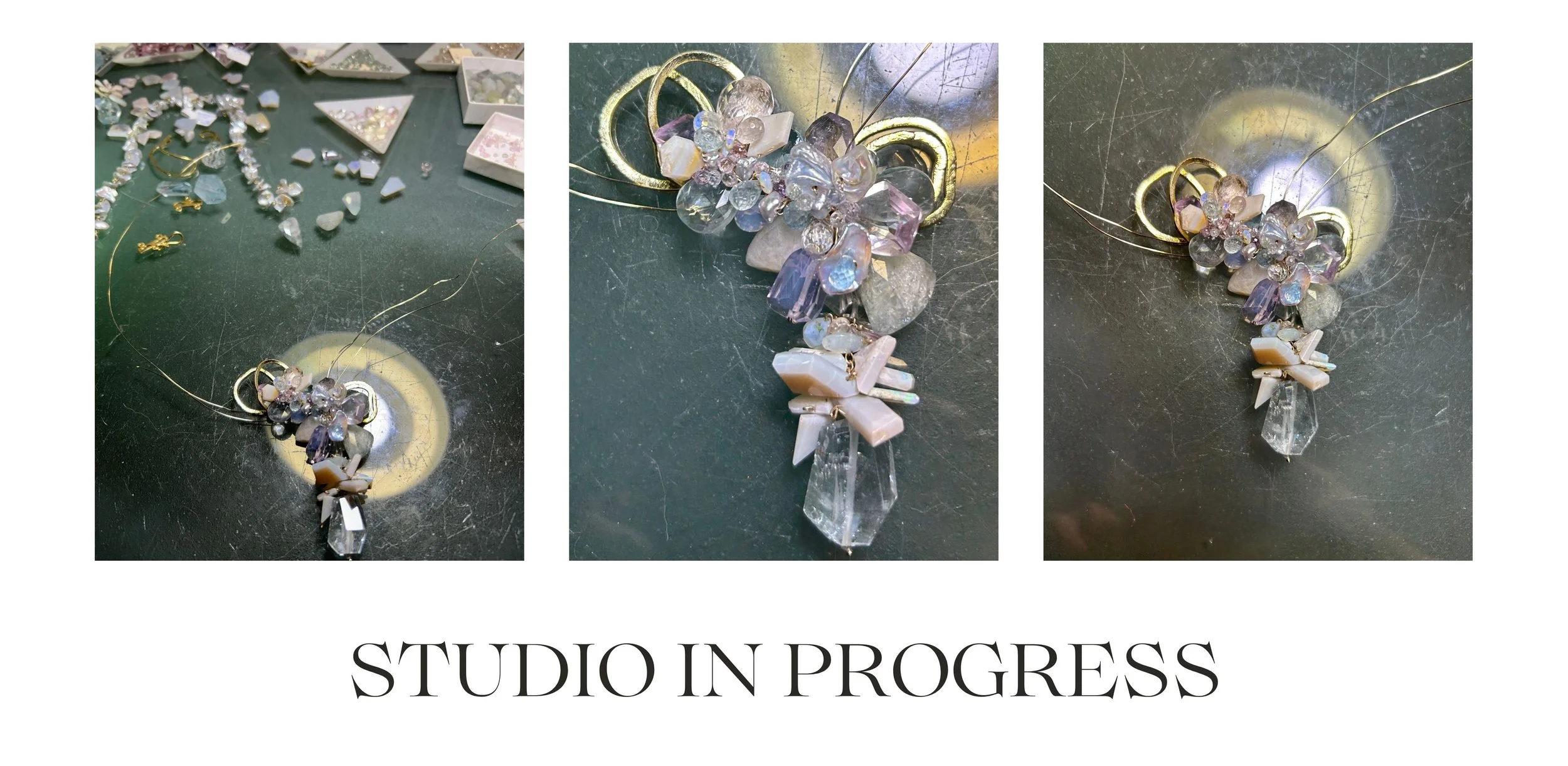
The two clusters at its heart were originally built for an ear cuff. Each one stacked a large, simple-cut blue topaz with geometric Australian opal briolettes, piled one on the next like stones in a river cairn. They were beautiful, and they were wrong for that ear cuff. Their chunky weight clashed with the delicate frame I had designed, so I used tiny opal rondelles and cascading gold chains for that piece instead. The two heavy clusters went onto my desk, where they sat and waited until I could find a design that honored how substantial they were.

Building the necklace around them

The answer was to return to the thing I do most naturally: my signature asymmetrical gemstone clustering.

The chains came first, and they were the real spark. I had an organic-shaped pearl chain whose knobby, irregular rhythm matched the cairn-like stack of the Australian opals almost exactly. The moment I held them next to each other, the necklace existed in my head. I added two 24k gold vermeil components as the connection points that carry the main cluster out to a pair of those chains.

Then came the part that is never optional. Once a cluster is built, I go back in and strategically add stones so the whole thing flows without any visual stutter. I built up the joins between the original cluster and the new main cluster, and I threaded tiny Australian opals through the design as single points of cohesion, small echoes that tie one area to the next.

My plan had been to simply attach the two pearl chains and stop there. I have a very hard time doing anything standard. So I added gemstones along the chains to break their monotony, and then the chains read as too heavy. To put the air back in, I added a single gold circle link. That link is what I call a Marilyn: one unexpected element that breaks the pattern and makes you look twice. Every piece needs one.

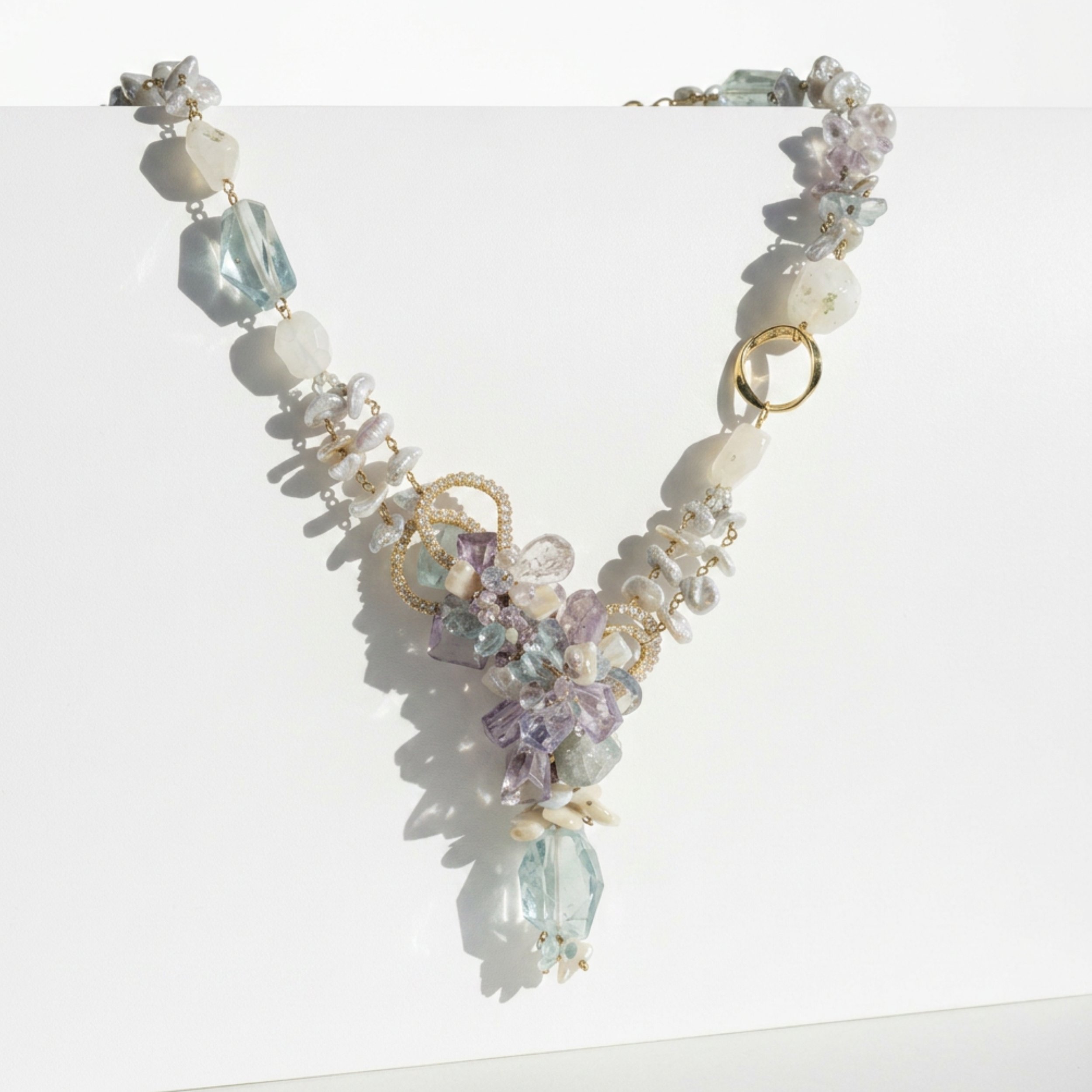
Around that blue topaz and opal core, the finished cluster gathers aquamarine, amethyst, kunzite, mystic labradorite, and keshi pearls, the soft pastel family I keep coming back to.

A note on the stones

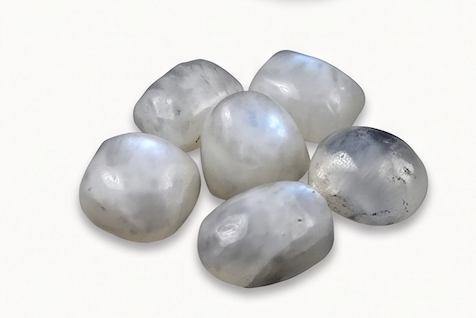
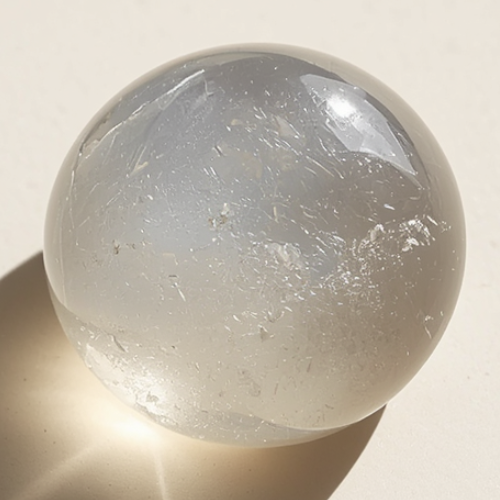
Moonstone is one of the soft, glowing stones running through this necklace, and it earns its place. Its dreamy sheen has a name, adularescence, and it comes from the way moonstone is built in microscopic layers of two feldspar minerals. Light enters, scatters between those layers, and floats back to your eye as that glow that seems to hover just below the surface. No two moonstones scatter light in quite the same way, which is exactly why they belong in a piece that exists only once.

Andrea Li

andreali.com

Guide to Moonstone Varieties

Grey, Peach, and Rainbow

Grey moonstone showing misty blue adularescence

Grey Moonstone

The lookA misty, smoky adularescence, the blue sheen drifting through a cool grey body.

Color range

Associated withCalm and clarity, new beginnings.

StructureMonoclinic feldspar.

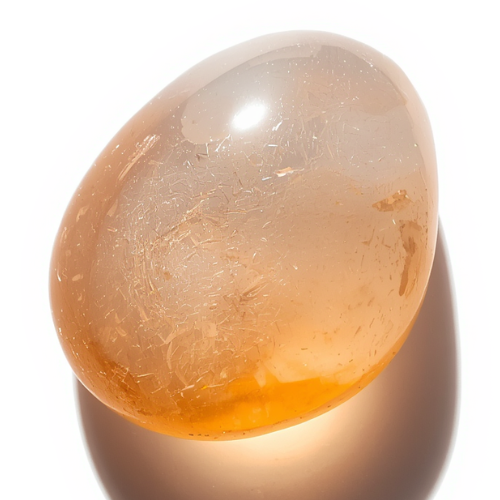
Peach moonstone with a warm glow

Peach Moonstone

The lookA warm peach glow, soft apricot tones lit from within.

Color range

Associated withEmpathy and growth, feminine energy.

StructureMonoclinic feldspar.

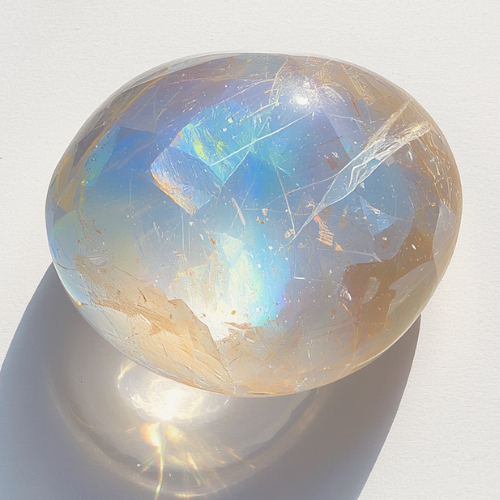
Rainbow moonstone with multi-color iridescence

Rainbow Moonstone

The lookMulti-color iridescence, the whole spectrum flashing across a clear body.

Color palette

Associated withIntuition and creativity, protection.

StructureTriclinic. Technically a labradorite.

Embrace the magic of natural stones

andreali.com

Handing it to the community

When the necklace was nearly there, I sent it to my list and asked a simple question: what would you name her? I made it easy to answer. No external poll, no form, just hit reply.

I was not prepared for what came back. Names arrived full of imagination and personal meaning. Jenny Blanchard, who would end up naming the winner, wrote that the piece gave her "the sensation of being from another world where fairies are busy at work." Other subscribers reached for mythology, for wine, for gratitude, for the night sky. Every single name came with a little story about why.

So I sent a second email. I listed every name that had been submitted, each with a short description so no one felt left out, and I let the community vote.

Fairy Dynamite

They chose Fairy Dynamite, a name Jenny submitted.

It fit better than anything I would have landed on alone. From across a room the necklace looks delicate and a little innocent, all soft blues and lilacs and pearl. Up close it is anything but quiet. It explodes into color and texture and weight. Delicate and explosive at the same time. Fairy Dynamite.

The part that mattered most

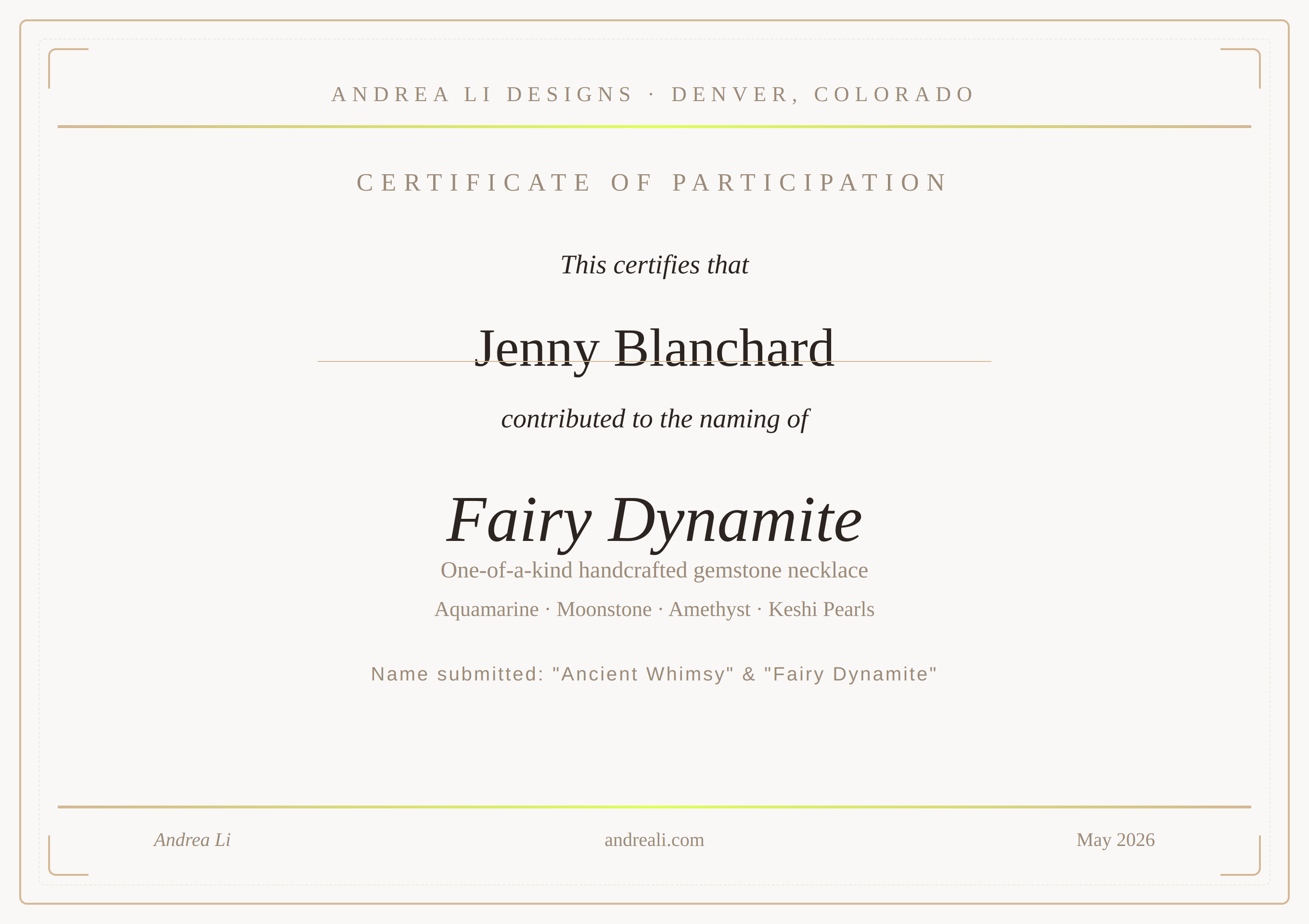
After the vote, I did not simply move on to the next thing. I wrote fifteen personal thank-you notes, each one from my own inbox rather than an automated send, and each one spoke to that person's specific submission. Then I made something for every contributor: a custom Andrea Li Designs certificate naming them, the piece, its stones, and the exact name they had submitted or voted for. Sixteen people, sixteen certificates.

Certificate of participation naming Jenny Blanchard as contributor to the one-of-a-kind gemstone necklace “Fairy Dynamite.”

I did this because these were never entries in a contest to me. They were people who handed me their imagination, and I wanted them to hold something that said so. The replies that came back told me it landed.

A name, and a piece, that are truly one of a kind

Fairy Dynamite is one piece in the collection I am releasing this fall, the next chapter of the pastel work I began with Tamar. Like everything I make, it exists exactly once. The stones in it will never gather in the same way again, and the design will never be repeated.

There is something right about a one-of-a-kind piece being named by the people who will remember it. The reason the world treasures a singular jewel is the same reason I make what I make. It will only ever be itself. And now it carries a name to match, given to it by the community that watched it come together.

Pastel gemstone statement necklace draped on a white display, featuring aquamarine, moonstone, amethyst, and gold details.

Fairy Dynamite earrings

(mate to the Fairy Dynamite necklace)

These echo Fairy Dynamite in miniature, built with the same stacked gemstone clustering and pearls drawn from the hand-bailed chain, so the intricate language of the necklace carries down to the ears. Each one is anchored by a teardrop aquamarine that gives the pair a polished, finished close.

Questions

How did the Fairy Dynamite necklace get its name?
Andrea invited her email community to name this one-of-a-kind piece, then chose from the replies they sent. The winning name, Fairy Dynamite, captures the way the necklace pairs delicate, fairy-like sparkle with a concentrated burst of energy.
What gemstones are in the Fairy Dynamite necklace?
Its asymmetrical cluster gathers Australian and Ethiopian opal, blue topaz, aquamarine, amethyst, kunzite, moonstone, sapphire, spinel, and mystic labradorite, finished with keshi pearls and set in 14k gold-filled and 24k gold vermeil.
Is it one of a kind, and can I commission something similar?
Yes. The piece exists exactly once, and its stones will never gather in the same way again. If you would like something made in the same spirit, you can begin a commission through the custom shop.

Discover

Jewelry that feels like you.

Two minutes. The quiz tells me how you want jewelry to feel in your life, and the messages that follow walk you through pieces I think you'll love.

Take the Style Quiz

Two minutes. I take it from there.

Stay Close

Love what you see? Keep finding us.

Google now lets you choose your favorite sources so they show up labeled in AI search answers. If you enjoy discovering handcrafted gemstone jewelry here, add Andrea Li Designs and we'll be easier to find next time you search.

Add Andrea Li Designs as a Preferred Source

One click. Works across Google Search, AI Overviews, and AI Mode.